
Why Most Writers Use AI Wrong (And Waste Hours Because of It)
You opened ChatGPT. You typed “help me with my story.” You got back something generic, vague, and useless. A list of tips you already knew. Suggestions so broad they could apply to any story ever written. You decided AI doesn’t work for fiction.
Wrong conclusion. AI works for fiction. Your prompts don’t. Prompt engineering for fiction writers is a specific skill that produces dramatically different results from generic conversational prompting.
The difference between a useless AI interaction and a productive one is specificity. “Help me with my story” gives AI nothing to work with. “My protagonist has avoidant attachment and just discovered her business partner has been stealing from her for two years. Generate five possible reactions that are consistent with avoidant psychology and advance the plot toward a confrontation she’s been avoiding” gives AI everything it needs.
I’ve written 113+ books. AI didn’t write any of them. AI helped me brainstorm, break through blocks, test ideas, and generate options I wouldn’t have reached on my own. The difference between “AI-written” and “AI-assisted” is who makes the decisions. You make the decisions. AI generates options.
Brainstorming Methods That Generate Usable Ideas
Brainstorming isn’t sitting around hoping inspiration strikes. It’s a systematic process for generating options, evaluating them, and selecting the ones that serve your story. The best brainstorming produces ideas you wouldn’t have found through linear thinking.
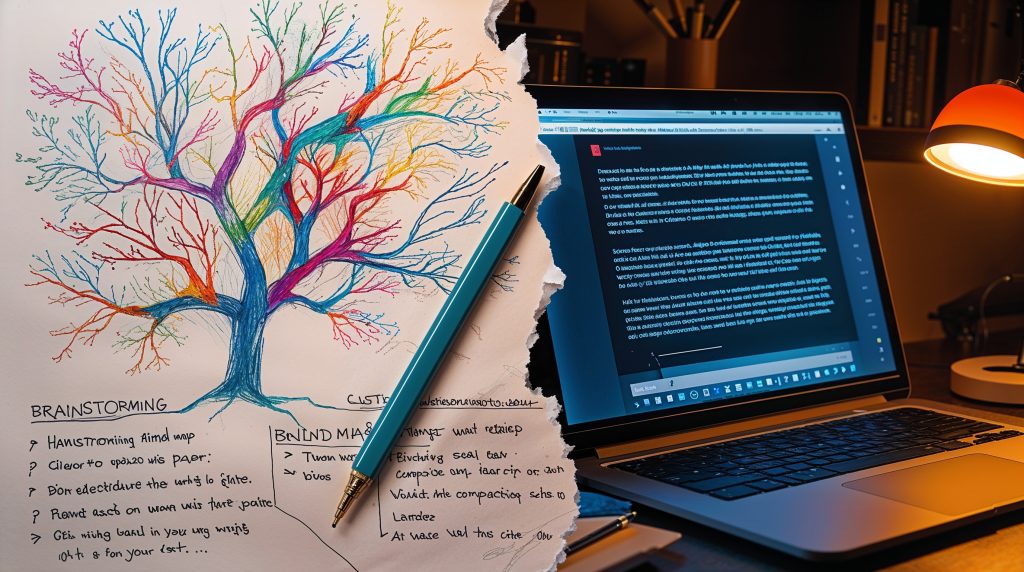
Mind mapping starts with a central concept and branches outward through associations. Put your protagonist’s wound in the center. Branch to behaviors that wound creates. Branch from behaviors to situations where those behaviors cause problems. Branch from situations to scenes. In fifteen minutes, you’ve generated twenty possible scenes grounded in character psychology.
The “What if” method generates story complications. Start with your current plot situation and ask “what if” questions. What if the ally betrays them? What if the safe house isn’t safe? What if the protagonist’s coping mechanism makes things worse? Each question generates a possible direction. Most will be wrong. Some will be brilliant.
Constraint-based brainstorming works by limiting options instead of expanding them. Your character can’t use their primary skill. The scene takes place in a single room. The protagonist has to solve the problem using only what’s in their pockets. Constraints force creative solutions that wouldn’t emerge from unlimited possibility.
The Brainstorming Guide Handbook covers eight brainstorming methods adapted for fiction writers, with AI prompts for each method. The prompts are designed to generate story-specific material, not generic writing advice.
How AI Actually Helps Fiction Writers
AI excels at generating options quickly. It can produce five plot directions in thirty seconds. Five character reactions. Five dialogue approaches. Five world-building details. The volume and speed of option generation is where AI provides genuine value.
AI also excels at systematic analysis. Feed it your plot outline and ask it to identify logical inconsistencies. Give it a character’s psychological profile and ask it to flag behaviors in your manuscript that contradict the profile. Present two scenes and ask which has higher tension and why. These analytical tasks use AI’s pattern recognition without requiring the creative judgment it lacks.
AI brainstorming partners work best when you provide context. Upload your character profiles. Share your plot outline. Give AI the rules of your world. The more context it has, the more specific and useful its suggestions become. Generic prompts produce generic output. Detailed prompts produce material you can actually use.
The AI Writing Partner Handbook covers the specific workflow of using AI as a collaborative brainstorming tool: how to structure prompts, what context to provide, how to evaluate AI suggestions, and how to maintain your creative authority while using AI’s strengths.
What AI Cannot Do for Your Writing
AI cannot generate your voice. It can mimic styles but can’t produce the specific combination of rhythm, word choice, perspective, and personality that makes your writing yours. Understanding what AI does well versus what it absolutely cannot do prevents the frustration of expecting it to perform tasks it’s structurally incapable of.
AI cannot feel emotion. It can describe emotional scenarios competently, but the descriptions lack the specificity that comes from lived experience. A scene about grief written by AI hits the expected notes. A scene about grief written by someone who’s grieved hits notes the reader didn’t expect, and that’s what makes it resonant.
AI cannot make creative judgments. It can generate ten options but can’t tell you which one serves your specific story, your specific character arc, and your specific thematic intentions. That judgment is the writer’s job. AI provides raw material. You provide direction.
AI hallucinates. It states falsehoods confidently. It invents citations. It presents made-up information as fact. The research shows that the majority of writers who use AI worry about exactly this problem, and they’re right to worry. Verify everything AI tells you, especially historical facts, scientific claims, and cultural details.
The AI Shortcomings handbook catalogs the specific ways AI fails fiction writers: voice flattening, emotional hollowness, factual errors, cultural insensitivity, and the corporate language patterns that signal AI-generated text to readers and editors.
The AI-Enhanced Writing Workflow
The productive AI workflow has four stages: prompt, generate, evaluate, transform. You craft a specific prompt with context. AI generates options. You evaluate which options have potential. You transform the selected material into something that’s yours — rewriting it in your voice, connecting it to your characters’ psychology, embedding it in your plot.
Here’s the difference between a generic and a specific prompt, both asking AI to help brainstorm a scene:
Generic prompt: “Write a scene where two characters have a conflict.”
Specific prompt: “My protagonist Elena is a former surgeon who quit after a patient died (her psychological wound is believing she destroys anything she touches). She’s confronting her business partner David, who just discovered she’s been secretly diverting company funds to a free clinic. David admires her but needs the money for payroll. Generate five ways this confrontation could play out that force Elena to choose between her guilt-driven need to help and her fear that getting close to David’s trust will end in another catastrophe.”
The generic prompt gives you a scene you could find in any novel. The specific prompt gives you five options rooted in your character’s psychology, your plot’s stakes, and the thematic tension between guilt and connection. Four of those options might be useless. The fifth might crack your second act open.
The evaluate and transform stages are where most writers skip steps. They generate AI output and paste it into their manuscript with minor edits. The result reads like AI because it is AI. The voice is flat. The emotional specificity is absent. The cleanup protocol for removing AI fingerprints exists because this shortcut is so common.
A better workflow: generate five options. Reject three immediately. Take elements from the remaining two. Write the scene yourself using those elements as a starting framework. The AI material disappears into your creative process and what emerges is your work, informed by AI brainstorming but executed by your brain.
Brainstorming Your Way Out of the Middle
The sagging middle is where brainstorming earns its keep. You know the beginning. You know the ending. The sixty percent between them is a wasteland of scenes that go nowhere.
Use constraint brainstorming: your character can only use one of their skills for the rest of the book. What changes? Use “what if” brainstorming: what’s the worst possible person who could show up in this scene? What secret could be revealed that makes the current plan impossible? Use reversal brainstorming: what if the character’s greatest strength becomes their biggest liability?
AI amplifies these methods. Ask it to generate twenty “what if” complications for your specific plot situation. You’ll reject fifteen immediately. Three will be interesting but not right. Two will make you stop and think. That’s the brainstorming producing value — not the AI output itself, but the reaction it triggers in your creative judgment.
Using AI Without Losing Your Voice
The writers who use AI most effectively never publish AI’s words. They publish their own words, written faster and with more options because AI helped them think through possibilities.
Your voice is the combination of your psychology, your experience, your obsessions, and your specific way of seeing the world. AI doesn’t have any of that. It has patterns from millions of writers averaged together. Using AI output directly produces average writing by definition.
Use AI to generate. Write the final version yourself. If a sentence in your manuscript could have been written by any competent writer, it’s not in your voice. If it could only have been written by you — because of the specific metaphor, the particular rhythm, the unexpected observation — that’s voice. Fighting AI wastes creative energy. Using AI strategically preserves your voice while accelerating your process.
The Purpose and Overview handbook and Using AI for Writing handbook together provide the complete framework for integrating AI into your writing process without sacrificing what makes your work yours. The AI-Enhanced Writer’s Library builds every handbook around this principle: AI assists, you create.
Free Stories, Straight to Your Inbox
Start with Nine Doors, nine short stories across nine genres, yours free the moment you sign up. After that, the occasional new collection and a note when there's a new book worth your time. No spam, no daily clutter. Just good stories.
We use MailerLite to manage our list and send these emails. Your address is used only to send you what you signed up for. We will not sell it, share it, or use it for anything else, and you can unsubscribe anytime.
Frequently Asked Questions
Will using AI make my writing sound generic?
Only if you publish AI output directly. Use AI to brainstorm options, break through blocks, and generate raw material. Then write the final version yourself in your own voice. The AI material should disappear into your creative process. If a reader can tell AI was involved, you skipped the transformation step.
What’s the best way to prompt AI for fiction writing?
Be specific. Provide character psychology, current plot situation, and what you need: reactions, complications, dialogue options, or world-building details. Generic prompts produce generic output. A prompt like “generate five complications for a protagonist with avoidant attachment who just lost their job” produces far more usable material than “help me with my story.”
Is it ethical to use AI for fiction writing?
Using AI as a brainstorming and research tool is no different from using a thesaurus, a writing guide, or a critique partner. The ethical line is between AI-assisted (you make the creative decisions and write the final text) and AI-generated (AI produces the text and you publish it as yours). The first is a tool. The second is misrepresentation.
How do I use ChatGPT for fiction writing?
Use it as a brainstorming partner, not a ghostwriter. Provide character psychology, plot context, and specific constraints, then ask for complications, dialogue options, or scene alternatives. Generate five to ten options, reject most of them, and write the final version yourself using the elements that sparked your creative judgment. Never paste AI output directly into your manuscript — the voice will be flat and the emotional specificity will be absent. The AI material should disappear into your creative process.
Can editors tell if you used AI to write?
Yes. AI-generated prose has identifiable patterns: overuse of certain transition words, emotional descriptions that hit expected notes without surprise, parallel sentence structures, and a corporate smoothness that lacks individual rhythm. Experienced editors and readers detect these patterns even when they can’t name them — the writing feels competent but hollow. The solution isn’t avoiding AI. It’s using AI for brainstorming and writing the final text yourself in your own voice.
-
Brainstorming Guide for Writers
Break through creative blocks with structured brainstorming sessions. Psychology-first approach, AI integration, quick-reference templates. From 113-book author. -
AI Writing Partner Handbook
Train AI to write in your voice. 50 robot patterns to catch, 40+ prompt templates, cleanup protocol. 15,000+ words from a 113-book author. -

AI-Enhanced Series: AI Shortcomings
Free guide to AI failure modes. Hallucinations, context drift, AI language patterns, the cleanup checklist, and using Claude to catch Claude's mistakes. -
AI-Enhanced Series: Purpose and Overview
Free guide to the AI-Enhanced Writer's Library. All 31 handbooks organized by category with descriptions and links. Find what you need, skip what you don't. -
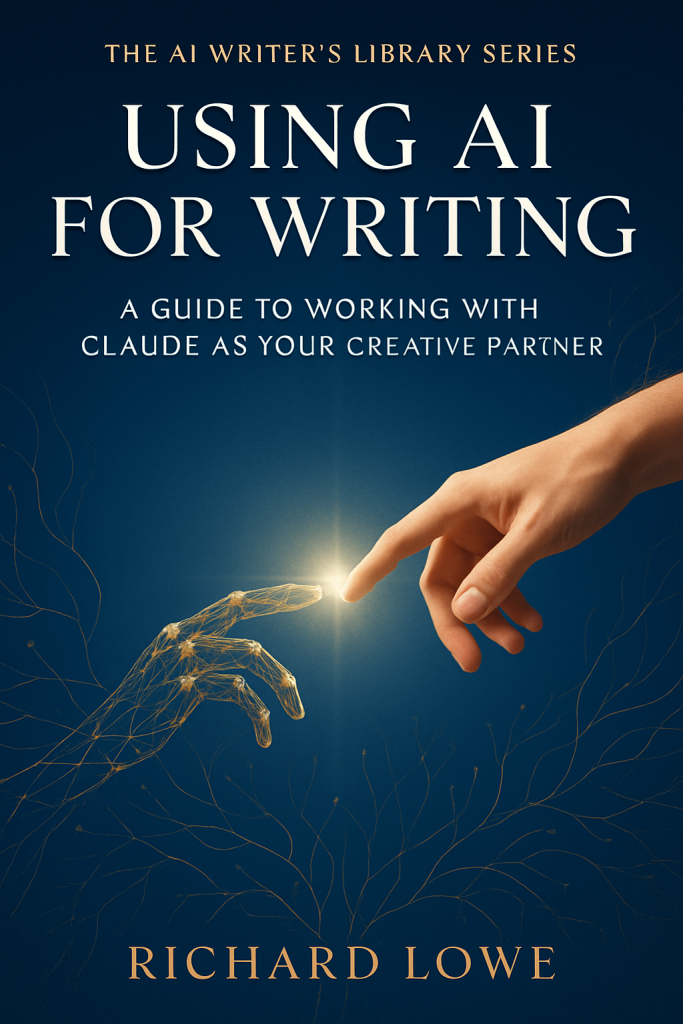
AI-Enhanced Series: Using AI for Writing
Free guide to using Claude for fiction writing. What AI does well, what it does poorly, the art of the prompt, and how to maintain your voice. Practical, not hype.