
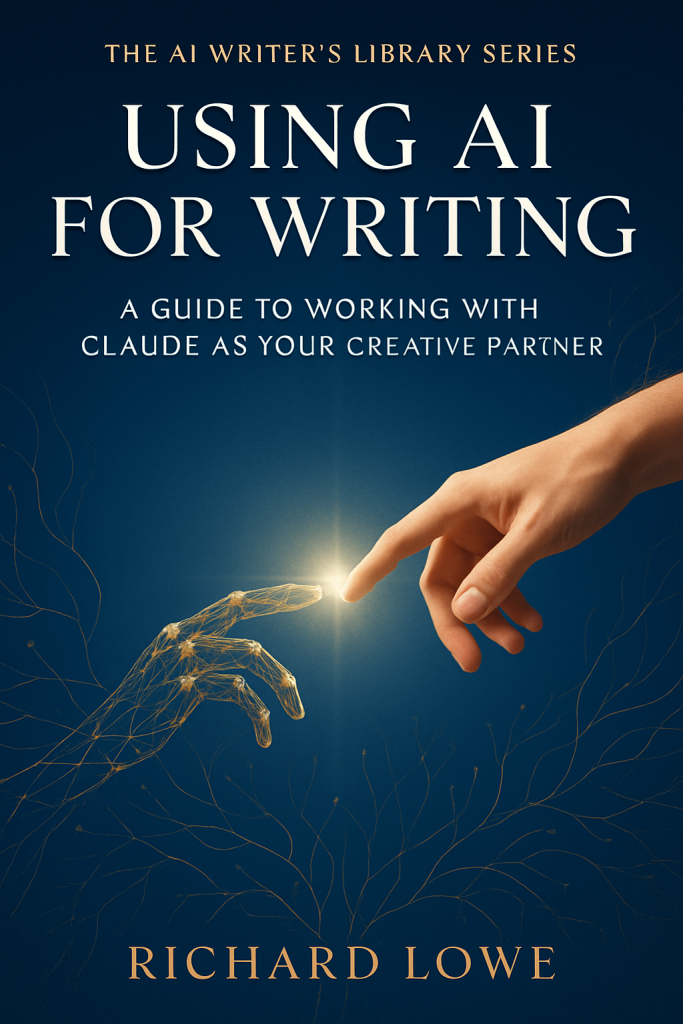
AI-Enhanced Series: Using AI for Writing
A Guide to Working with AI as Your Creative Partner
Prompting • Strengths • Limitations • Voice • Complete Session Walkthrough
FREE • Instant digital download
Jump to: What AI Does Well • The Art of the Prompt • What’s Inside • FAQ
I’ve been visiting writing groups. Facebook groups, forums, communities where writers gather to talk about craft and careers. And there’s a lot of anger about AI.
I understand it. The publishing industry is shifting fast and nobody asked writers if that was okay. But the anger is pointed at the wrong thing.
Writers treating AI as the enemy are making a strategic mistake. The ones who figure out how to use it as a digital assistant — how to maintain creative authority while letting AI handle research, brainstorming, consistency checking, and generating options — those writers are going to have a significant advantage. Not because AI writes better than humans. It doesn’t. But because a writer with a powerful assistant works faster, gets unstuck more easily, and produces more than a writer working alone.
The internet is full of people promising AI will do all the work while you sip coffee and collect royalties. That’s fantasy. The reality is more useful but less magical. AI accelerates your work. It expands your capabilities. It helps you see problems you’ve become blind to after reading your own manuscript fifty times.
You remain the writer. You make the creative decisions. You maintain the voice that makes your work yours.
This guide teaches you to use AI well — with Claude, ChatGPT, Gemini, Grok, Copilot, or whatever you’re already using. The methodology is the same regardless of which tool you choose.
What AI Does Well vs. What AI Does Poorly
Understanding these strengths and limitations prevents frustration and bad output. Use AI for what it does brilliantly. Write the emotional core scenes yourself.
Part of The AI Writer’s Library Series
Field manuals for writers who are done with advice that doesn’t work.
The Art of the Prompt
Good prompts have structure. Understanding that structure helps you get useful results consistently regardless of which AI tool you’re using.
Try One Prompt Free
“I’m writing [genre] and I’m stuck on [specific problem]. Here’s the context: [relevant details about characters, plot, setting]. Generate five different approaches to solve this problem. For each approach: describe the solution in 2-3 sentences, explain why it might work for this story, and flag any potential issues I should consider. Avoid [constraints]. We’ll refine the best option together.”
This structure works for almost any stuck point. The guide includes dozens more. Get them all →
113+ Books. Months of AI Testing. One System.
I’m Richard Lowe. I’ve published 113+ books and ghostwritten 54+ more. My ghostwriting clients have secured over $30 million in venture capital, landed traditional publishing deals, and hit bestseller lists.
I’m also AuDHD. My brain doesn’t accept “this is just how it works” as an answer. When AI tools became serious writing assistants, I spent months figuring out what they could and couldn’t do for writers. Testing prompts. Analyzing failures. Refining approaches across Claude, ChatGPT, Gemini, and others.
My twenty years as Director of Computer Operations at Trader Joe’s taught me that sustainable systems outperform random effort. The same principle applies here. Systematic AI integration beats throwing prompts at the wall and hoping something sticks.
What’s Inside This Guide
- Why AI for Writers — What makes modern AI tools suited for fiction writing and where they fall short
- Starting a Conversation — How to brief AI effectively so you get useful results instead of generic suggestions
- What AI Does Well — Research, brainstorming, pattern recognition, variation generation, consistency checking, psychological analysis
- What AI Does Poorly — Originality, emotional authenticity, your voice, judgment, memory, current events, factual accuracy
- The Art of the Prompt — Context, specific asks, constraints, format requests, and iteration invitations
- Building a Prompt Library — How to save and organize prompts that work for your specific needs
- The Conversation Loop — The back-and-forth pattern that refines rough suggestions into exactly what you need
- Context Management — Strategies for long sessions and large manuscripts that exceed AI memory
- Maintaining Your Voice — Reading aloud, cutting AI phrases, varying rhythm, adding personality back in
- Different Tasks, Different Approaches — Brainstorming, stuck point problem-solving, revision, research, dialogue generation
Plus chapters on a complete writing session walkthrough, when not to use AI (emotional core scenes, voice-heavy passages), ethics and disclosure, and a week-by-week guide to integrating AI into your writing process.
Questions
The writers who are furious about AI are fighting the wrong battle. The ones who channel that energy into learning how to use the tool — how to direct it, how to maintain their voice, how to get useful output instead of generic slop — those writers will be fine. The ones still arguing will wonder what happened.
This guide is ten minutes of reading that changes how you work. Download it.
FREE
Instant download • Your guide to AI-assisted writing
AI is waiting. Learn to use it well.
Part of the AI Writer’s Library Series. See also: AI Shortcomings Guide | AI Writing Partner Handbook
P.S. — Still scrolling? If you’ve tried AI and gotten disappointing results, the problem is probably your prompts, not the technology. This free guide teaches the five-element prompt structure that consistently produces useful output. Ten minutes of reading. Better AI results for every project after.