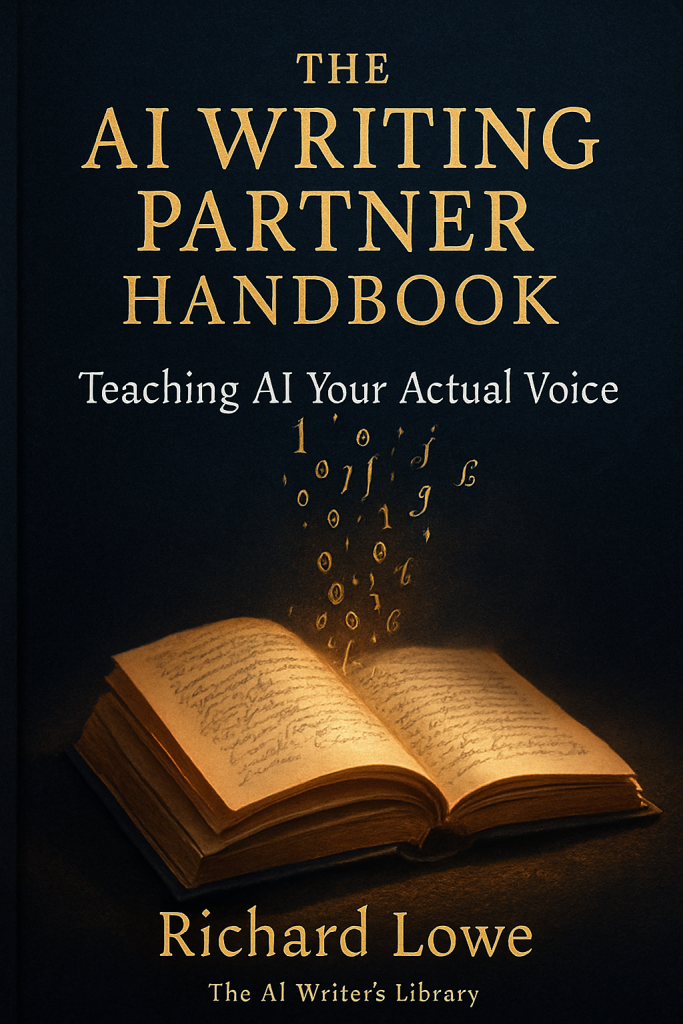
In the early days of ChatGPT, I ran an experiment that taught me exactly what AI needs to be a genuine writing partner.
I tried to write a novel with it. A 21-year-old woman discovers an interdimensional doorway. She starts naive — curious, uncertain, in over her head. I gave the AI the premise and watched what happened with no training, no voice document, no prompt architecture. Just raw generation.
By the time it was done with her, she was destroying the universe.
That wasn’t the story I intended. But it was the most useful education I’ve had in how AI actually works. The tool wasn’t broken. It was untrained. It had no document telling it who this character was, no constraints keeping the story in the direction I intended, no voice guidance preventing it from defaulting to the average of every story it had ever processed. It did exactly what an untrained tool does — it produced statistically probable prose instead of mine.
Everything I’ve built since then is the answer to that experiment. How do you give AI a precise enough target that it hits your voice instead of the average? How do you structure prompts so the generation stays in your story instead of drifting toward every other story? How do you build a cleanup protocol that catches what still slips through? How do you integrate AI into a writing workflow so it handles the tasks that drain you while you keep creative authority over the tasks that matter?
The answer is partnership — but partnership requires training. A brilliant collaborator who doesn’t know your voice, your intentions, or your story is just noise. A trained one produces work that sounds like you, stays in your story, and gives you back hours you were spending on tasks the tool handles better than you do.
I’ve published 113+ books. Some written entirely by hand, some with heavy AI collaboration. My ghostwriting clients have secured over $30 million in venture capital. The difference between AI that works as a genuine partner and AI that produces generic mush is systematic training, targeted prompts, and knowing exactly what to clean up.
That 21-year-old with the interdimensional doorway eventually got her story — with AI as a trained partner rather than an untrained engine. This handbook is how.
$7.95
One-time investment • Lifetime access • Instant download
Get The Handbook →
14-Day Money-Back Guarantee
If this handbook doesn’t change how your AI output sounds, request a full refund. No questions.
Questions
Why does AI drift away from my intentions?
Because AI doesn’t know your intentions. It knows probable word sequences and patterns from its training data. It knows stories escalate, protagonists become powerful, stakes increase toward climaxes. It applies all of that regardless of what you intended, because the only information it has is the text you’ve given it and the patterns from everything it was trained on. A 21-year-old with an interdimensional doorway becomes a universe-destroyer not because AI is creative but because that’s where statistical probability takes a story when nobody’s holding the wheel. The fix is a voice document and prompt architecture that constrain the generation toward your story instead of the average of all stories.
How do I make AI output sound like me instead of generic?
Train AI with a voice document specifying your vocabulary range, sentence architecture, paragraph structure, attitude toward subject and reader, and formality level. AI defaults to statistical averages because it has no target to hit. Give it a precisely defined target and output quality transforms. The handbook walks you through analyzing your existing work for each voice element, then documenting them in a format AI can actually use. AI can’t hit a target you haven’t defined — but once you define it, it can hit it consistently.
What are the most common robot patterns to catch?
Hedge words that drain energy from prose: “somewhat,” “rather,” “quite,” “fairly.” Corporate vocabulary nobody actually uses in conversation: “leverage,” “utilize,” “facilitate.” Filler phrases that announce themselves: “it’s important to note,” “it’s worth mentioning,” “in order to.” Passive voice where active would hit harder. Over-explanation that restates what the previous sentence already said. Sentences that all run the same length with no rhythm variation. The handbook covers fifty tells across word, sentence, structural, and voice levels — with examples and fixes for each. Once you see them, you can’t unsee them.
How long does the cleanup protocol actually take?
About 20-40 minutes per 1,000 words depending on output quality, running three phases in sequence: mechanical fixes with find-and-replace for the word-level tells, sentence-level revision for rhythm and passive voice, then voice restoration that brings your personality back into the prose. Better initial prompts produce cleaner output that needs less cleanup. The handbook’s prompt templates are designed to reduce cleanup time by catching problems before they get into the draft rather than after.
What if I’ve been using AI for a while and my voice has already drifted?
The handbook includes a voice restoration protocol for exactly this situation. Go back to your pre-AI work — the writing that was unambiguously yours before the tool got involved — and use it to rediscover what your authentic voice actually sounds like. Document it. Then use the cleanup protocol systematically on your recent work to identify and purge the accumulated AI patterns. Voice drift is reversible. It requires deliberate effort but the process is systematic, not intuitive. The handbook walks you through it.
Does this work for fiction and nonfiction both?
The core voice-training system applies to any prose. The handbook includes specific guidance for fiction — where the challenge is maintaining character voice consistency across chapters and keeping narrative voice distinct from character voice. For nonfiction the challenge is different: avoiding institutional tone drift, maintaining your opinion when AI wants to hedge everything into meaninglessness, and keeping expertise from sounding like a Wikipedia article. Marketing copy has its own failure modes. All three are covered.
Refund policy?
14 days. If it doesn’t change how your AI output sounds, full refund. No questions.
The woman with the interdimensional doorway eventually got her story. Not the first version — that one belongs to the limitations handbook, the cautionary tale about what happens when you hand AI a premise and step back. This version has a voice document, prompt architecture, and a cleanup protocol. This version sounds like me. Her story goes where I intended it to go.
That’s what a trained AI partner produces. Not the average of all stories. Yours.
$7.95
One-time investment • Lifetime access • Instant download
Get The Handbook →
14-Day Money-Back Guarantee
If this handbook doesn’t change how your AI output sounds, request a full refund. No questions.
Part of the AI Writer’s Library Series. See also: Productivity Handbook | Revisions Handbook