
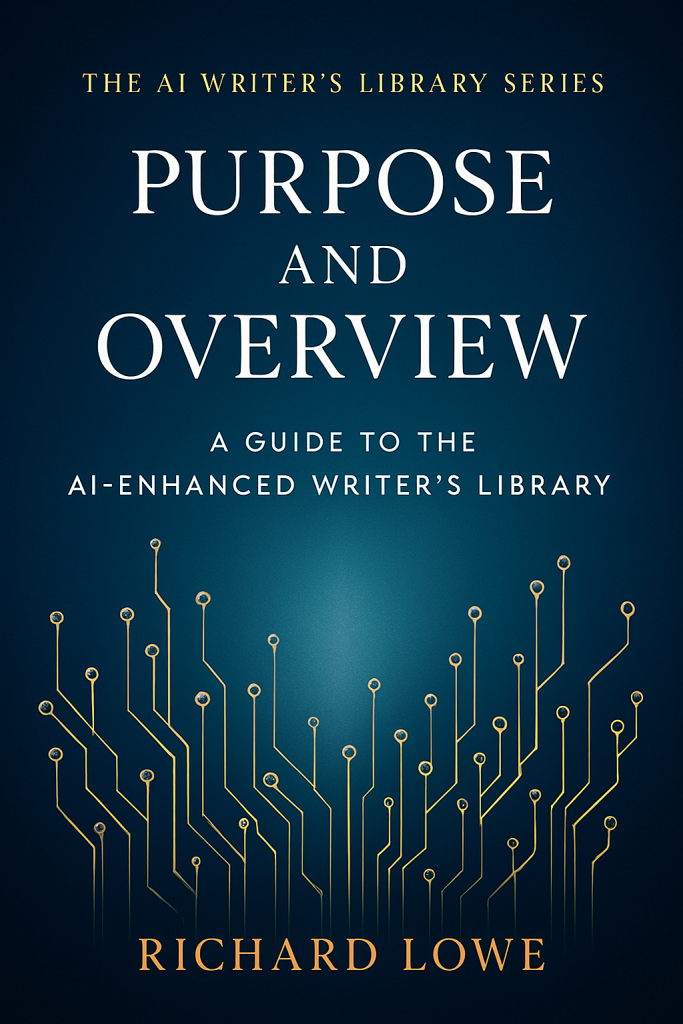
AI-Enhanced Series: Purpose and Overview
A Guide to the AI-Enhanced Writer’s Library
Craft • Genre • Business • Productivity • Where to Start
FREE • Instant digital download
Jump to: Handbook Categories • What Makes It Different • What’s Inside • FAQ
I’ve been visiting writing groups. Facebook groups, forums, communities where writers gather to talk about their craft and their careers. And there’s a lot of anger.
AI is stealing our work. AI is going to replace writers. AI is trained on stolen books. AI is the enemy and anyone using it is a traitor to the craft.
I get it. Change feels threatening. The publishing industry is shifting and nobody asked writers if that was okay. The anger makes sense as an emotion.
As a strategy, it’s going to destroy careers.
Here’s what the angry writers are missing: AI doesn’t write books. It can’t. It has no experience, no voice, no understanding of what it means to be human. What it has is the ability to be the most capable writing assistant any writer has ever had access to — available at 2am when your critique group is asleep, never tired of your questions, able to research and brainstorm and stress-test your plot and check your timeline and generate twenty options for a scene you’re stuck on in thirty seconds.
The writers who are furious about AI are fighting the last war. The writers who are quietly figuring out how to use it as a digital assistant — how to maintain their voice and their creative authority while letting AI handle the heavy lifting of research and consistency checking and brainstorming — those writers are going to have a significant advantage over everyone still arguing about whether AI should exist.
This library is built on that premise. AI as assistant, not author. You keep the creative authority. AI accelerates the work. Every handbook includes specific prompts that treat AI as a tool in service of your vision — not a replacement for it.
The anger is understandable. The writers who channel it into learning how to use the tool will be fine. The ones who don’t will wonder what happened.
45+ Handbooks. Where Do You Start?
You’ve seen the AI-Enhanced Writer’s Library. Character psychology. Dialogue mastery. Plot architecture. Genre-specific guides. Business and platform. Productivity systems.
45+ handbooks covering everything a fiction writer needs.
That’s a lot of options when you just want to fix what’s broken in your current manuscript.
This guide is your map.
The Library at a Glance
This guide shows you exactly which handbooks address your current challenge — and which ones pair together when you need comprehensive coverage.
Part of The AI Writer’s Library Series
Field manuals for writers who are done with advice that doesn’t work.
What Makes This Series Different
Most writing advice tells you what to do without teaching you why it works.
“Show don’t tell.” Great. But when? And why does showing work in some scenes while telling works better in others?
“Give your character a fatal flaw.” Wonderful. But how do you make that flaw generate story instead of just sitting there like a decorative scar?
The AI-Enhanced Writer’s Library answers the why questions. Psychology-first instruction that explains how human minds process story. AI integration that accelerates your work without replacing your voice. Practical application you can use on your current project today.
Not someday. Today.
Try One Prompt Free
“I’m struggling with [your current writing challenge]. Based on these symptoms: [describe what’s not working], help me identify whether my problem is primarily: (1) character depth, (2) dialogue distinctiveness, (3) plot structure, (4) pacing, (5) genre expectations, or (6) productivity/mindset. Then suggest which specific craft area I should focus on first.”
This is one way to identify your starting point. The guide gives you the complete roadmap. Get it free →
Built for Writers Who Use Any AI
Every handbook in this series includes specific prompts tested to produce useful results. Not generic AI suggestions that could apply to any book ever written. Targeted prompts for specific problems.
The prompts work with any major AI — Claude, ChatGPT, Gemini, Grok, Copilot, or whatever you’re already using. The methodology is the same: you keep creative authority, AI handles the heavy lifting of research, brainstorming, consistency checking, and generating options.
AI doesn’t write your books. You do. But the right prompts turn any AI into the most capable writing assistant you’ve ever had.
What’s Inside This Guide
- Why This Series Exists — The psychology-first approach that separates these handbooks from hundreds of writing guides cluttering Amazon
- How to Use the Handbooks — Which ones stand alone, which ones pair together, how to pick based on your current challenge
- Craft Fundamentals — Handbooks covering character, dialogue, plot, pacing, POV, theme, world-building, and more
- Genre-Specific Guides — Handbooks for mystery, fantasy, science fiction, historical, romance, horror, and beyond
- Business and Platform — Handbooks on author platform, book promotion, lead magnets, and Substack growth
- Productivity and Mindset — Handbooks on writer’s block, neurodivergent writing, and sustainable creative practice
- Complete Alphabetical Reference — All handbooks with descriptions and direct links
- Where to Start — Guidance based on your current challenge so you grab the right handbook first
113+ Books. 45+ Handbooks. One Map.
I’m Richard Lowe. I’ve published 113+ books and ghostwritten 54+ more. My ghostwriting clients have secured over $30 million in venture capital, landed traditional publishing deals, and hit bestseller lists.
I’m also AuDHD. My brain doesn’t accept “this is just how it works” as an answer. When something doesn’t make sense, I dig until I find the system underneath.
That’s what these handbooks are: the systems underneath the craft advice. The psychology that explains why techniques work. The frameworks that let you apply those techniques consistently.
My twenty years as Director of Computer Operations at Trader Joe’s taught me that sustainable systems outperform random effort. The same principle applies to writing. Psychology-first craft beats surface-level technique every time.
Questions
Ready to Explore the Library?
FREE
Instant download • Your map to 45+ handbooks
Find what you need. Skip what you don’t. Start writing better today.
Part of the AI Writer’s Library Series. See also: Deep Character Handbook | Plot Handbook
P.S. — Still scrolling? This free guide takes ten minutes to read. It’ll save you from grabbing the wrong handbook and show you exactly where to start based on your current challenge. Download it, skim the “Where to Start” section, and you’ll know which handbook to grab first.