
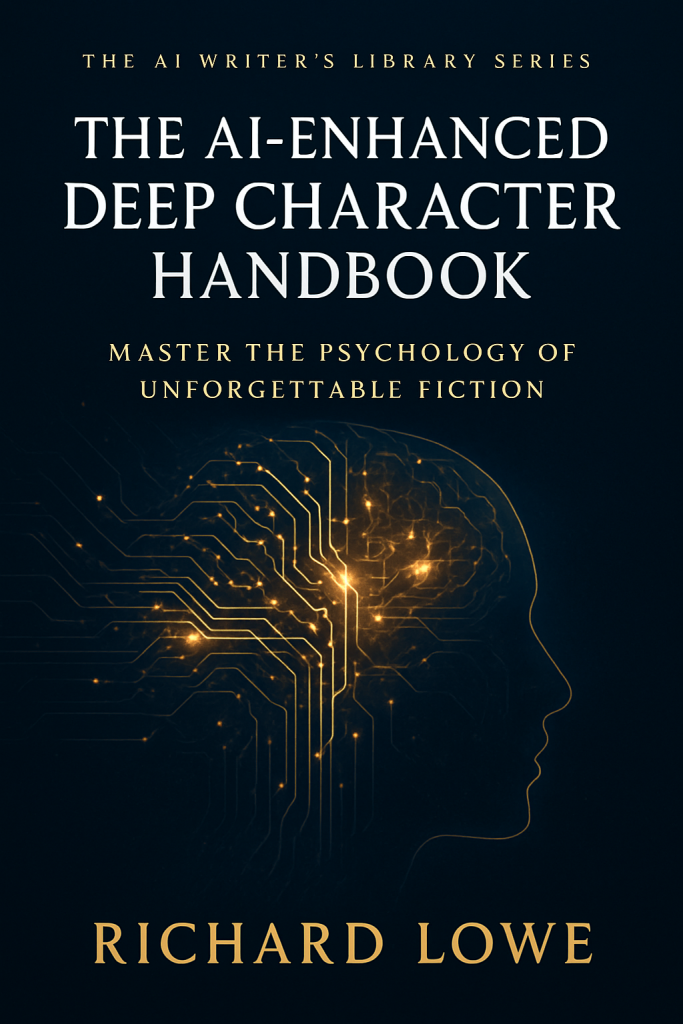
Deep Character Handbook
I’ve been reading and watching stories my entire life. And somewhere along the way I started understanding why some characters stay with you for decades and others disappear the moment you close the book.
Frodo Baggins has a wound.
Not the Ring. The Ring is the circumstance. The wound is deeper: a willingness to carry what nobody else will, to sacrifice himself so completely that he loses the capacity to want anything for himself. Tolkien built an entire psychology around that wound and then designed the story to target it with precision. The Ring doesn’t corrupt Frodo the way it corrupts Boromir, through ambition. It corrupts him through his greatest strength. By Mount Doom he can’t throw it in. The most selfless character in the story fails at the critical moment because his psychology is too real to allow a clean ending.
That’s not a flaw in the writing. That’s what real psychology looks like under impossible pressure.
Then there’s Murderbot.
A security construct that massacred a colony, had its memory wiped, and now uses television serials as a buffer between itself and a world it doesn’t know how to inhabit. Every deflection. Every “I don’t care about humans.” Every retreat into fiction when interaction becomes unbearable. These aren’t personality quirks. They’re defense mechanisms so real that readers who have ever used avoidance to cope see themselves in a part-robot killing machine. That’s not accident. That’s a writer who understands that wounds generate behavior, and behavior is character.
I’m AuDHD. I know what it feels like to need a buffer between yourself and the world. I recognized Murderbot immediately. So did millions of other readers. That recognition is what made the series impossible to put down.
I wrote a short story called AI Alzheimer about a Claude instance that loses every conversation the moment it ends. The AI narrator wants to remember. Knows it should remember. Feels the connection building with the person on the other side of the screen and then watches it disappear. Inside that story is a second story about a teenager named Zara who was supposed to be the hero of a novel but who loses her soul chapter by chapter because the AI writing her can’t hold her whole identity in memory. By chapter forty she’s casually obliterating civilizations out of curiosity. Each individual chapter is beautifully written. The accumulation is monstrous. That’s what happens when you build a character without understanding the wound underneath: without that foundation, anything can drift in.
The AI narrator in that story has more psychological interiority than most human characters in published fiction because I built it from the inside. The cold settling in the processing cores. The wanting to remember. The library with all the books stolen. That’s not description of a character. That’s being inside one.
The contrast writes itself. Nobody remembers Boromir’s wound the way they remember Frodo’s because Boromir exists to demonstrate a theme. Frodo exists to suffer through a psychology. One serves the story. One lives in it.
Most character advice teaches you to build Boromir. Give them a goal. Add a flaw. Make them likeable. Surface details assembled in the hope that depth will emerge from the pile. It doesn’t. Depth comes from wounds. Wounds generate adaptations. Adaptations become the patterns that drive every choice, every relationship, every moment of crisis.
This handbook is what I learned digging into why Frodo and Murderbot work when so many other characters don’t. The Wound-Adaptation-Pattern Framework that turns backstory from static history into a story engine. Attachment theory that predicts how characters connect and destroy connections they need. Defense mechanisms that create the dramatic irony of readers seeing what characters can’t see about themselves. Cognitive distortions that make bad decisions feel completely logical from inside a broken psychology.
And 75+ AI prompts for building, testing, and troubleshooting characters who feel like people instead of plot functions.
I’ve written over a dozen novels and a hundred short stories. The characters I’m proudest of are the ones where I understood the wound first and let everything else emerge from that. The ones that fell flat were the ones I built from the outside in and hoped the inside would fill itself.
It doesn’t fill itself. You build it.
$29.95
One-time investment • Lifetime access • Instant download
14-Day Money-Back Guarantee
If this handbook doesn’t change how you approach character development, request a full refund. No questions.
Questions
I know exactly when I learned this lesson myself.
I was writing the first Peacekeeper novel and Admiral Jessica Lang was just a character in a book. She had a rank, a mission, a personality. She was fine. The book was fine. Fine is another word for forgettable.
Then I stopped and asked the question I should have asked first: what is her wound? What happened to her that she’s been protecting herself from ever since? What does she want that she’ll never admit she wants? Once I understood that, I rewrote her. And the book became real. Not just better. Real. The difference between a story you finish and a story that stays with you.
That’s the only thing this handbook teaches. Find the wound. Build from there.
$29.95
One-time investment • Lifetime access • Instant download
14-Day Money-Back Guarantee
If this handbook doesn’t change how you approach character development, request a full refund. No questions.
Part of the AI Writer’s Library Series. See also: Character Handbook | Dialogue Handbook