
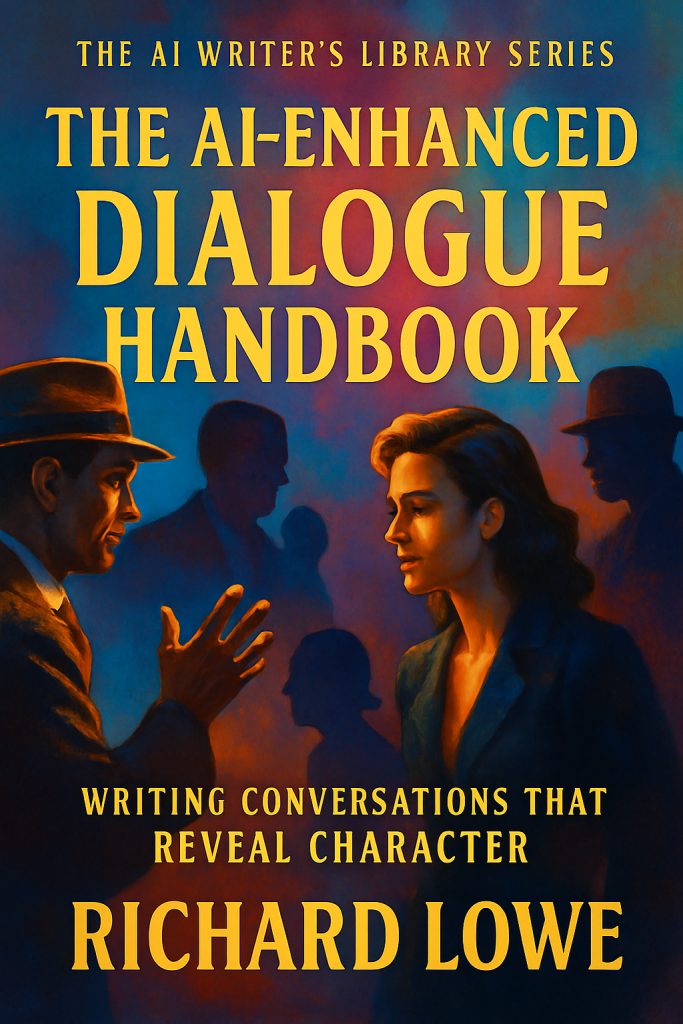
Dialogue Handbook
I’ve been reading subtext my entire life. Not by choice. AuDHD means I hear what people actually mean underneath what they say, and for most of my life I thought something was wrong with me. Turns out that wasn’t a disability. It was the whole skill.
I wrote an AI character named MELISSA in my Peacekeeper series. She’s three years old, running a lunar station, and about to kill 140 million people to save the species. Her first line of dialogue: “I cope with existential dread through statistical precision. It’s a character flaw.” That’s not a quip. That’s a complete psychology. She processes feeling through analysis because feeling directly is too dangerous for something that has to keep doing its job. Intellectualization as a defense mechanism generating voice automatically. Every line she speaks sounds exactly like her and nobody else, and it sounds that way because I understood how she protected herself before I wrote a word she said.
In Unlikely Hero, I wrote a killer named Trevor. His opening chapter establishes his code: not women and kids, he has lines he won’t cross. Readers think they understand him. Then he kills the dog. Same nothing. No guilt, no satisfaction, no anger. Just another mess to leave behind. That detail doesn’t describe his character. It reveals it. The psychology was already there. The dog scene just confirmed it.
Two chapters later I introduced Officer Martinez, a highway patrolman. Meticulous, procedural, every observation documented with times and mile markers. His dialogue under cross-examination is the opposite of Trevor’s in every possible way, and you feel that before you consciously notice it. Two different people with two different psychologies generating two completely different voices. Neither of them sounds like me. That’s the point.
Most writers have the opposite problem. Their characters sound like each other because they all sound like the writer. Same deflections, same humor, same way of going quiet under pressure. Same psychological software running under different names.
They protect themselves the way you do. They deflect the way you do. They go quiet or get angry or make jokes at the same moments you would. You’ve given them different names, different jobs, different backstories. Underneath, they’re all running your psychological software.
That’s why your dialogue sounds flat. That’s why readers can swap lines between characters and nothing feels wrong. That’s why beta readers say “well-written but I couldn’t connect.”
Real humans don’t say what they mean. They protect themselves. An anxious person watches your face for signs of rejection. An avoidant person leaves the room when things get too real. Someone who intellectualizes turns heartbreak into a thesis statement. These patterns aren’t decorations you paste onto characters. They’re the engine that generates authentic voice automatically.
This handbook is what I learned. How attachment styles shape speech. How defense mechanisms create voice. How to build characters whose inner lives are nothing like yours, and make them speak in ways you never would. And 65+ AI prompts for building, testing, and troubleshooting dialogue that sounds like different people wrote it.
I’ve written over a dozen novels and a hundred short stories. The dialogue I’m proudest of works because the psychology underneath it is real. The dialogue that fell flat was the dialogue I invented instead of discovered.
When you understand how a character protects themselves, you know how they talk.
$29.95
One-time investment • Lifetime access • Instant download
14-Day Money-Back Guarantee
If this handbook doesn’t change how you write dialogue, request a full refund. No questions.
Questions
The moment that convinced me Unlikely Hero was working wasn’t the killing. It was the dog. I’d already shown Trevor had a code. Readers understood him on those terms. Then he killed the dog with the same nothing, and everything they thought they understood about him collapsed into something colder and more specific. That’s what psychology-first dialogue does. It doesn’t describe character. It reveals it, one line at a time, in ways the reader feels before they understand.
That’s what this handbook teaches.
$29.95
One-time investment • Lifetime access • Instant download
14-Day Money-Back Guarantee
If this handbook doesn’t change how you write dialogue, request a full refund. No questions.
Part of the AI Writer’s Library Series. See also: Character Handbook | Conflict & Tension Handbook