Every client who came to my book coaching service had an idea.
Not a vague wish to write a book someday — an actual concept, specific enough to explain in a sentence, interesting enough that I immediately wanted to know what happened next. The ideas weren’t the problem. The problem was that the ideas were stuck. A premise with nowhere to go. A character with no situation. A “what if” with no answer to “and then what?” Session after session, the same pattern: promising seed, no system for expanding it, and a writer who’d been circling the same three thoughts for months wondering why the story wasn’t materializing.
I started documenting what actually moved clients forward. Not the questions that felt productive — brainstorming sessions can feel enormously productive while generating nothing you can write tomorrow. The questions that produced something usable. The techniques that took a concept from seed to story structure in a single session. The difference between a client who left with three scenes blocked out and a client who left with the same premise they’d arrived with, still promising, still stuck.
The pattern that emerged wasn’t about generating new ideas. It was about expansion. Every great concept contains its own story — the characters it implies, the complications it requires, the stakes it demands, the world it assumes. None of that appears automatically. It surfaces through the right questions in the right sequence. A premise about a woman who discovers her husband has a second family implies a specific kind of protagonist psychology, a specific kind of betrayal arc, a specific set of complications that emerge from that particular wound. The concept already knows what story it wants to be. Brainstorming is the process of asking it.
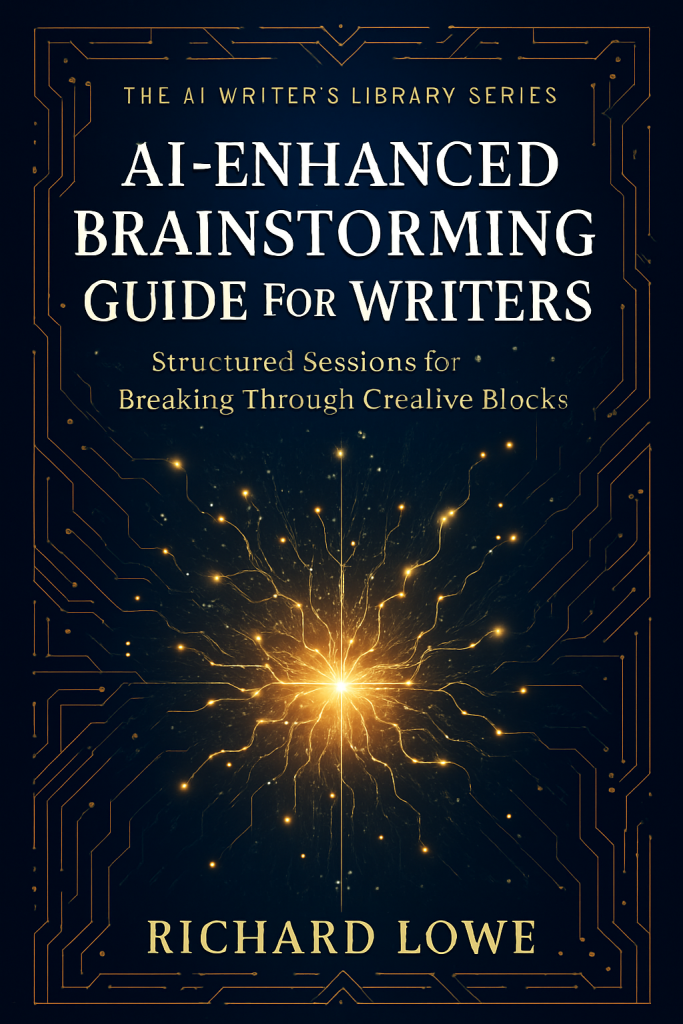
I ran enough of these sessions to know which techniques break through and which ones produce comfortable-feeling circles. I eventually wrote this handbook because my clients kept asking for the framework between sessions — something they could use when I wasn’t in the room. Everything that worked in those sessions is in here: the structured approaches, the expansion techniques, the AI integration that generates volume when you need options fast, and the decision frameworks for when you have too many directions and need to choose one.
I’m Richard Lowe. 113 published books, ghostwriting clients who’ve secured over $30 million in venture capital, and years of book coaching sessions where I watched great concepts become actual stories. I’m also AuDHD, which means I don’t accept “wait for inspiration” as a methodology. This handbook is what I built instead.
Your concept already knows what story it wants to be. This handbook teaches you how to ask.
$29.95
One-time investment • Lifetime access • Instant download
Get The Guide →
14-Day Money-Back Guarantee
If this guide doesn’t change how you approach creative blocks, request a full refund. No questions.
Questions
I have an idea but can’t figure out what happens next. What do I do?
That’s the expansion problem — the most common block in book coaching. The concept is sound but the story it implies hasn’t surfaced yet. Every premise contains its own characters, complications, and stakes; they don’t appear automatically. The handbook’s premise and concept brainstorming section walks you through expansion techniques that pull the story out of the seed: implication mapping, character psychology that emerges from the concept’s specific wound, complication generation that follows from the premise’s inherent logic. One structured session typically moves a stuck concept further than months of unstructured thinking.
What’s the difference between brainstorming that works and brainstorming that just feels productive?
Productive-feeling brainstorming generates possibilities you immediately sense you’ll never use. Working brainstorming ends with something you can write tomorrow. The difference is specificity and constraint. Unconstrained brainstorming circles back to the same obvious options. Structured sessions with specific parameters — generate fifteen options, include at least three that violate your initial assumptions, evaluate each one for the problem it creates as well as the possibility it opens — force past the obvious into territory where usable ideas live. The handbook covers session structures that are designed to end with actionable output, not just explored territory.
How does AI help with brainstorming specifically?
AI generates volume faster than you can alone, which is useful for breaking obvious loops. When you’ve been circling the same three options, AI can produce twenty more in two minutes — and somewhere in that volume is usually an angle you hadn’t considered. The limitation is that AI can’t evaluate what it generates. It doesn’t know which of its twenty suggestions fits your story’s specific psychology. You provide the evaluation and direction. AI provides the volume. The handbook covers how to prompt for useful brainstorming output rather than generic suggestions, and how to run the human-AI collaboration loop that produces specific usable ideas for your specific project.
How do I expand a premise into a full story structure?
Start with what the premise implies rather than what it states. A premise about betrayal implies a specific protagonist psychology — someone who trusted, which means someone who had reason to trust, which means a relationship history that shaped that trust. It implies a specific wound from the discovery, complications that emerge from that particular kind of wound, and a resolution that addresses the wound rather than just the surface situation. Expansion isn’t invention. It’s excavation. The handbook teaches you to ask the questions that surface what the concept already contains.
What do I do when I have too many ideas and can’t choose?
Stop brainstorming and start deciding. The commitment block — having ideas but being unable to choose between them — needs decision frameworks, not more options. More brainstorming when you’re in a commitment block produces more paralysis. The handbook covers decision frameworks that evaluate options against your story’s specific requirements: which direction creates the most interesting constraint for your protagonist, which one you can sustain for 80,000 words, which one resolves the central question your premise is actually asking.
Does this work for series planning?
Series planning is expansion at the largest scale — taking a concept that has enough in it for multiple books and mapping which elements belong where. The handbook covers arc development across multiple books, planting seeds in early volumes that pay off later, managing the complexity that accumulates as a series grows, and brainstorming that considers long-term implications rather than just immediate needs. The Peacekeeper series across 15+ books required exactly this kind of systematic expansion thinking — the handbook reflects what actually works at that scale.
Refund policy?
14 days. If it doesn’t change how you approach creative blocks, full refund. No questions.
The clients who came to coaching with great concepts weren’t lacking creativity. They were lacking the questions that would unlock what was already there. Once they had the framework, they didn’t need me in the room — they could run the sessions themselves, surface the implications of their own premises, and move from stuck concept to actual story.
That’s what this handbook gives you. Not ideas. The questions that find the ideas you already have.
$29.95
One-time investment • Lifetime access • Instant download
Get The Guide →
14-Day Money-Back Guarantee
If this guide doesn’t change how you approach creative blocks, request a full refund. No questions.
Part of the AI Writer’s Library Series. See also: Character Handbook | Plot Handbook