
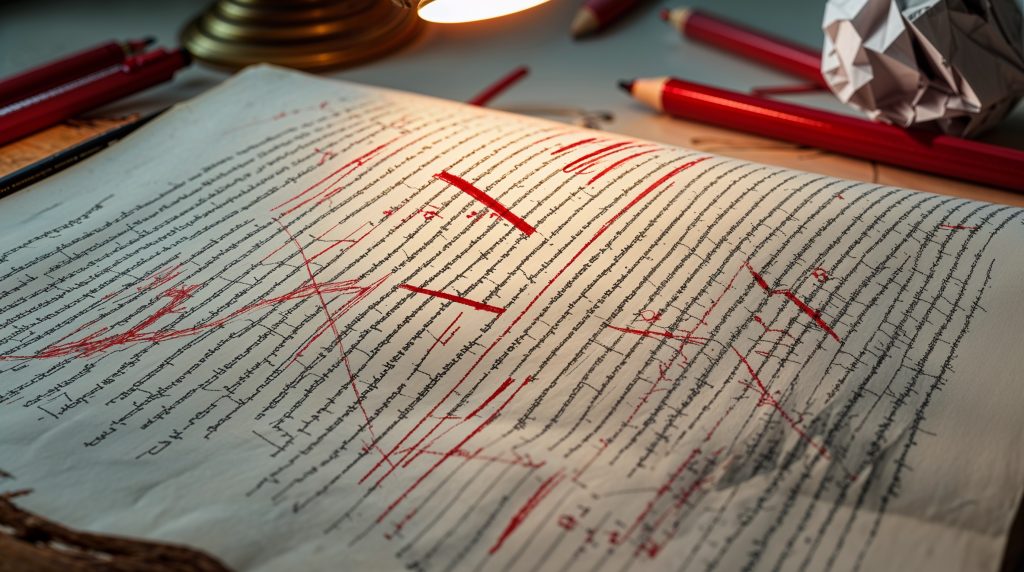
Why Your First Draft Is Supposed to Be Terrible
You finished the draft. You read it back. It’s awful. The pacing is wrong, the dialogue is stiff, the middle sags, three subplots go nowhere, and your protagonist does something in chapter twelve that contradicts everything established in chapter four.
This is normal. Not “it happens to everyone, keep your chin up” normal. Structurally, mechanically, inevitably normal. First drafts are discovery documents. You were learning your story while you wrote it. Of course the early chapters don’t match the late chapters — you didn’t know where you were going when you started.
I’ve written 113+ books. Every single one had a terrible first draft. The difference between published authors and abandoned manuscripts isn’t talent in the first draft. It’s willingness to revise systematically instead of tinkering endlessly or giving up entirely.
The draft exists so you can revise it. Revision is where the book becomes itself.
The Revision Hierarchy: What to Fix First
Most writers start revision by fixing sentences. Polishing prose. Adjusting word choice. This is like repainting the walls of a house that needs its foundation repaired.
Revision works in layers, from large to small. Fix structural problems first. Then character consistency. Then scene-level pacing. Then dialogue. Then prose. Then line edits. If you polish sentences in chapter three and later discover that chapter three needs to be cut entirely, you’ve wasted time on work that doesn’t survive.
The hierarchy looks like this:
Structural revision: Does the plot work? Do the acts function? Is the inciting incident in the right place? Does the midpoint shift the story meaningfully? Does the climax earn the ending?
Character revision: Are characters consistent? Do their decisions follow from their psychology? Does the wound-adaptation-pattern hold across every scene? Does the arc land?
Scene revision: Does every scene turn? Is the emotional value different at the end than at the beginning? Can any scene be cut without affecting downstream scenes? If yes, cut it.
Dialogue revision: Does each character have a distinct voice? Is there subtext? Can you remove the tags and still identify who’s speaking?
Prose revision: Sentence-level polish. Rhythm. Word choice. Eliminating filler words, passive constructions, and the dead language that crept in during drafting.
The Revision Pass Checklist
Each revision pass has specific diagnostic questions. Work through them in order. Don’t skip ahead — fixing a lower-level problem before the higher-level pass is wasted effort if the scene gets cut or restructured.
Pass 1 — Structure (allow 1-2 weeks): Read the manuscript in one sitting, taking notes only. Mark where your attention drops. Then ask: Does the inciting incident happen within the first 15% of the book? Does the midpoint change the protagonist’s approach to the problem? Does every subplot connect to the main arc? Can you state the climax in one sentence? Does the ending deliver on the promise of the opening? Cut or relocate any chapter that doesn’t advance the central conflict.
Pass 2 — Character (allow 1 week): Track each named character through the manuscript. Ask: Does this character want something in every scene they appear in? Does their behavior follow from their wound and adaptation? Do they change between their first and last appearance? Can any two characters be combined without losing plot function? Does the protagonist make the climax happen through their own choice, not luck or rescue?
Pass 3 — Scene (allow 1 week): Examine each scene individually. Ask: What is the emotional value at the start of this scene? Is it different at the end? If this scene were deleted, would any downstream scene need to change? Does the scene enter late and exit early? Is the point-of-view consistent throughout?
Pass 4 — Dialogue (allow 3-5 days): Read all dialogue aloud. Ask: Can you identify the speaker without tags? Is there subtext — a gap between what the character says and what they mean? Are characters exchanging information for the reader’s benefit or talking the way real people talk? Does every conversation contain at least a hint of conflict or tension?
Pass 5 — Prose (allow 3-5 days): Line-level polish. Ask: Can any word be cut without changing the meaning? Are you using active voice unless passive is deliberately chosen? Are there filler phrases (“began to,” “seemed to,” “started to”) that can be eliminated? Does the sentence rhythm vary? Does the prose carry any AI-generated language patterns that need to be cleaned?
The Revisions Handbook walks through each level of this hierarchy with checklists, diagnostic questions, and AI prompts for identifying problems at each layer before you start fixing them.
How to Evaluate Your Own Work Honestly
The hardest part of revision isn’t knowing what to fix. It’s seeing what’s broken. You’re too close to the manuscript. You know what you meant, so you read meaning into passages that don’t actually deliver it. You remember the emotional context of a scene, so you feel the emotion even when the prose doesn’t create it.
Distance helps. Put the manuscript away for at least two weeks before starting revision. A month is better. You need enough time to forget the specifics so you can read what’s on the page instead of what’s in your head.
Read the entire manuscript in one or two sittings without stopping to fix anything. Mark problems with a simple notation — “slow,” “confusing,” “who cares?” — and keep reading. The goal is to experience the manuscript the way a reader would: continuously, without the author’s backstage knowledge.
Your gut reactions during this read-through are the most valuable revision tool you have. Where you got bored is where readers will get bored. Where you got confused is where readers will get confused. Where you felt nothing is where readers will stop reading. Trust the feeling even when you can’t explain it yet.
Cutting Scenes You Love (And Why It Makes the Book Better)
The most common revision failure is refusing to cut material that doesn’t serve the story. You wrote a beautiful scene. The prose sings. The dialogue crackles. It took you three days to get it right. And it doesn’t advance the plot, develop characters, or increase tension.
Cut it.
The scene can be beautiful and still be wrong for this book. A subplot can be interesting and still be a distraction. A character can be charming and still be unnecessary. Every element in the final manuscript has to earn its place by doing work that nothing else in the book does.
The test is simple: remove the element and read the surrounding pages. If the story flows better without it, the element was interrupting rather than contributing. If nothing downstream breaks, the element wasn’t load-bearing.
Save your cuts in a separate file. You’re not destroying them. You’re moving them somewhere they can’t damage the pace, structure, and focus of the book you’re actually writing. Some of those cuts might become the seed of your next project.
Recognizing and Fixing Awful Writing Patterns
Every writer has default bad habits. Patterns they fall into during drafting that need to be identified and corrected during revision. The faster you learn your personal patterns, the faster your revision process becomes.
Common awful writing patterns include hedging language (she seemed to maybe feel somewhat upset), filter words that create distance (he noticed that the room was dark vs. the room was dark), echoed words and phrases repeated within the same page or paragraph, dialogue that summarizes emotion instead of demonstrating it, and scenes that start too early or end too late.
AI-generated text has its own awful patterns: corporate transitional phrases, hedging qualifiers, balanced-to-the-point-of-saying-nothing conclusions, and the word “delve.” If you’ve used AI during drafting, cleaning up those AI fingerprints is a distinct revision pass on its own.
The Awful Writing Handbook catalogs the most common bad writing patterns across prose, dialogue, structure, and AI-assisted drafting. Each pattern includes examples, diagnostic tests, and AI prompts designed to identify instances in your manuscript so you can fix them systematically instead of hoping you catch them on a read-through.
Beta Readers and When to Use Them
Beta readers are invaluable — after you’ve completed your own structural revision. Sending a first draft to beta readers wastes their time and yours. They’ll identify structural problems you already know about. They’ll react to character inconsistencies you haven’t fixed yet. Their feedback will be accurate but unhelpful because it’s addressing the version of the book you haven’t finished revising.
Send beta readers a manuscript that represents your best effort. You’ve done the structural pass. You’ve checked character consistency. You’ve fixed pacing. You’ve polished the prose. Now you need eyes that aren’t yours to tell you what still isn’t working.
Good beta reader questions are specific. “Did the midpoint surprise you or did you see it coming?” is useful. “What did you think?” is not. “At what point did you first consider putting the book down?” gives you actionable data. “Did you like it?” gives you nothing.
Not all beta reader feedback is equal. If one reader found chapter eight confusing, it might be their reading. If three readers found chapter eight confusing, chapter eight has a problem. Look for patterns in the feedback, not individual opinions.
The Revision Timeline: How Long This Actually Takes
First-time authors underestimate revision by a factor of three to five. If your first draft took four months, expect revision to take two to four months at minimum. More if the structural problems are significant.
A realistic revision timeline looks like this: two to four weeks of rest between finishing the draft and starting revision. One full read-through with notes, taking one to two weeks. Structural revision, two to four weeks. Character and scene revision, two to three weeks. Dialogue and prose polish, two to three weeks. Beta reader period, four to six weeks. Post-beta revision, two to three weeks.
This isn’t a production line. Stages overlap. You’ll discover structural problems during prose polish. You’ll fix dialogue during character revision. The hierarchy guides your focus, not your rigid schedule. But knowing the real timeline prevents the frustration of expecting to “quickly clean up” a draft and finding yourself still revising months later.
When to Stop Revising
Revision has a point of diminishing returns. After a certain number of passes, you’re not improving the manuscript. You’re rearranging furniture. Changing a word back and forth between drafts. Cutting a sentence and then putting it back. Adding a comma and then removing it.
The manuscript is ready when you can read it without stopping to fix things. Not without noticing imperfections — every author sees those forever — but without feeling that the imperfections are structural, character-based, or pacing-related. If your objections are all at the sentence level and even those are minor, the book is done.
Perfectionism disguised as revision is procrastination. The book doesn’t need to be perfect. It needs to be finished, polished, and honest. A published imperfect book reaches readers. A perpetually revised manuscript reaches nobody.
The AI-Enhanced Writer’s Library covers revision as an integrated craft skill, connecting structural revision to character work, pacing, dialogue, and prose polish so each revision pass addresses multiple layers simultaneously.
Free Stories, Straight to Your Inbox
Start with Nine Doors, nine short stories across nine genres, yours free the moment you sign up. After that, the occasional new collection and a note when there's a new book worth your time. No spam, no daily clutter. Just good stories.
We use MailerLite to manage our list and send these emails. Your address is used only to send you what you signed up for. We will not sell it, share it, or use it for anything else, and you can unsubscribe anytime.
Frequently Asked Questions
How many revision passes does a novel need?
Most novels need three to five major passes: structural, character and scene, dialogue, prose, and post-beta reader. Each pass focuses on a different layer following the revision hierarchy from large-scale structure down to sentence-level polish. Fixing structural problems first prevents wasted effort on scenes that might get cut.
How do I know if a scene should be cut?
Remove it and read the surrounding pages. If the story flows better without it, it was interrupting rather than contributing. If nothing downstream breaks, it wasn’t load-bearing. Beautiful writing that doesn’t advance plot, develop character, or increase tension is decoration, and decoration gets cut in revision.
Should I hire a professional editor or revise on my own?
Both, in sequence. Complete your own revision first — structural, character, pacing, dialogue, and prose. A professional editor working on a polished manuscript can focus on craft issues you can’t see. An editor working on a first draft will spend your money identifying problems you could have found yourself. Self-revision makes professional editing more valuable, not less necessary.
How long should I wait before revising my first draft?
Long enough to forget the version in your head so you can see the version on the page. For most writers, two to four weeks works. The goal is distance — when you return to the manuscript, you want to read what’s actually written rather than what you intended to write. If you can’t take a full break, work on a different project during the gap. The revision will be sharper because your brain has had time to reset.
What is developmental editing vs. line editing?
Developmental editing addresses structure, character arcs, pacing, and plot logic — the large-scale elements that determine whether the story works. Line editing addresses prose quality, sentence rhythm, word choice, and clarity at the paragraph and sentence level. Developmental editing should come first because there’s no point polishing prose in a chapter that needs to be restructured or cut. Many writers skip developmental editing and go straight to line editing, which is like painting a house before fixing the foundation.
-

Revisions Handbook
Complete revision methodology from structural surgery to line editing. AI guardrails, feedback integration, genre-specific requirements. Case studies. 256 pages. -

Awful Writing Handbook
Fix writing mistakes in romance, fantasy, thriller & historical fiction. 68 sins, AI pattern cleanup & revision prompts. 399 pages from 113-book author.