

Why All Your Characters Sound Like the Same Person
You wrote six characters. A retired Marine. A teenage hacker. A Southern grandmother. A corporate lawyer. An immigrant shop owner. A seven-year-old child. They all speak with your vocabulary, your sentence rhythm, and your communication style. Strip the dialogue tags and nobody can tell who’s talking.
This isn’t a dialogue problem. It’s a psychology problem. Each character processes the world through different fears, different desires, and different defense mechanisms. Those internal differences should produce external differences in how they speak. When they don’t, every conversation reads like one person arguing with themselves. (If this sounds familiar, your characters sounding alike is one of the most common craft problems in fiction.)
I’ve written 113+ books and ghostwritten memoirs for executives who speak very differently from each other. A Fortune 50 CEO talks nothing like a retired firefighter, even when they’re discussing the same topic. The difference isn’t vocabulary. It’s what they’re protecting, what they’re performing, and what they refuse to say out loud.
How to Write Dialogue That Reveals Character
Good dialogue does three jobs simultaneously: it moves the plot forward, it reveals character, and it creates tension. Most writers only manage the first one. Their characters exchange information. The scene advances. Nobody learned anything about who these people actually are.
The fix starts with understanding that people rarely say what they mean. A husband who says “I’m fine” after his wife mentions her ex-boyfriend is not fine. A teenager who says “whatever” when grounded is performing indifference to mask fury. A boss who says “interesting approach” in a meeting means your idea is dead.
This gap between what characters say and what they actually feel is subtext, and it’s where dialogue comes alive. Without subtext, dialogue is just two people reading a script. With it, every line carries weight because the reader knows more than the words suggest.
An avoidant character doesn’t say “I’m scared of getting close to you.” They say “I think we should keep things casual.” An anxious character doesn’t say “I’m terrified you’ll leave.” They say “You’d tell me if something was wrong, right?” The attachment style drives the word choice, and the reader feels the psychology without the author explaining it.
Here’s the same scene written two ways. A woman discovers her business partner has been stealing from her.
Without psychology-driven dialogue: “I can’t believe you stole from me,” Sarah said. “I trusted you completely and you betrayed that trust. How could you do this to me after everything we’ve been through together?”
With psychology (avoidant attachment, raised by an emotionally volatile parent): Sarah set the spreadsheet on the desk between them. “So the Hendricks account.” She straightened a pen that didn’t need straightening. “Interesting numbers.” She watched him start to speak and added, “I’ve already called the accountant. Just thought you should know.”
The second version reveals more about Sarah in four lines than the first reveals in three sentences. She doesn’t name the betrayal. She doesn’t express emotion directly. She controls the conversation, cuts off his response, and presents the consequence before he can offer an excuse — because she learned as a child that showing pain gives the other person power over you.
The Dialogue Handbook covers voice differentiation, subtext mechanics, conflict-driven conversation, and 40+ AI prompts for generating dialogue that reveals character psychology instead of just delivering plot information.
How to Develop a Unique Voice for Each Character
Voice isn’t accent or dialect. It’s the pattern of thought that shapes how a person communicates. Two characters from the same town, the same social class, and the same age group can sound completely different because they think differently.
A character who grew up being ignored speaks in short declarative sentences. They learned early that nobody was going to wait for them to finish. A character who grew up being criticized over-qualifies everything. “I think maybe it could possibly be worth considering” instead of “yes.” A character who grew up performing for approval tells stories, uses humor, and steers every conversation back to themselves.
These patterns come from the psychological foundations you build during character development. The wound creates the adaptation. The adaptation shapes the communication style. The communication style becomes the voice.
Practical markers that differentiate voices include sentence length (choppy vs. flowing), vocabulary range (simple vs. ornate), directness (says exactly what they mean vs. talks around it), metaphor source (a mechanic thinks in mechanical metaphors, a chef thinks in food metaphors), and what they notice first in any room (threats, exits, people, objects, beauty, danger).
Build a voice sheet for each major character. Not a full profile — just five or six speech patterns that distinguish them. Then read your dialogue scenes with the voice sheet next to you. Every line that could be spoken by any character gets rewritten until it can only belong to one.
First Person, Third Person, or Something Else: Choosing Your POV
Point of view isn’t a formatting decision. It’s a contract with the reader about how much access they get to the story and whose version of reality they’re experiencing. Choose wrong and you’ll spend the entire novel fighting your own narrative structure. (For a deep comparison, the POV decision that shapes everything breaks down exactly what each choice costs you.)
First person creates intimacy but limits scope. The reader knows only what the narrator knows, sees only what they see, and filters everything through their biases. This works for mysteries, coming-of-age stories, and any narrative where the narrator’s unreliability is part of the experience. It fails when the story needs scenes the narrator can’t witness or information the narrator doesn’t have.
Third person limited gives you the intimacy of first person with more flexibility. You’re still locked to one character’s perspective per scene, but you can switch viewpoints between chapters. Most commercial fiction uses this because it balances closeness with scope. The danger is head-hopping — accidentally switching perspectives within a scene, which dislocates the reader.
Third person omniscient lets you go anywhere, know everything, and comment on the action from above. It’s the hardest POV to execute because the narrative voice itself becomes a character. Done well, it creates sweeping stories that feel authoritative. Done poorly, it feels like the author can’t commit to a perspective.
Second person, present tense, and experimental POVs exist for specific effects. They draw attention to the narrative structure itself, which works for literary fiction and interactive storytelling but alienates genre readers who want transparency.
The Point-of-View Handbook covers every POV option with case studies, genre-specific recommendations, and AI prompts for testing which perspective serves your story before you commit 80,000 words to the wrong one.
Show Don’t Tell: What This Actually Means (And When to Ignore It)
“Show don’t tell” is the most repeated and least understood writing rule in fiction. Most writers interpret it as “never use summary, always write scenes.” That interpretation produces bloated manuscripts where every cup of coffee gets a paragraph and every emotion gets an external demonstration.
The real principle is simpler: show when the moment matters, tell when it doesn’t. A character’s first kiss deserves a scene. Their commute to work probably doesn’t. A betrayal that changes the plot needs to happen on the page. The six months of routine that preceded it can be covered in a paragraph.
Telling isn’t weakness. It’s efficiency. “Three years passed” is telling, and it’s exactly right when those three years aren’t the story. “She was angry” is telling, and sometimes it’s the fastest way to establish an emotional baseline before the scene that matters starts.
The problem most writers have isn’t too much telling. It’s telling in the wrong places. They summarize the confrontation that should have been a scene and write a scene for the conversation that should have been a sentence. The rule should be: show the moments that carry emotional weight, and tell everything that connects them. (This connects directly to the pacing problems nobody talks about — knowing what to scene and what to summarize is the foundation of narrative rhythm.) For a deeper treatment of the principle with extended examples, Show Don’t Tell breaks down the technique across scene types.
The Showing and Telling Handbook replaces the binary rule with a practical framework: when to scene, when to summarize, when to use telling for pace, and how AI prompts can help you identify which moments in your manuscript deserve full treatment and which are dragging because they should have been compressed.
How Dialogue, Voice, and POV Work Together
These three elements aren’t separate skills you develop independently. They’re interconnected systems that reinforce or undermine each other depending on how well they’re integrated.
Your POV choice determines whose voice dominates the narrative. First person means the narrator’s voice colors every description, every observation, every line of internal thought. Third person limited means the prose takes on qualities of the viewpoint character even in non-dialogue passages. The character’s psychology should bleed into the narrative voice, not just the dialogue.
A scene written from an anxious character’s perspective should feel anxious in the prose itself. Shorter sentences when tension rises. Attention pulled toward potential threats. Interpretations that assume the worst. The reader should feel the character’s psychology in the rhythm of the writing, not just in what the character says.
Dialogue within that same scene should contrast with the internal experience. The anxious character says something casual while their internal monologue spirals. The gap between the two creates dramatic irony — the reader knows the character is falling apart while the other characters in the scene see someone who appears perfectly composed.
This layering is what separates competent fiction from the kind readers obsess over. It’s the difference between characters who speak and characters who live on the page. When voice, dialogue, and POV work in concert, every page does triple duty: advancing the plot, revealing character, and building the tension that makes readers unable to stop reading.
Common Dialogue Mistakes That Kill Reader Immersion
Dialogue tags beyond “said” and “asked” are the first sign of an amateur manuscript. Characters don’t “exclaim,” “retort,” “interject,” or “opine.” They say things. The dialogue itself should carry the emotion. If it doesn’t, the problem is the line, not the tag.
On-the-nose dialogue destroys subtext. When a character says exactly what they feel — “I’m angry because you betrayed my trust and now I don’t know if I can ever forgive you” — the reader has nothing to interpret. Real people don’t narrate their emotional states. They slam doors, change subjects, go quiet, and order another drink.
Exposition through dialogue — characters explaining things they both already know for the reader’s benefit — breaks the reality of the conversation. “As you know, Professor, our research into quantum tunneling has been funded by the government for three years.” Nobody talks like that. If the reader needs background information, find a way to deliver it that doesn’t require characters to become tour guides.
Every character speaking in complete, grammatically correct sentences flattens the dialogue. Real speech is messy. People interrupt each other. They trail off. They start sentences and abandon them. They repeat themselves. They talk over each other. The messiness signals reality, and the absence of messiness signals a writer who’s cleaning up their characters’ speech until it sounds like nobody who ever lived.
Building a Voice and Dialogue System for Your Novel
Before you write a single line of dialogue, build the system. Know each character’s attachment style, their primary defense mechanism, their communication pattern under stress, and what they’re performing versus what they’re feeling. This groundwork from psychology-first character development feeds directly into every conversation in the book.
Test your system by writing one scene three ways: from each of your main characters’ POVs. The facts of the scene stay the same. The experience should be completely different. What each character notices, how they interpret other people’s behavior, what they say versus what they think — all of it should shift based on who’s telling the story.
If the three versions feel similar, your characters don’t have distinct enough psychology yet. Go back to the character work. If the three versions feel like different stories, your system is working and your dialogue will take care of itself because each character has a genuine perspective that generates genuine speech.
The AI-Enhanced Writer’s Library provides integrated tools for building voice, dialogue, and POV systems that work together instead of being developed in isolation. Each handbook connects to the others because craft elements don’t exist in a vacuum.
Free Stories, Straight to Your Inbox
Start with Nine Doors, nine short stories across nine genres, yours free the moment you sign up. After that, the occasional new collection and a note when there's a new book worth your time. No spam, no daily clutter. Just good stories.
We use MailerLite to manage our list and send these emails. Your address is used only to send you what you signed up for. We will not sell it, share it, or use it for anything else, and you can unsubscribe anytime.
Frequently Asked Questions
How do I make each character’s dialogue sound different?
Start with their psychology, not their accent. Each character’s fears, desires, and defense mechanisms produce different communication patterns. An avoidant character uses deflection and humor. An anxious character over-explains and seeks reassurance. Build a short voice sheet listing five or six speech patterns unique to each character, then audit every line of dialogue against it.
When should I use first person versus third person?
First person creates intimacy but limits what the reader can see to one character’s experience. Third person limited offers similar closeness with the flexibility to switch viewpoints between scenes. Choose first person when the narrator’s subjective experience IS the story. Choose third person limited when the story needs multiple perspectives or information the protagonist doesn’t have.
Is “show don’t tell” always the right approach?
No. Show the moments that carry emotional weight and tell everything that connects them. Telling is efficient narration, not lazy writing. The problem is showing when you should tell (bloated scenes about commutes and coffee) and telling when you should show (summarizing the betrayal that should have been the most important scene in the book).
What is subtext in dialogue?
Subtext is the gap between what a character says and what they actually mean. A husband who says ‘I’m fine’ after his wife mentions her ex is not fine — the words perform composure while the emotion underneath is jealousy or hurt. Subtext exists because real people rarely state their feelings directly. They deflect, minimize, redirect, and perform. Writing dialogue with subtext means letting the reader interpret the emotional truth behind the spoken words.
How do I avoid head-hopping in third person?
Head-hopping is switching between characters’ internal thoughts within the same scene. Pick one viewpoint character per scene and stay locked to their perspective. You can only show what that character sees, knows, thinks, and feels. Other characters’ emotions must be conveyed through external behavior — facial expressions, body language, word choice — that the viewpoint character interprets. Switch viewpoints only at scene or chapter breaks.
-
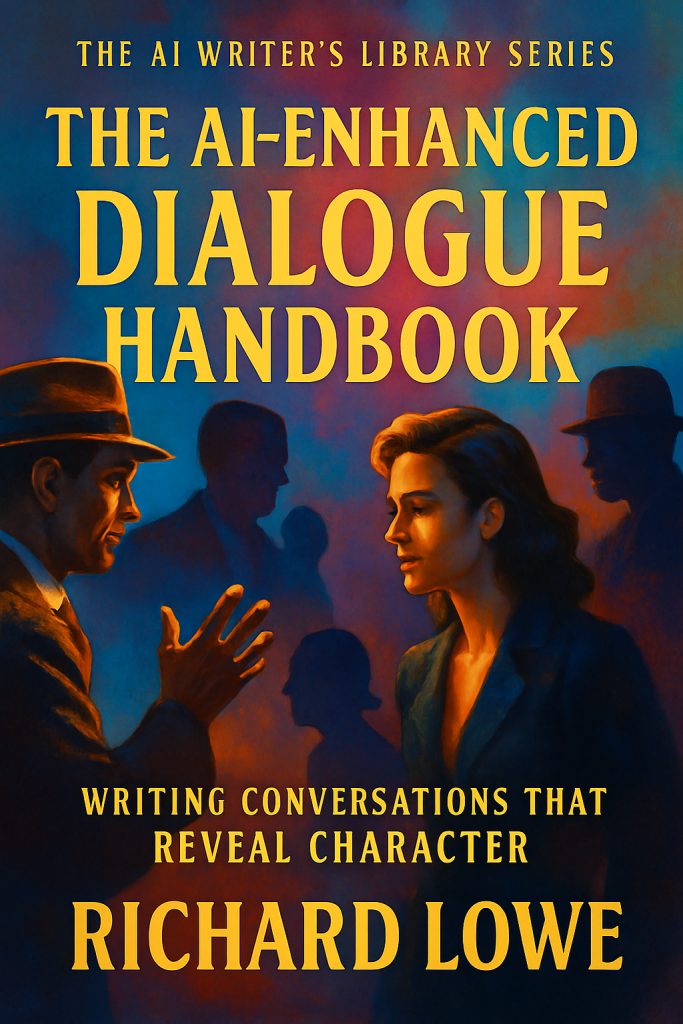
Dialogue Handbook
Write dialogue that sounds like different people wrote it. Attachment styles, defense mechanisms, subtext. 298-page guide from 113-book author. -

Point-Of-View Handbook
Psychology-first POV guide covering first person, third limited, omniscient, and multiple viewpoints. Gone Girl & Harry Potter case studies. AI prompts. 155 pages. -

Showing and Telling Handbook
Neuroscience-based showing guide covering embodied simulation, mirror neurons, and sensory gateway technique. AI prompts for testing immersion. 281 pages + 2 bonuses.