

The Voice Problem Nobody Talks About
Could a reader identify your characters by dialogue alone, with no tags? If the answer is probably not, you’re not alone. Most writers fail this test.
Every character in your manuscript went to the same finishing school. They pause at the same moments. They use “really” and “just” at identical rates. They all think in complete sentences with proper grammar.
Your villain sounds like your hero sounds like your sidekick sounds like the waitress who appears for three paragraphs.
Readers can’t articulate the problem. They’ll say the dialogue “felt flat” or “didn’t grab me.” What they mean: everyone sounds the same, and that sameness broke the spell.
Most dialogue advice focuses on cutting tags and avoiding adverbs. Useful, sure. But that’s editing advice, not voice creation.
The real problem happens earlier. You haven’t built distinct speech patterns for each character. You’re writing dialogue that sounds like written dialogue instead of people talking.
Here’s the test: Cover the dialogue tags in your manuscript. Read a page of conversation. Can you tell who’s speaking from word choice and rhythm alone?
Most writers fail this test. Not because they lack talent. Because nobody taught them the system.
I figured this out the hard way. Peacekeeper has characters from hundreds of different worlds. Shield of Ashes has Ukrainian presidents, Chinese submarine captains, Japanese-American admirals, and Filipina communications officers, each speaking English filtered through their native language and culture. Unlikely Hero throws two people from completely different backgrounds together under extreme stress, where their speech patterns reveal character faster than any backstory dump could. Every book forced me to build distinct voices or watch characters blur into the same person wearing different costumes. I had to build a system or drown.
Speech Patterns Are Built From Parts
Every person has a verbal fingerprint made of specific components:
Vocabulary range. A surgeon uses different words than a mechanic. Not just jargon. The entire relationship with language differs. One might say “optimal” where the other says “best.” One “ascertains” while the other “figures out.”
Think about education level, profession, region, generation. A 60-year-old rancher from Montana doesn’t reach for the same words as a 25-year-old software developer from San Francisco. Neither speaks wrong. They speak different.
Sentence length tendency. Some people speak in fragments. Clip everything short. Never waste a word. Others can’t stop a sentence once they’ve started, piling clause on clause until they’ve lost even themselves in the verbal maze, circling back to pick up threads they dropped three tangents ago. Most fall somewhere between.
Sentence length reflects how people think. Short sentences suggest action-orientation, impatience, or military/blue-collar background. Long sentences suggest academics, overthinkers, people who see complications everywhere.
Filler patterns. “Like” versus “you know” versus “I mean” versus no fillers at all. These tiny markers distinguish characters fast.
A character who says “basically” constantly differs from one who says “honestly” before every opinion. Neither filler means anything literally. Both reveal character. One wants to simplify. One wants to be believed.
Question habits. Some people turn statements into questions? With that rising inflection? Others never ask anything, even when they don’t understand. Some ask rhetorical questions to control conversations. Some ask genuine questions because they’re curious. Some ask questions to avoid making statements they’d have to defend.
Interruption tolerance. Does this character finish thoughts or let others cut them off? Do they bulldoze through interruptions or yield? Do they interrupt others? When?
Power dynamics show in interruption patterns. Who gets to finish speaking tells readers about relationships without exposition.
Verbal tics and pet phrases. Real people repeat themselves. They have go-to expressions. “At the end of the day…” or “The thing is…” or “Look…” as conversation starters.
One pet phrase per character creates instant recognition. Two feels natural. Five becomes parody.
Build these components per character and they’ll never sound alike again.
The Subtext Problem
Amateur dialogue puts everything on the surface.
“I’m angry at you because you forgot our anniversary and that makes me feel like you don’t value our relationship.”
Real people don’t talk like this. Real people talk around things.
“Fine. It’s fine. Have fun at poker.”
The anniversary isn’t mentioned. The anger comes through anyway. Readers feel smart because they caught what wasn’t said.
Every line of dialogue has three layers: what the character says, what they mean, and what they’re trying to accomplish. When all three align, the dialogue feels flat. When they conflict, the scene crackles.
A character says “I’m happy for you” while meaning “I’m devastated” while trying to preserve dignity. Three layers. One line. Readers lean in.
How Subtext Works In Practice
Two coworkers. One just got the promotion the other wanted.
No subtext (boring):
“Congratulations on the promotion. I wanted it, but you deserved it more.”
“Thanks. I know you wanted it too. I hope this doesn’t hurt our friendship.”
With subtext (alive):
“So. Corner office.”
“It’s not that big.”
“No, it’s great. Really. You’ll do great.”
“We should grab lunch sometime. Catch up.”
“Sure. Yeah. Let me know when you’re free.”
Neither character says what they feel. The passed-over coworker performs graciousness badly. The promoted one tries to minimize and reconnect but knows the relationship just changed. Readers feel the tension in what’s not said.
The Iceberg Principle
Hemingway called it the iceberg theory. The dignity of movement of an iceberg comes from only one-eighth of it being above water.
Your dialogue is the eighth above water. The other seven-eighths (character history, desires, fears, relationships, secrets) stay submerged but shape everything visible.
When you know your characters deeply, subtext happens naturally. They can’t say everything they think because real people don’t. The gap between thought and speech becomes automatic.
When you don’t know your characters, you write on-the-nose dialogue because you’re discovering what they think as they say it. The thought and speech match because both are being invented simultaneously.
Dialogue Tags: Less Than You Think
New writers overwrite tags.
“I don’t believe you,” she said skeptically.
The dialogue already conveys skepticism. The tag explains what we already understood. Cut “skeptically.”
Better: “I don’t believe you.”
Even better when action replaces the tag entirely:
She crossed her arms. “I don’t believe you.”
The crossed arms tell us the tone. The tag becomes optional.
When Tags Help
Tags serve two functions: identification and pacing.
Identification matters in conversations with more than two people, or when you’ve gone several lines without reminding readers who’s speaking.
Pacing comes from where you place the tag.
“I don’t believe you,” she said.
She said, “I don’t believe you.”
“I don’t,” she said, “believe you.”
Same words. Different rhythms. The middle placement creates a pause that emphasizes what follows.
Use “said” and “asked” for 90% of tags. They’re invisible. Readers skip past them. Fancy verbs (“exclaimed,” “interjected,” “queried”) draw attention to the author’s vocabulary instead of the characters’ words.
Save distinctive verbs for when they do real work. “Whispered” tells us volume. “Snapped” tells us tone that might not be clear from context. “Queried” just sounds pretentious.
Dialect Without Stereotyping
Regional speech adds flavor. Overdone, it becomes caricature.
Don’t write this:
“Well, I reckon y’all gonna hafta come on down to the holler and fetch some vittles, ya hear?”
Nobody can read it. And it reduces the character to an accent.
Write this instead:
“Come by the house. Mama’s cooking.”
Regional flavor comes from word choice (“come by” instead of “visit,” “Mama” instead of “Mom”) not phonetic spelling.
Give readers one or two regional markers and let them hear the rest. “Fixin’ to” tells us Southern without needing every dropped g transcribed.
Same principle applies to non-native English speakers. One or two markers of their first language influence. Not broken English that makes them seem stupid.
Try This: The Constraint Exercise
Pick your two most similar-sounding characters. Give each one a constraint:
Character A cannot ask questions. Must convert every question to a statement. “I wonder what time it is” instead of “What time is it?”
Character B cannot use contractions. Every “don’t” becomes “do not.” Every “can’t” becomes “cannot.”
Write a scene with these constraints. The dialogue will feel weird at first. By page two, each character will have developed distinct rhythm. You can relax the constraints in revision, but the differentiation often survives.
More Constraint Options
Character can only speak in sentences of five words or fewer. Character must include a metaphor in every other line. Character always deflects personal questions with questions. Character never uses “I” (must rephrase everything). Character ends every statement with a qualifier (“…I think,” “…maybe,” “…but who knows”).
Constraints are training wheels. They force differentiation until differentiation becomes habit.
AI Prompts That Actually Help
AI can’t write great dialogue. But it can analyze patterns you’re too close to see. For the full rundown on how AI fits into the writing process, the brainstorming guide covers the workflow.
Voice consistency check:
“Here are two dialogue samples from [CHARACTER NAME]. First sample: [paste]. Second sample: [paste]. Do these sound like the same person? Point to specific word choices, sentence structures, and speech patterns that match or conflict.”
Subtext diagnostic:
“In this exchange, what is each character trying to accomplish beyond the literal conversation? What do they want from each other that they’re not saying directly? [paste scene]”
Differentiation audit:
“Here are dialogue samples from three different characters in my manuscript. Can you identify which character is speaking from voice alone? What distinguishes each one? [paste samples without attribution]”
Speech pattern builder:
“My character is a [background]. Generate a speech pattern profile: likely vocabulary range, sentence length tendency, verbal fillers, education markers, regional influences. Don’t write dialogue. Just map the pattern.”
Tag and action balance:
“Review this dialogue scene for tag usage. Where am I over-tagging? Where do I need identification? Where could action beats replace tags? [paste scene]”
On-the-nose detector:
“Flag any dialogue in this scene where characters state their emotions directly instead of showing them through subtext or behavior. Suggest alternatives. [paste scene]”
These prompts turn AI into a diagnostic tool. You still write the dialogue. AI helps you see what you’ve written.
Common Dialogue Mistakes
Maid-and-butler dialogue. Characters telling each other things they both already know for the reader’s benefit.
“As you know, we’ve been partners for fifteen years and your wife left you last spring.”
Real people don’t say “as you know” and then say it anyway. Find another way to convey backstory.
Perfect articulation under stress. Your character is being chased by killers and delivers a paragraph of grammatically perfect complex sentences. Under stress, speech fragments. Thoughts don’t complete. People can’t find words.
Everyone sounds witty. Banter is fun to write. Not everyone banters. Some people are earnest. Some are dull. Some try to be funny and fail. Your cast shouldn’t all sound like sitcom writers.
Monologuing. Real conversation interrupts. Real listeners interject, question, react. Long speeches without interruption feel theatrical, not natural. Break up monologues with reaction, with interruption, with the speaker losing their train of thought.
Identical contractions. Everyone uses “don’t” and “can’t” and “won’t” at the same rate. In reality, some people contract everything, some use formal speech, some mix based on context.
The Real Secret
Good dialogue isn’t about cleverness or wit, though those help. Good dialogue creates the illusion that you’ve transcribed real speech while actually crafting something more interesting than real speech.
Real conversations wander. They bore. People say “um” and “uh” and circle back and repeat themselves. Transcribe actual speech and it reads as tedious.
Your job: capture the feeling of real speech while removing the tedium. Keep the interruptions and fragments and subtext. Cut the throat-clearing and repetition.
This is craft. Learnable. Systematic.
Free Stories, Straight to Your Inbox
Start with Nine Doors, nine short stories across nine genres, yours free the moment you sign up. After that, the occasional new collection and a note when there's a new book worth your time. No spam, no daily clutter. Just good stories.
We use MailerLite to manage our list and send these emails. Your address is used only to send you what you signed up for. We will not sell it, share it, or use it for anything else, and you can unsubscribe anytime.
Frequently Asked Questions
How do I make my characters sound different from each other?
Build a speech pattern profile for each character: vocabulary range, sentence length tendency, filler words, question habits, and pet phrases. A surgeon and a mechanic don’t just use different jargon. They have entirely different relationships with language. Map these components deliberately and your characters will never sound alike.
What is subtext in dialogue and why does it matter?
Subtext is the gap between what characters say and what they mean. Real people talk around things instead of stating them directly. “Fine. It’s fine. Have fun at poker” conveys more anger than “I’m angry you forgot our anniversary.” When characters say exactly what they feel, dialogue falls flat. When they hide, deflect, or perform, readers lean in.
How many dialogue tags should I use?
Fewer than you think. Use “said” and “asked” for 90% of tags because readers skip past them. Replace tags with action beats when possible: “She crossed her arms. ‘I don’t believe you'” tells us more than “‘I don’t believe you,’ she said skeptically.” Only use distinctive verbs like “whispered” or “snapped” when they do real work.
How do I write dialect without stereotyping characters?
Use word choice, not phonetic spelling. “Come by the house. Mama’s cooking” conveys Southern without being unreadable. One or two regional markers let readers hear the rest. The same applies to non-native English speakers: a few markers of first-language influence, not broken English that makes characters seem stupid.
Can AI help me write better dialogue?
AI can’t write great dialogue, but it can analyze patterns you’re too close to see. Use it to audit voice consistency across scenes, detect on-the-nose dialogue, check if characters sound distinct from each other, and build speech pattern profiles. AI is a diagnostic tool. You still write the dialogue.
Go Deeper
The AI-Enhanced Dialogue Handbook covers everything here and more: speech pattern construction for any character type, subtext techniques across genres, dialect and accent without stereotyping, dialogue in exposition, genre-specific conventions, and 40+ AI prompts for every dialogue problem you’ll face. Part of the AI-Enhanced Writing Series.
-
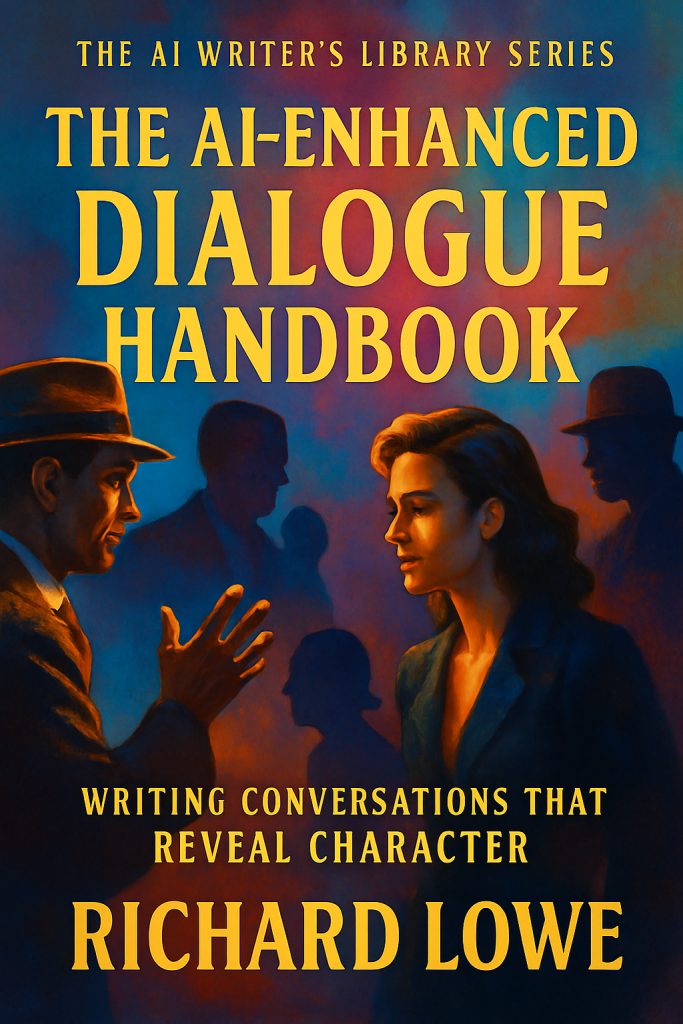
Dialogue Handbook
Write dialogue that sounds like different people wrote it. Attachment styles, defense mechanisms, subtext. 298-page guide from 113-book author.