
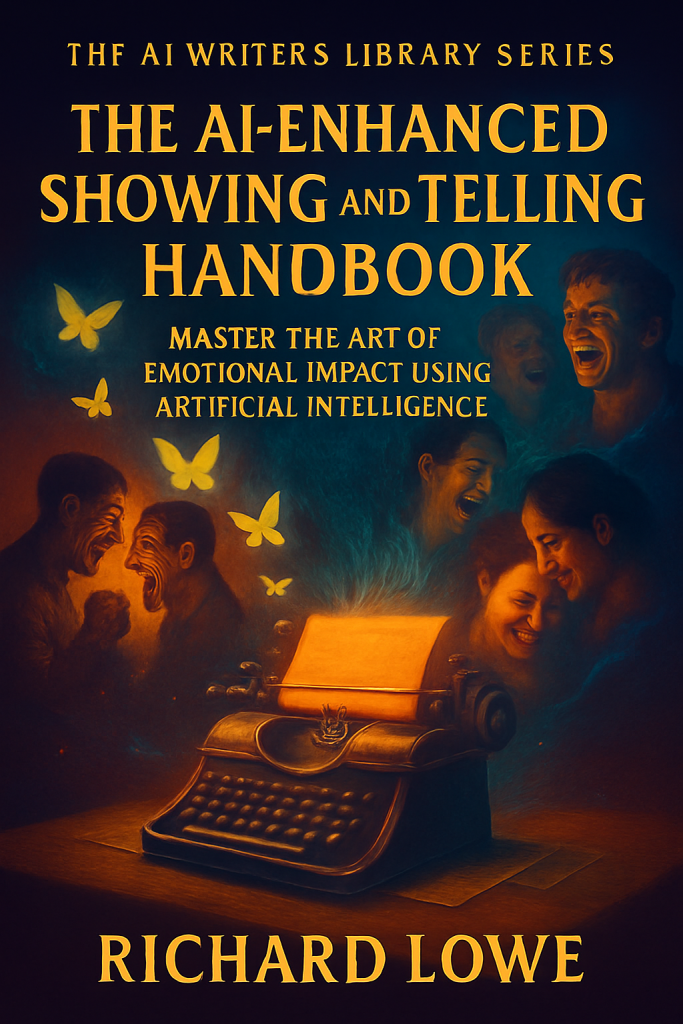
Showing and Telling Handbook
Modern movies are often made for people watching on their phones. Every emotional beat gets labeled. Every character motivation gets announced out loud. The audience isn’t trusted to feel anything that isn’t first explained to them, because the filmmakers know half the audience is checking Instagram and needs the subtitle when they look back up.
Ozark never does that. The Sopranos never does that. Hitchcock never did that. The shower scene in Psycho has no character turning to camera to announce the stakes. Bernard Herrmann’s strings hit the nervous system directly, before the brain catches up to name what it’s feeling. That’s not technique. That’s understanding how human neurology actually processes experience.
The writing equivalent is Karl Hendricks in Zombies, Murder, and Death. Karl never announces he’s becoming a monster. He explains each murder to himself as soul liberation, as cosmic purpose, as evidence of his partnership with Death. The horror isn’t what he does. The horror is how reasonable it sounds inside his head while he’s doing it. You sit inside the rationalization and feel it working on you, and the dread arrives before you can name what you’re feeling. The moment you step outside Karl’s consciousness and tell readers he’s delusional, you destroy the book.
Then there’s Biscuit, the Golden Retriever narrator of Detective Biscuit: The Neighborhood Sleuth, who is absolutely certain his partnership with Fluffball the Persian cat is strictly professional. He says this while nudging kibble in her direction when she isn’t looking. He says “not terrible” about the fish cake she left near his bowl, then eats it the moment she’s gone. When she throws herself against Mrs. Kowalski’s window glass during a storm, frantic, trying to direct help toward the injured dog in the street, Biscuit understands what she’s done before he names it. The story never announces they’re friends. Their friendship exists entirely in behavior, and the comedy exists entirely in the gap between what Biscuit says and what he does.
The same mechanism that makes Karl’s rationalizations horrifying makes Biscuit’s denials funny. Showing isn’t a dramatic technique reserved for serious fiction. It’s how all fiction creates reality. The reader’s nervous system processes the behavior and generates the emotion independently. Label it and you kill it, whether the label is “he felt monstrous” or “they were friends now.”
Marty Byrde never tells you he’s terrified. You watch him do the math. You watch him smile at the wrong moment. Tony Soprano doesn’t explain his psychology. You see the panic attacks, the ducks, the way he looks at his kids after a job. You do the work. The story trusts you to do it. The MCU doesn’t trust you. Neither does the new Star Trek or the new Star Wars. They explain everything because they’re competing with your phone. This handbook is for writers who want to do the opposite.
$29.95
One-time investment • Lifetime access • Instant download
14-Day Money-Back Guarantee
If this handbook doesn’t change how you approach scene construction and reader immersion, request a full refund. No questions.
Questions
The test I use: could this scene play without explanation and still land? Karl’s murders pass it. Biscuit eating Fluffball’s leftover fish cake the moment she’s gone passes it. The storm scene where Fluffball throws herself against Mrs. Kowalski’s window passes it completely. You don’t need a single word of narration to understand what Fluffball is doing and why. The behavior is the story.
The moment Biscuit announces “I think I love this cat,” the comedy evaporates. The moment you step outside Karl’s rationalizations to explain they’re wrong, the horror evaporates. The moment Hitchcock cuts to a character saying “that was terrifying,” the terror evaporates. Explanation destroys the neurological response it’s trying to describe.
That’s what this handbook teaches. Not rules about adverbs. Not techniques for describing shoelaces. The neuroscience of how readers’ bodies process fictional experience, and how to write scenes that hit the nervous system before the analytical brain has a chance to maintain its distance. Whether you’re writing psychological horror, cozy animal fiction, or crime drama, the mechanism is identical. Trust your readers to feel what you’ve built. Don’t explain it to them.
$29.95
One-time investment • Lifetime access • Instant download
14-Day Money-Back Guarantee
If this handbook doesn’t change how you approach scene construction and reader immersion, request a full refund. No questions.
Part of the AI Writer’s Library Series. See also: Deep Character Handbook | Conflict & Tension Handbook