

Both Sides Are Wrong
The writing community is having a meltdown over AI, and both sides are missing the point so completely it’s almost entertaining.
On one side, the purists. AI is the end of real writing. Using it means you’re a fraud. They’ll die on the hill of doing everything manually because suffering makes art more valid. They’re spending eight hours researching Victorian flower symbolism for one paragraph while feeling morally superior about it.
On the other side, the efficiency cult. They discovered ChatGPT writes entire blog posts in thirty seconds and decided their job was done. Copy, paste, publish. Their content reads like it was written by someone who learned English from instruction manuals and has never experienced a human emotion.
I’ve written 113+ books. I’ve ghostwritten 54+ more for clients. I’ve been doing this long enough to remember when spell check was controversial and people claimed it would destroy our ability to spell. (Most people still can’t spell. At least now their manuscripts are readable.)
Tools don’t ruin writing. Unskilled writers using tools badly ruin writing. And right now, a lot of writers are making bad decisions about AI because they’re arguing about philosophy when they should be asking one practical question: does this help me write better books?
The Debate Is Really About Fear
Writers who refuse to touch AI are terrified they’ll lose something essential. Like if a machine helps with research or structural organization, their creative spark will evaporate. They’re treating rough drafts like sacred texts emerging fully formed from tortured artist souls.
Writers who use AI to generate everything are terrified they’re not good enough on their own. They found a tool that makes them feel productive and mistook output volume for quality. They’re hiding behind the machine because facing a blank page with just their own thoughts is too frightening.
Both groups are letting fear make their decisions. Neither is asking the practical question: does this tool help me produce better work faster without turning me into a content robot?
What AI Does Well and Where It Falls Apart
I use AI every day. My clients have no idea, because the final product sounds like me. That’s the point.
AI is excellent at tedious structural work nobody wants to do. I can feed it 50,000 words of brain dump and ask it to show me what organizational patterns are hiding in the mess. It finds structure I can’t see because I’m too close to the material. That’s not cheating any more than using an editor is cheating.
AI handles research without deep expertise. When I was writing Shield of Ashes, I needed missile velocity data, weapon system specifications, and intercept calculations for a defensive scenario. AI gave me three viable missile types with their specs, walked me through the tracking and guidance systems, calculated velocity differentials, and provided realistic success rates. I picked the system that fit my plot timeline, verified the critical details, and wrote a technically accurate scene in two hours. The alternative was two days buried in military defense manuals. The scene didn’t get better because I suffered more.
AI helps when I’m stuck between scenes. I know what happened in scene A, I know what happens in scene B, and the bridge between them won’t come. I tell AI both scenes and ask for three possible connections. I pick one, completely rewrite it in my voice, and move forward. The alternative is staring at the screen for two hours feeling stupid.
When I wrote Behind the Wire, my grandfather’s World War II memoir, AI helped me organize hours of interview transcripts into chronological order, cross-reference dates, identify gaps, and flag contradictions in the timeline. Research that would have taken weeks got compressed into days. But AI didn’t write a single sentence of the final book. I wrote every word in my grandfather’s voice based on his interviews. AI was the research assistant and the organizational tool. I was the writer.
That’s the partnership.
But AI is terrible at voice. Every output sounds the same. It hedges with “it’s important to note” and “one might consider.” It uses “individuals” instead of “people” and “utilize” instead of “use.” Formal when it should be casual, vague when it should be specific, generic when it should be distinctive.
AI can’t write humor. It can identify where humor belongs, but the actual jokes land with the comedic force of a tax document. AI thinks humor is making a mildly unexpected comparison and then explaining why it’s funny. Not how comedy works.
AI is useless for emotional truth. Ask it to write a sad scene and you’ll get someone crying with tears streaming down their face while thinking about how sad they are. Real emotion doesn’t announce itself. It hides in the wrong details, the thing a grieving person notices that has nothing to do with grief. The Showing and Telling Handbook covers how to convey emotion through specific behavior instead of labeling feelings.
The Part Where I Make People Mad
If you’re refusing to use AI because you think it’s cheating, you’re not noble. You’re stubborn. And your stubbornness is costing you productivity for no benefit to anyone, least of all your readers.
Nobody cares how long your book took to write. Nobody cares how many hours you spent researching train schedules or Victorian architecture or police procedures. Readers care whether your book is good. If using AI to handle the research lets you spend more time on character development and emotional truth, you wrote a better book.
If you’re using AI to generate content you slap your name on, you’re not efficient. You’re lazy. And readers can tell.
I can spot AI-generated content in three sentences. It has a flat, generic quality where every statement could apply to anything. “This is an important topic many people are thinking about.” “There are several factors to consider.” “It’s essential to understand the context.” That’s not writing. That’s verbal filler wearing a word count.
Your AI-generated blog posts aren’t building an audience. They’re training readers to skip your content because they know it won’t contain anything worth reading. You’re producing noise, not signal. Volume doesn’t matter when nobody’s listening. The Revisions Handbook covers how to identify and strip AI patterns from your drafts so the final product sounds like a human being wrote it.
The Practical Position
Stop arguing about whether AI is good or evil. Start asking what helps you write better books.
AI handles tedious research so you spend more time on creative work. Use it for that. AI organizes messy rough drafts so you can see the structure you built. Use it for that. AI generates content that sounds like you? No, it doesn’t. Don’t even try. Rewrite everything. AI replaces your judgment about what’s good, true, or important? Never.
The writers succeeding right now aren’t on either side of this debate. They’re not arguing about AI ethics at conferences or defending AI output on Reddit or swearing they’ll never touch the technology. They’re quietly using it as a tool while everyone else fights about principles.
They’re finishing more books. Building bigger audiences. Making more money. And nobody knows they’re using AI because their work still sounds like a human being with opinions and scars and a specific way of seeing the world wrote every word.
Free Stories, Straight to Your Inbox
Start with Nine Doors, nine short stories across nine genres, yours free the moment you sign up. After that, the occasional new collection and a note when there's a new book worth your time. No spam, no daily clutter. Just good stories.
We use MailerLite to manage our list and send these emails. Your address is used only to send you what you signed up for. We will not sell it, share it, or use it for anything else, and you can unsubscribe anytime.
FAQ
Is using AI for writing cheating?
Is using spell check cheating? A thesaurus? A developmental editor? A research assistant you pay by the hour? AI is a tool. The creative decisions, the voice, the judgment about what’s good, those still come from you. The question isn’t whether you use AI. It’s whether your final work sounds like you and delivers value to readers. If the answer is yes, nobody cares what tools you used to get there.
How can I spot AI-generated content?
AI prose has fingerprints. Hedge phrases like “it’s important to note” and “one might consider.” Formal words where casual ones belong: “individuals” instead of “people,” “utilize” instead of “use.” Generic statements that apply to nothing specific. A flat, even rhythm that never surprises or delights. Once you learn the pattern, you see it everywhere, and you can’t unsee it.
What should I use AI for in my writing process?
Research synthesis, structural organization, brainstorming options, consistency checking, and technical verification. Anything that needs volume, pattern recognition, or information you don’t have at your fingertips. Not for generating prose you publish. Not for creative decisions. Not for anything requiring voice, humor, or emotional truth. AI is the research department. You’re the writer.
How do I use AI without losing my voice?
Never publish AI output directly. Treat everything it generates as raw material you transform completely. If AI brainstorms ten options, pick the seed of one idea and develop it yourself. If AI provides research, write the scene in your own words using the information. Your voice lives in your specific word choices, rhythms, and the way you see things that nobody else sees the same way. AI can’t replicate that. It doesn’t even know what it’s missing.
The AI-Enhanced Writer’s Library
The AI-Enhanced Writer’s Library breaks down character, dialogue, pacing, and two dozen other craft elements the same way. Why things work, not just that they work. Psychology-based instruction with AI prompts built in. 35+ guides and counting.
-

AI-Enhanced Series: AI Shortcomings
Free guide to AI failure modes. Hallucinations, context drift, AI language patterns, the cleanup checklist, and using Claude to catch Claude's mistakes. -
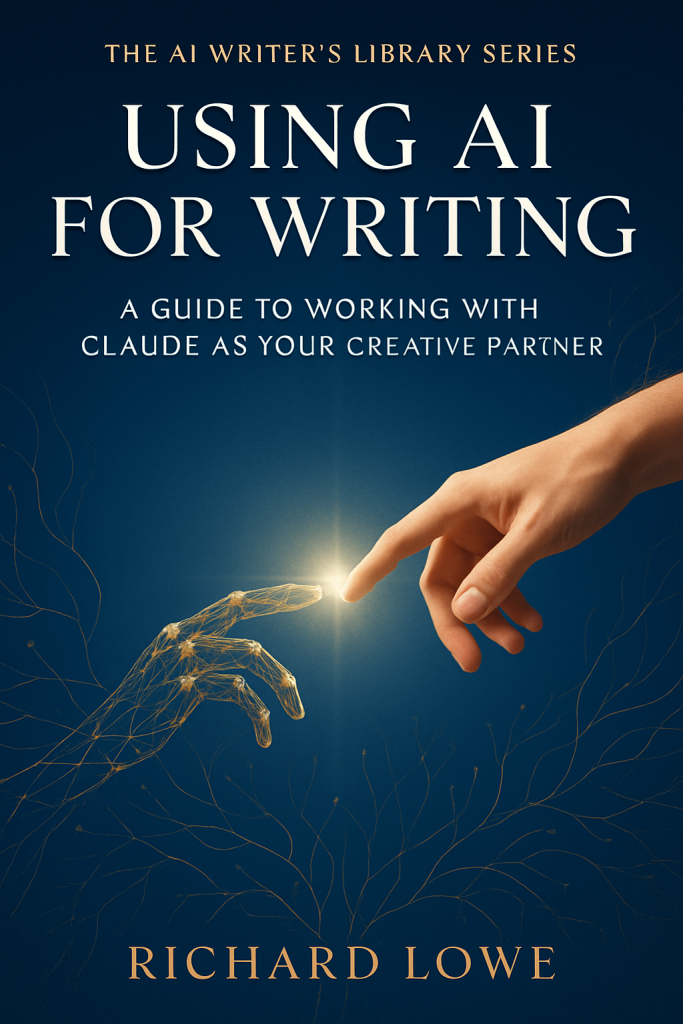
AI-Enhanced Series: Using AI for Writing
Free guide to using Claude for fiction writing. What AI does well, what it does poorly, the art of the prompt, and how to maintain your voice. Practical, not hype. -
AI-Enhanced Series: Purpose and Overview
Free guide to the AI-Enhanced Writer's Library. All 31 handbooks organized by category with descriptions and links. Find what you need, skip what you don't.