
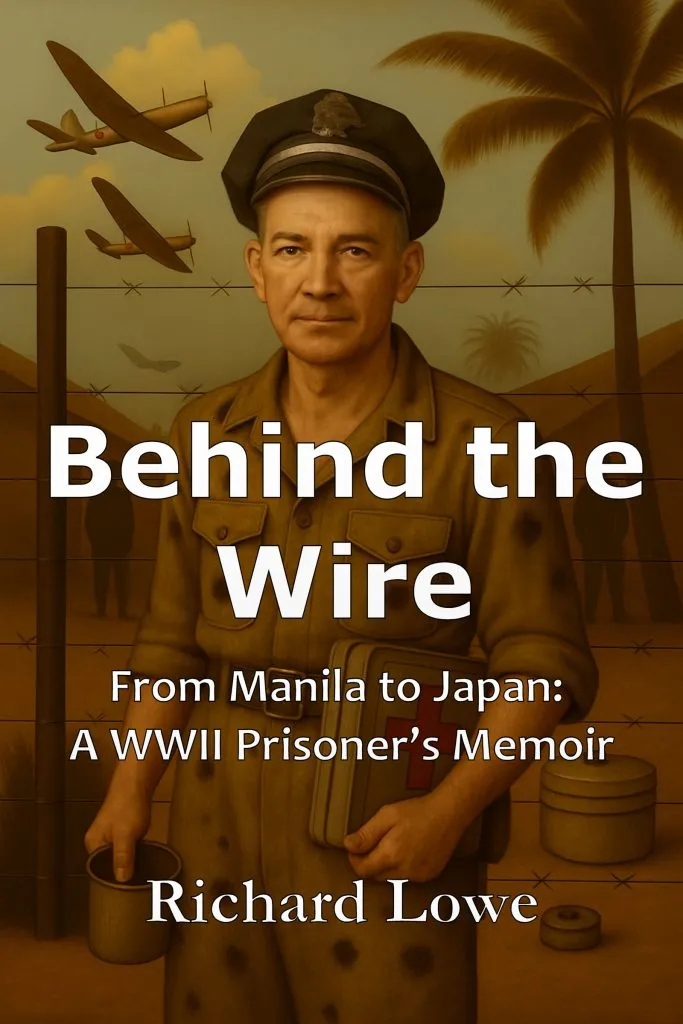
Behind the Wire
Three years and four months as a Japanese prisoner of war. Frank Hoeffer came home and wrote it all down from memory. Nobody wanted to publish it.
My first ghostwriting project started when I was seventeen. My grandfather handed me his World War II diary and asked me to turn it into a book.
My family warned me he was “weird” and “off his rocker.” What I found when I sat down with his diary was a man who had survived something most people cannot imagine and needed the world to know what happened.
He had served on the USS Oahu, part of the Yangtze River Patrol, before the Japanese invasion of the Philippines. In 1938, at nineteen years old, he crossed the Pacific and had no idea he was walking into the last years of peace. After the fall of Corregidor, he was marched through Manila as a prisoner. When I reviewed his journals decades later for the memoir, I discovered that detail had been conflated with the Bataan Death March in family retellings. It was not Bataan. It was its own nightmare.
He spent the next three years and four months as a prisoner of war in Japanese camps. Forced labor on the factory docks of Osaka. Scarce rations. Appalling conditions. Physical abuse. Dysentery and beriberi. Air raids that lit the sky for ten hours straight. The slightest perceived transgression met with severe punishment — four men shot in front of the entire camp so everyone understood what happened to people who ran.
Through all of it, Frank Hoeffer kept feeding people. It was the only thing he knew how to fight with. When there was nothing left, he made something from nothing. When the rations ran out, he found another way.
Publishers rejected the manuscript. They said the world had seen enough war books. My grandfather did not care. He was determined that his experiences would be recorded.
That project taught me what ghostwriting actually is. Not writing someone else’s words for them. Sitting with another person’s experience, understanding it deeply enough to put it on the page in a way that makes a reader feel what the original person felt. I was seventeen and I did not know what I was doing. But I knew that his story mattered and that getting it right was more important than getting it published.
The book was eventually published as Behind the Wire. It remains one of the most important things I have ever written.
Behind the Wire is the story of a Navy ship’s cook captured when Corregidor fell. From the bars and back alleys of Shanghai to the suffocating holds of the hell ships, through the factory docks of Osaka and the air raids that followed, Frank Hoeffer kept nine hundred men alive one meal at a time. He survived. He came home. He wrote it down.
The book documents not just how he stayed alive but how he stayed human. Those are two different problems, and the second one is harder. Character isn’t determined by circumstances. It’s determined by choices made moment by moment when everything around you is designed to make the right choice impossible.
He told these stories once, during Christmas visits in the late 1970s, to his grandson Richard. Then Alzheimer’s took them away. This memoir is reconstructed from Frank’s own written account of his captivity and from conversations that happened just in time.
| Amazon Kindle | Paperback (IngramSpark) | epub (Kobo) |
| 📖 Look Inside | Have a Story Like This? Let’s Talk | |
| ISBN: | 978-1-972810-17-0 (Paperback) |
| ISBN: | 978-1-972810-16-3 (eBook) |
| Publisher: | The Writing King |
| Publication Date: | April 7, 2026 |
| Print Length: | 184 pages |
| Language: | English |
Questions
[site_reviews_summary]
[site_reviews]
[site_reviews_form]
Read the Prologue
Prologue
Christmas Kitchen
The drive from Lake Arrowhead to Escondido was five hours of pure hell. My parents were arguing in the front seat about everything and nothing: money, directions, whose fault it was we were running late. My sister and I were trapped in the back, watching Southern California’s incomplete freeway system crawl past while listening to another round of greatest hits on the car radio. Who spent too much, who didn’t call ahead, who forgot to bring the right gift for whom.
Grandmother was waiting in the driveway before we’d even shut off the engine. She started complaining while our car doors were still opening. The suitcase was too heavy, we were later than expected, why didn’t we leave earlier like she’d told us to? Her smile appeared instantly when she noticed someone might be watching from a neighboring house, then vanished the moment she turned back to us.
I fled immediately to the TV room, sinking into the big easy chair surrounded by her obsessions. UFO magazines scattered across every surface, Erik von Däniken’s books about ancient astronauts stacked in towers, Buddha statues competing for space with alien conspiracy theories.
I’d read those von Däniken books cover to cover, all of them, several times over during previous visits. Chariots of the Gods, Gods from Outer Space, mysteries of vanished civilizations and ancient technology. I was seventeen, bored out of my mind, and desperate to disappear into theories about anything other than my family.
Christmas morning arrived quietly. Everyone sleeping off Christmas Eve tensions, the house finally still except for sounds coming from the kitchen. I needed to escape from that chair full of ridiculousness about visitors from outer space, from the atmosphere that had followed us across three counties. The kitchen offered refuge. No magazines about flying saucers, no family arguments, just the steady rhythm of someone working.
I found my grandfather already deep into Christmas dinner preparation. Standing straight as an arrow while dicing onions for stuffing. Every movement precise, practiced. Knives sharp, cutting board clean, and his ingredients arranged with military efficiency. He had the timing calculated to feed fifteen people without a single dish going cold, the kind of logistical planning that looked effortless but revealed decades of experience feeding hungry men under pressure.
The kitchen smelled like sage and butter, onions sweating in cast iron. Steam rose from pots on every burner. He moved between stove and counter without wasted motion, checking seasoning with a wooden spoon, adjusting heat with quick twists of his wrist.
My parents had mentioned he could be moody, made an irritating noise with his teeth, and kept to himself mostly. But watching him work, I saw something different. This man took feeding people seriously. He couldn’t stand the thought of someone leaving his table hungry. The care was there in every careful measurement, every tested seasoning, buried under years of gruffness and distance.
Every few minutes, that sharp intake of air through his teeth. The sound that drove everyone crazy but seemed necessary for his concentration. His Navy posture never left him, even while stirring gravy or checking the oven. This was his domain, the one place where whatever had made him difficult transformed into something useful, something generous.
After the morning feast was finished and the dishes cleared, the family scattered to digest and complain about other things. We moved to the living room. The afternoon light slanted through windows, dust motes drifting in the warm air. He settled into his comfortable easy chair, worn brown leather that molded to his frame. I took one of those metal folding chairs they kept stacked in the hall closet, the kind with vinyl padding that stuck to your legs. The physical discomfort seemed appropriate somehow. I was the outsider here, the one asking for something.
“You want to know about the war?” he said, glancing at me while making that familiar sucking sound through his teeth. “It didn’t start with Pearl Harbor for me.”
What followed would take years for me to fully understand. The stories came in pieces, fragments, sometimes prompted by a question, sometimes emerging from long silences. He’d pause mid-sentence to make that noise with his teeth, straighten his already perfect posture, then continue with some details about Shanghai or Manila or places I’d never heard of.
It would take several conversations for me to understand why he cooked with such fierce intensity, why he always made too much food, why he watched everyone’s plate to make sure they ate enough. The abundance of every meal was his quiet rebellion against memories he’d carried for forty years without talking about them.
This man who couldn’t let anyone leave his table hungry had once been starved nearly to death for three years and four months.
The conversations happened just in time. Years later, Alzheimer’s would steal both the stories and the man who could tell them, but for those few Christmas visits when I was a teenager, his mind was still sharp enough to trust me with everything that had shaped him. While other family members complained about his moods and avoided his presence, I sat on that uncomfortable folding chair and learned what it meant to survive hell and emerge still willing to feed anyone who walked through your door.
These were the stories no one else had asked for. This was the inheritance no one else had wanted.
This was how I learned that feeding people isn’t just kindness…sometimes it’s the only way left to fight a war that never really ended.