

What the Wall Actually Is
You started your writing session ready to work. You had the time blocked. You had the coffee. You had the document open.
Then nothing happened.
Not the productive nothing where ideas percolate in the background. The empty nothing. The kind where you stare at the ceiling and wonder if you ever actually knew how to write at all. The kind where you cancel commitments, disappoint clients, and watch your cat follow you room to room because even she knows something broke.
This is what happens when the wall shows up. Not writer’s block in the romantic, struggling-artist sense. Something else. A real phenomenon that hits working writers at every level, without warning, without explanation.
The wall isn’t lack of discipline. It isn’t laziness. It isn’t “you just don’t want it enough.”
It’s a genuine psychological phenomenon that happens to creative people. One day you’re productive. The next day the part of your brain that makes things has closed for business and left no forwarding address.
I’ve written 113+ books, including this entire handbook series. I can produce 15,000 words in an 18-hour hyperfocus session when everything aligns. Last week I produced zero words and stared at the ceiling while a client email sat unanswered and an event got canceled a day before start time.
Experience doesn’t protect you. Track record doesn’t protect you. The wall doesn’t check credentials before it shows up.
Why It Happens
I don’t know. Nobody does.
There are theories. Burnout, creative cycles, neurochemistry, accumulated stress presenting its invoice. Some of these might be partially true. None of them are satisfying when you’re in it, and none of them reliably prevent the next occurrence.
The honest answer is that the wall shows up when it shows up. You can do everything right (sleep, exercise, routine, boundaries) and still wake up one morning to find that motivation has vanished like it was never there.
The Writer’s Block Handbook covers The Four Types of creative blocks and their specific fixes. But even with that knowledge, the wall still finds you sometimes. Knowing the territory doesn’t mean you never get lost.
The Voice That Comes With It
The worst part isn’t the lost productivity. It’s the voice.
The one that whispers maybe this time it won’t pass. Maybe you’ve finally emptied the tank. Maybe the other books used up whatever you had. Maybe everyone was just being polite about your work this whole time.
That voice is a liar. But it’s convincing when you’re horizontal and the ceiling has no answers. It exploits the vulnerability of the moment to say things that would sound ridiculous on a productive Tuesday but feel absolutely true when you can’t string a sentence together.
The voice conflates temporary inability with permanent failure. It treats a bad day as evidence of fundamental inadequacy. This is the same cognitive distortion that makes people catastrophize in other areas of life, and it’s no more accurate here than anywhere else.
Your track record is real. The work exists. It didn’t write itself.
What Coming Back Looks Like
Coming back doesn’t feel like triumph. It doesn’t arrive as a surge of inspiration or a breakthrough insight.
It feels like movement where there wasn’t any. Then a little more movement. Then you look up and two hours have passed.
For me, last week, it started because I had obligations I couldn’t cancel twice. Client meetings. A manuscript deadline for someone counting on me. The work existed whether I felt like doing it or not.
So I opened the file. Started making changes. The first hour was mechanical, words like pushing rocks uphill, no confidence any of it was good. But somewhere around the third paragraph, the friction eased. Just slightly. The next sentence came easier than the one before.
The wall doesn’t lift and then you return to work. You return to work (mechanically, badly, without confidence) and somewhere in the returning, the wall starts to crumble.
What This Means for Your Writing Life
If you’re building a writing career, the wall will find you. Probably multiple times. Knowing a few things might help when it does.
It passes. It doesn’t feel like it will when you’re in it, but it does. Every time so far, for me and every working writer I know. The voice that says this time is different is the same liar it always was.
Showing up matters more than feeling ready. Waiting until you feel inspired to write means waiting until the wall decides to leave on its own. Sometimes that works. More often, the act of showing up is what makes the wall start to crumble.
Hitting the wall isn’t a referendum on your talent. It hits productive writers and struggling writers alike. It’s not a sign you’re in the wrong field or that you should quit. It’s just a thing that happens, like weather. You don’t take a rainy day as evidence that the sun no longer exists.
External structure helps. Deadlines, client obligations, accountability partners, scheduled sessions. When internal motivation fails, external structure can carry you until it returns. This isn’t weakness. It’s using the tools available.
The Productivity Handbook covers building systems that produce finished manuscripts regardless of how you feel on any given Tuesday. The wall is one of the reasons those systems matter.
The Difference Between the Wall and Other Problems
Not every creative struggle is the wall. Sometimes you’re stuck because the story has a structural problem. Sometimes you’re blocked because you’re trying to write the wrong scene. Sometimes motivation is low because the project isn’t right for you.
The wall is different. It’s not project-specific. It hits regardless of what you’re working on. The document could be a novel you love or a client piece you’re indifferent to. The wall doesn’t care about the content. It’s a system-wide shutdown, not a localized malfunction.
If you’re struggling with one specific project but could write something else fine, that’s not the wall. That’s a signal to examine what’s wrong with the project. The Writer’s Block Handbook helps diagnose the difference.
Free Stories, Straight to Your Inbox
Start with Nine Doors, nine short stories across nine genres, yours free the moment you sign up. After that, the occasional new collection and a note when there's a new book worth your time. No spam, no daily clutter. Just good stories.
We use MailerLite to manage our list and send these emails. Your address is used only to send you what you signed up for. We will not sell it, share it, or use it for anything else, and you can unsubscribe anytime.
Frequently Asked Questions
How long does hitting the wall usually last?
It varies. Sometimes a day. Sometimes a week. Rarely longer than that if you keep showing up. The duration often shortens when you stop waiting for it to pass and start working through it mechanically. Waiting for inspiration tends to extend the wall. Working anyway tends to shorten it.
Should I push through or rest when I hit the wall?
Both answers can be right depending on the situation. If you’re genuinely exhausted and running on fumes, rest serves better. If you’re not depleted but motivation simply vanished, showing up anyway usually works better. The Writer’s Block Handbook covers how to diagnose which situation you’re in.
Does hitting the wall mean I’m not meant to be a writer?
No. It means you’re a writer. Every working writer hits the wall. The ones who make careers aren’t the ones who never struggle. They’re the ones who keep going despite the struggle. Hitting the wall is part of the job, not disqualification from it.
How can I prevent hitting the wall?
You probably can’t prevent it entirely. You can reduce frequency by maintaining good physical health, managing stress, protecting creative energy, and building sustainable routines. But even doing everything right, the wall sometimes shows up anyway. Accepting that it will occasionally happen makes it less catastrophic when it does.
The AI-Enhanced Writer’s Library
The AI-Enhanced Writer’s Library breaks down character, dialogue, pacing, and two dozen other craft elements the same way. Why things work, not just that they work. Psychology-based instruction with AI prompts built in. 35+ guides and counting.
-
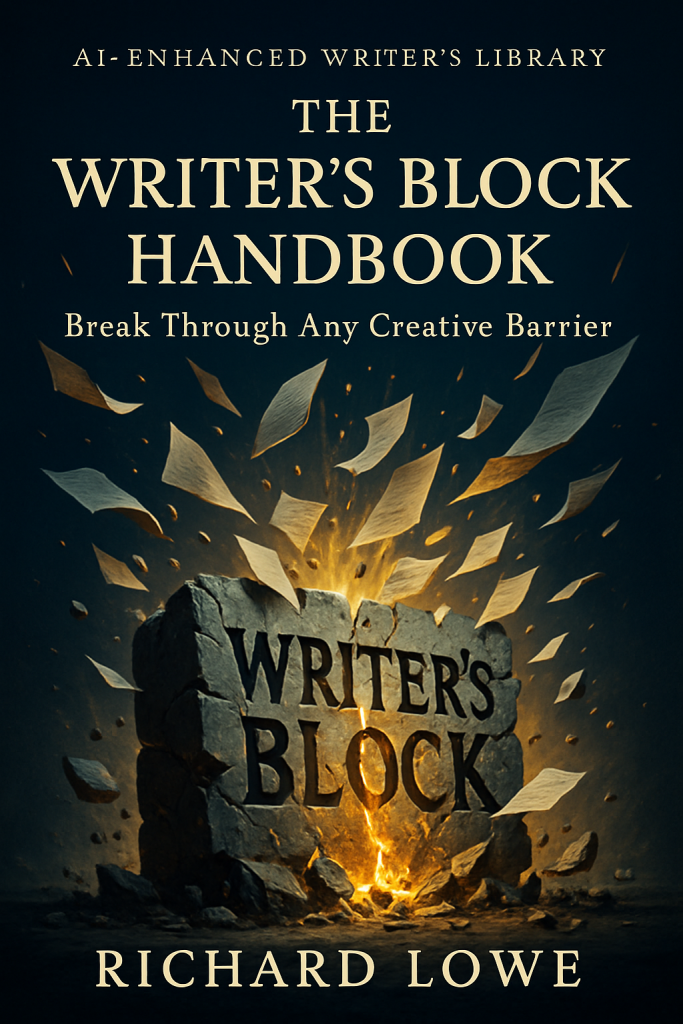
Writers Block Handbook
Neuroscience-based writer's block guide covering four block types (anxious, angry, apathetic, disappointed). Emergency protocols & AI prompts. ADHD chapter. 153 pages. -

Writer’s Productivity Handbook
Psychology-first productivity guide covering completion phobia, perfectionism, and resistance. AI platform comparison (Claude, ChatGPT, Gemini). 131 pages.