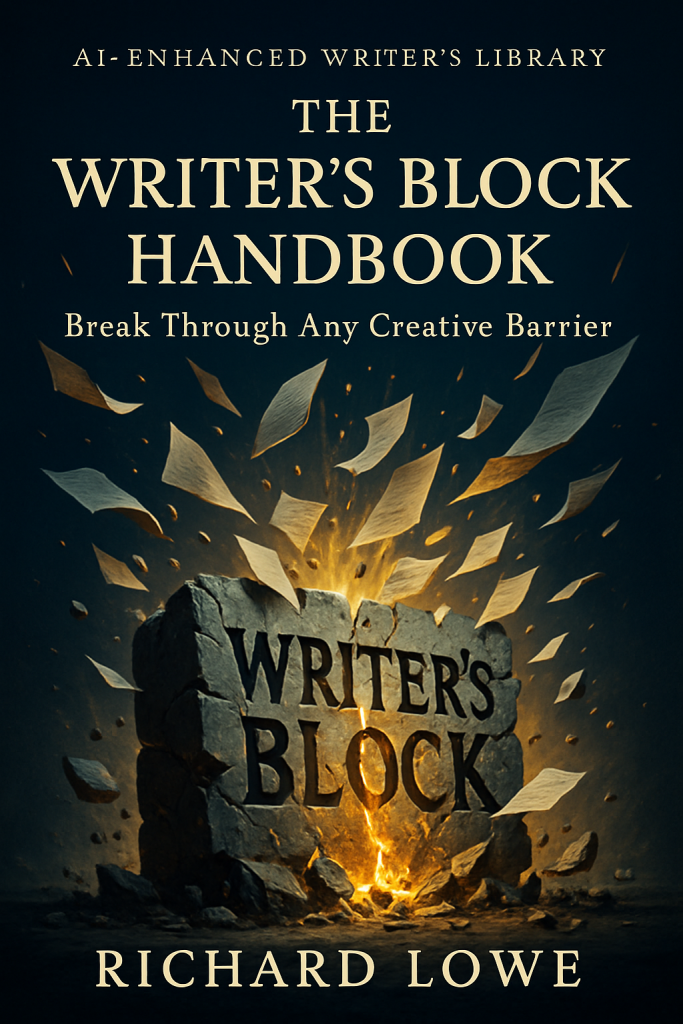
I write four to ten books at a time.
When I hit a wall on one, I move to another. Or I take a walk. I can’t afford writer’s block — writing is my living, and my living requires that words get produced regardless of whether any particular project is cooperating on any particular day. So I built a system where block on one book is just a signal to rotate, not a reason to stop.
Most writers treat writer’s block as a crisis because they have one project. When it stalls, everything stops. They sit at the keyboard trying to force words that won’t come, or they walk away from writing entirely until the muse returns. Neither approach produces books. The portfolio approach does. Book A stalls at chapter seven? Book B is waiting. Book B feels flat today? Book C needs a scene written. The block that would shut down a single-project writer is just a rotation cue in a multi-project workflow.
The walk isn’t giving up. Walking works neurologically — it shifts blood flow, quiets the prefrontal cortex that generates the inner critic, and activates the default mode network where creative ideas actually form. The solution to a stalled scene often arrives fifteen minutes into a walk not because inspiration is mystical but because you stopped actively blocking it. When you sit at a keyboard forcing a scene that won’t come, you’re keeping the critic engaged. When you walk, you let the creative system do what it does when it’s not being supervised.
I’m AuDHD, diagnosed at 50 after decades of boom-bust creative cycles. The portfolio system works with that neurology instead of against it. Hyperfocus locks onto whichever project is alive that day. When it releases, you rotate rather than grind. The books get written because you’re always working on something, not because you muscled through every block on a single manuscript.
But the portfolio approach only solves the productivity problem. It doesn’t tell you why any particular book is stalling, which matters when you need to go back to it. That’s where the four-type framework comes in. Yale researchers Singer and Barrios spent months studying blocked writers and found they weren’t all blocked the same way. The perfectionist frozen by fear needs different medicine than the writer whose imagination has gone dark. The writer blocked by anger at external judgment needs different interventions than the writer whose motivation collapsed without validation. Knowing which type you’re dealing with tells you exactly what to do when you rotate back.
I’ve published 113+ books. Writer’s block has never stopped production because I never gave it the chance. This handbook teaches you both the system and the diagnosis.
$9.95
One-time investment • Lifetime access • Instant download
Get The Handbook →
14-Day Money-Back Guarantee
If this handbook doesn’t help you break through your creative blocks, request a full refund. No questions.
The Four Types of Writer’s Block
Based on Yale research by Singer and Barrios. Every blocked writer was unhappy, but not in the same way. The unhappiness clustered into four distinct profiles — each with different triggers, different emotional signatures, and different paths to recovery. The fix for one type makes another type worse.
Block Type
What It Feels Like
Root Cause
Anxious
Fear of failure, grinding dread, constant self-editing
Perfectionism, inner critic
Angry
Rage at comparison, irritability, fear of judgment
External criticism, envy avoidance
Apathetic
Creative deadness, can’t visualize, nothing interests you
Imagination shutdown, burnout
Disappointed
Motivation depends on validation, checking stats constantly
External validation dependence
The handbook includes a diagnostic quiz to identify your dominant type and targeted interventions for each. Telling an apathetic writer to lower their standards doesn’t help — their problem isn’t high standards. Their imagination is dead. They need stimulation, not permission.
Questions
What if I only have one project? I can’t just rotate to another book.
The portfolio approach is one solution — not the only one. The handbook covers the full toolkit for single-project writers: the garbage draft (deliberately writing the worst possible version to bypass the inner critic), the private file (writing scenes no one will ever see to release pressure), the wrong genre switch (writing something completely different for twenty minutes to reset the creative system), and the walk protocol for activating the default mode network when the prefrontal cortex is running too hot. You don’t need four books in progress to make block irrelevant. You need options, and the handbook gives you a full set of them.
How do I know which of the four types I’m dealing with?
The handbook includes a diagnostic quiz based on the Singer and Barrios research. The patterns are usually recognizable once you know what to look for. Anxious block feels like dread and self-editing — you write a sentence, reread it, change a word, reread it, delete the whole thing, and an hour passes with twelve words on the page. Angry block feels like irritability and resistance to external judgment. Apathetic block feels like creative flatness — you can’t visualize scenes, can’t generate ideas, nothing interests you. Disappointed block shows up as compulsive stats-checking and motivation that collapses without audience response. Most writers have a dominant type with occasional visits to others.
Why does taking a walk actually help?
Because the block usually isn’t a creativity problem — it’s a prefrontal cortex problem. Your inner critic lives in the prefrontal cortex, and when it’s running hot, it vetoes ideas before they reach conscious awareness. You experience this as “nothing comes.” Walking quiets the prefrontal cortex and activates the default mode network — the part of your brain that generates creative ideas when it’s not being supervised. The solution to a stalled scene often arrives fifteen minutes into a walk because you stopped actively blocking it. This isn’t mystical. It’s what the default mode network does when you leave it alone.
One harsh critique knocked me out for weeks. Is that a weakness?
No. Your brain processes criticism using the same neural circuits it uses for physical pain. A harsh review isn’t just emotionally unpleasant — it’s neurologically painful in a documented, measurable way. The writers who bounce back faster aren’t tougher. They’ve built psychological armor that lets criticism sting without destroying momentum. The handbook covers how that armor gets built and why it works differently for each block type. Angry-type writers and anxious-type writers both get knocked out by criticism, but they get knocked out differently and need different recovery protocols.
I have ADHD. Standard productivity advice never works for me.
Standard advice assumes neurotypical dopamine systems. ADHD block operates differently — dopamine scarcity makes starting feel impossible regardless of how much you want to write, rejection sensitive dysphoria means criticism hits harder and lasts longer, and the boom-bust cycle of hyperfocus followed by flatness looks like block but isn’t. The handbook includes a full chapter on ADHD-specific unblocking written by an AuDHD author who’s navigated these cycles for decades. The portfolio rotation system works particularly well with ADHD neurology — you follow the hyperfocus to whichever project is alive rather than forcing engagement with whichever one you’re “supposed” to be working on.
How do AI prompts help with writer’s block?
AI becomes useful when you’re blocked not for writing your book but for breaking the paralysis. When you can’t visualize a scene, AI can describe it multiple ways until something clicks. When your inner critic won’t shut up, AI can generate ten imperfect options that give you something to react against. When you’re stuck on what happens next, AI can produce possibilities in seconds — you won’t use most of them, but one might spark something. The handbook includes type-specific prompts because different block types need different approaches. The anxious writer needs permission to be imperfect. The apathetic writer needs novelty and stimulation. Generic “help me write” requests don’t address the actual block.
Refund policy?
14 days. If it doesn’t help you understand and break through your creative blocks, full refund. No questions.
Writer’s block has never stopped my production because I never gave it a single point of failure to attack. Four to ten books in progress means block on any one of them is just a rotation cue. And when I come back to a stalled book, I know which of the four types I’m dealing with and exactly what to do about it.
That’s the system. Rotation plus diagnosis. The handbook gives you both.
$9.95
One-time investment • Lifetime access • Instant download
Get The Handbook →
14-Day Money-Back Guarantee
If it doesn’t help you break through your creative blocks, request a full refund. No questions.
Part of the AI Writer’s Library Series. See also: Writer’s Productivity Handbook | ADHD Writer’s Handbook