
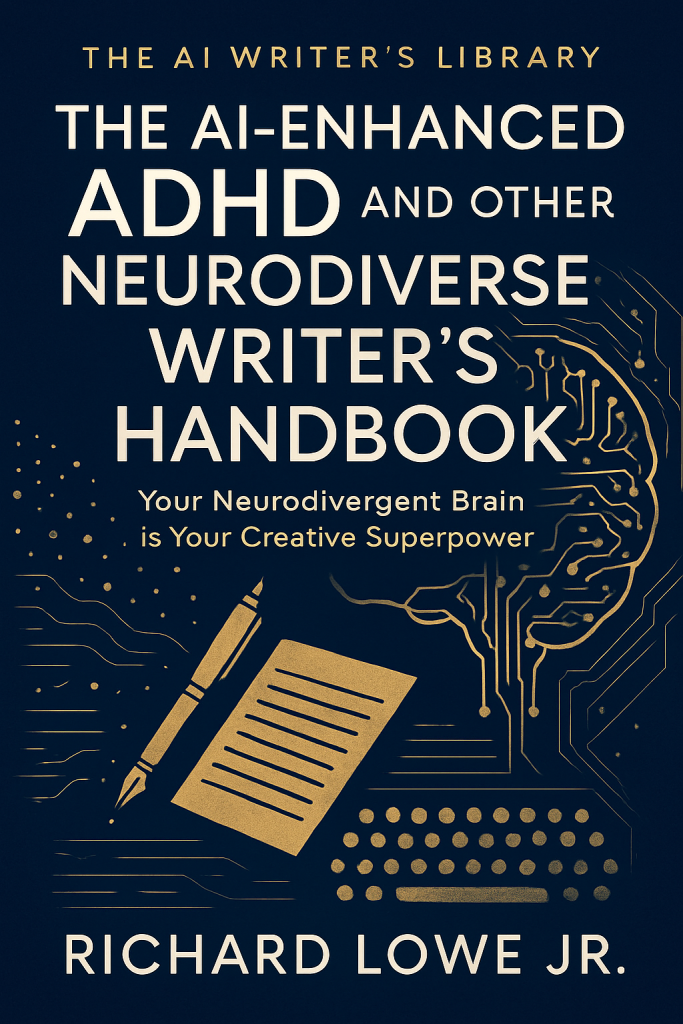
ADHD Writing Handbook: Systems That Work With Your Brain
The first skill I developed as a writer was reading faces.
Not for craft. For survival. I grew up in what I now call Crazytown — nineteen years in a household where the rules changed without warning, where the people who were supposed to protect me were often the ones I needed protection from, where predicting the next explosion before it arrived was a practical necessity. You learn to read micro-expressions when the alternative is getting blindsided. You develop pattern recognition when chaos has no consistent rules and the only way to find the pattern is to watch everything simultaneously. You build organized thinking to navigate an environment that punishes unpredictability, because if you can’t control what happens around you, you control what happens inside your own head.
I disappeared into books for hours as a child. That wasn’t a hobby. It was a survival mechanism — the only reliable exit from an environment I couldn’t change. What it built, without my knowing it was being built, was the capacity for total immersion. The hyperfocus that now lets me write complete handbooks in a single session. The ability to live inside a character’s psychology so completely that their voice becomes more accessible than my own. The emotional distance that lets me sit with someone else’s most difficult material and organize it into narrative without losing myself in it.
Crazytown built the tools. I spent decades using them professionally without understanding where they came from. VP of Consulting at twenty. Thirty-three years in enterprise technology, twenty of them running critical systems as Director of Computer Operations at Trader Joe’s — building infrastructure that kept billion-dollar supply chains running when components failed, which required exactly the same redundancy thinking and external scaffolding that my childhood had already taught me. Then 113+ published books. Ghostwriting manuscripts that secured over $30 million in venture capital for clients. All of it running on systems I’d built without knowing what I was building them for.
At 64, I was diagnosed AuDHD. The diagnosis didn’t reveal something new. It named what had always been true. The pattern recognition that catches character inconsistencies three chapters before they become problems — architecture. The hyperfocus sessions that produce entire handbooks in a day — architecture. The working memory failures that require external scaffolding — constraints to engineer around, the same way you engineer around any physical constraint in a system you’re building. Not deficits. Design specifications.
Christian Wolff in The Accountant is the clearest illustration I know of what this actually means in practice. His autism isn’t a superpower in the motivational-poster sense. It’s a specific set of capabilities and constraints that shaped a specific life under specific pressure. He can track numbers at a level that makes him invaluable and dangerous. He cannot leave a task incomplete without real distress. Those aren’t separate traits — they’re the same architecture operating in different contexts. The film treats neurodivergence as design, not inspiration, and that’s why it works as a story.
AuDHD writing isn’t a disability that occasionally produces advantages. It’s a different architecture that neurotypical systems were never designed for. Every planner, every timer, every “just write 500 words a day” prescription assumes executive function you don’t have in that form, and emotional regulation patterns your brain never needed because it found other solutions — often in childhood, under pressure, without anyone naming what it was doing. Your brain built workarounds for decades before anyone told you what it was working around. This handbook teaches you to use those workarounds deliberately instead of accidentally, and to build the ones you’re still missing.
The engineering discipline from Trader Joe’s transfers completely to writing infrastructure. Redundancy. External tracking. Failsafes. Systems that keep running when components fail. This handbook is the transfer document — written by someone who spent 64 years figuring out what the architecture actually was, and another decade learning how to build for it on purpose.
$29.97
One-time investment • Lifetime access • Instant download
14-Day Money-Back Guarantee
If this handbook doesn’t change how you approach writing with your neurodivergent brain, request a full refund. No questions.
Questions
Crazytown built the tools before I knew I needed them. The hypervigilance that made childhood dangerous became the pattern recognition that makes me good at my work. The emotional distance that complicated personal relationships became the ability to sit inside someone else’s difficult material without losing myself in it. The disappearing into books that was a survival mechanism became hyperfocus. The organized thinking I built to navigate chaos became the systems architecture that keeps 113+ books worth of projects moving.
The diagnosis at 64 didn’t give me new tools. It gave me the explanation for why the tools I’d already built — the ones that emerged from nineteen years in Crazytown and twenty years at Trader Joe’s and decades of ghostwriting other people’s most difficult stories — were the right tools. I’d spent a lifetime building the correct solution without knowing what problem I was solving.
That’s what this handbook is. Not inspiration. Not neurotypical advice with ADHD branding. The architecture document, written by someone who spent 64 years figuring out what the architecture actually was, starting from a childhood that accidentally built it.
$29.97
One-time investment • Lifetime access • Instant download
Start Writing With Your Brain, Not Against It →
14-Day Money-Back Guarantee
If this handbook doesn’t change how you approach writing with your neurodivergent brain, request a full refund. No questions.
Part of the AI Writer’s Library Series. See also: Writer’s Block Handbook | Productivity Handbook
Everything in this handbook comes from lived experience and decades of trial and error, not clinical training. I’m an AuDHD writer, not a healthcare provider. This is craft advice, not medical advice.