My parents didn’t want me watching horror.
Which meant I watched it anyway. That’s how forbidden things work, especially for a kid who already understood that the adults keeping something from you were telling you it had real power. I watched whatever I could get away with, whenever I could get away with it, and I paid close attention to what it actually did.
Then I watched it scare my sister.
Not a metaphor. Something she saw genuinely got into her — the way real horror does when it works — and stayed. I watched that happen and understood something about the medium that no amount of reading about it could have taught me. Horror that works doesn’t just entertain. It colonizes. It follows people out of the room, into the dark, into the moments when they’re alone and something moves at the edge of vision. My sister wasn’t entertained. She was marked.
That’s what the genre is capable of at its best. And that’s what most horror writing fails to achieve — not because the writers aren’t talented, but because they’re focused on content when they should be focused on psychology. More monsters. More gore. More jump scares. None of it matters if you don’t understand how fear actually operates in the brain, why people seek controlled terror in the first place, and what the difference is between a scare readers see coming and dread that accumulates until they can’t stop reading even though they want to.
I wrote the Grim anthology to understand this from the inside. Thirty stories about Death and the people who encounter him, calibrated across a spectrum from dark to darkly funny, each one a different attempt to find the specific frequency of unease that gets under skin without losing humanity. That project taught me more about horror craft than anything I’d read about it — because writing toward genuine dread is different from analyzing it, and failing to achieve it in a first draft shows you exactly where the psychology broke down.
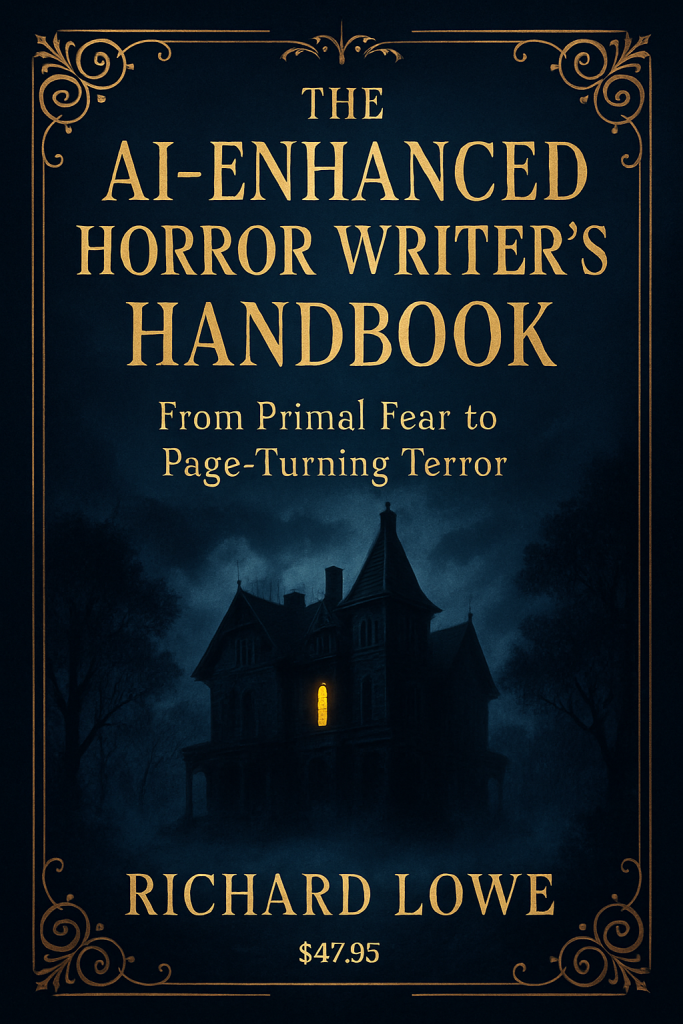
I’m Richard Lowe. 113 published books, one anthology that taught me what fear actually requires, and a childhood’s worth of forbidden horror that showed me what the genre does to people when it works. This handbook is built on all of it.
$29.95
One-time investment • Lifetime access • Instant download
Get The Handbook →
14-Day Money-Back Guarantee
If this handbook doesn’t change how you approach horror, request a full refund. No questions.
Seven Horror Subgenres
Each subgenre makes different promises to readers. Understanding which contract you’re signing shapes every craft decision.
Subgenre
Reader Expectation
Core Technique
Psychological
Sustained ambiguity, unreliable narration
Two parallel storylines, both internally consistent
Supernatural
Real entities with consistent rules
Mythology that terrifies without over-explaining
Cosmic
Existential dread, dangerous knowledge
Suggesting the incomprehensible without becoming vague
Gothic
Atmosphere, decay, buried secrets
Place as character, unhurried revelation
Survival
Body count, resource scarcity
Group dynamics under pressure, earned survival
Body
Physical transformation, visceral detail
Horror grounded in flesh readers feel in their own bodies
Quiet
Subtle unease, lingering dread
Accumulated wrongness without explicit threat
Questions
What actually makes horror scary rather than just unpleasant?
Fear works through the amygdala hijacking conscious thought before readers can rationalize the threat away. That means you have to trigger the response before the analytical brain catches up — through accumulated wrongness, sensory immersion that puts readers physically in the scene, and threats that tap primal fears rather than just intellectual concerns. Gore and monsters are delivery mechanisms. The psychology underneath determines whether readers feel anything. My sister wasn’t scared by what she saw because it was graphic. She was scared because something got past her conscious defenses and settled in somewhere deeper. That’s the target. Most horror writing never reaches it because writers keep adding content when they should be working on psychology.
Why do people seek horror when fear is unpleasant?
Controlled terror is different from actual threat. Reading horror or watching it gives readers the neurochemical experience of danger — the adrenaline, the heightened senses, the physical responses — from a position of safety. They get to feel the fear without the actual risk. That’s valuable in ways that go beyond entertainment. Fear is a system designed to keep us alive, and exercising it in controlled conditions is genuinely pleasurable for many people. The forbidden aspect that drew me to horror as a kid was part of this — the sense that something real and powerful was being accessed, that this wasn’t just entertainment but contact with something that mattered. When horror fails to deliver that, readers feel cheated. They came for an experience that engaged their actual fear systems, and got content that left those systems untouched.
How do I build dread rather than just startle readers?
Dread is accumulated wrongness before any threat appears. You’re feeding readers’ threat-detection systems signals that something is off — sensory details that don’t quite fit, environmental pressure that suggests displacement, history in a place that implies consequences still unresolved. The key is that dread builds before the monster arrives, so by the time anything happens, readers are already primed. Jump scares work through surprise, which depletes quickly. Dread works through sustained low-level activation of threat systems, which compounds. Shirley Jackson builds dread through prose rhythm and the careful accumulation of small dissonances. The Grim anthology required me to find dread across thirty stories, which meant learning to create it quickly and sustain it briefly rather than over the course of a novel — which taught me a great deal about what the core mechanism actually is.
How do I make exhausted monsters like vampires and ghosts scary again?
Return to the psychological fear they originally embodied and find the unexplored territory there. Vampires weren’t scary because of fangs. They were scary because of violation, corruption, the seduction of surrendering your humanity, the predator wearing a familiar face. Paranormal romance has claimed the surface elements. The psychological core is still available. Ghosts aren’t scary because they flicker lights. They’re scary because they represent unfinished business that demands resolution, the past refusing to stay past, the dead who won’t release the living. Find what the creature actually means at the fear level, strip away the surface conventions that have become familiar, and you have territory most writers haven’t touched because they were working with the costume instead of the concept.
What did writing Grim teach you about horror craft?
That failing to achieve dread in a first draft shows you exactly where the psychology broke down — more directly than any analytical reading of horror theory. When a story in the anthology didn’t land the way I intended, the problem was always specific and diagnosable: the wrongness signals weren’t landing before the threat appeared, or the emotional stakes weren’t high enough to make readers care what happened, or I’d explained too much and let readers’ analytical brains catch up with their fear responses. Thirty stories gave me thirty opportunities to get it right and thirty cases where something didn’t work that I had to fix. That process built a diagnostic sense for horror that I couldn’t have gotten any other way. The handbook is built on those diagnostics.
How do I pace horror without exhausting readers?
Horror is rhythm. Sustained maximum intensity depletes the fear response — readers become numb rather than scared. You need valleys between peaks, genuine release after tension, escalation that includes plateaus where readers can breathe. The contrast between safety and threat makes both more effective. Structure fear across chapters so each scare lands harder than the last, because readers are more primed each time, not because each threat is objectively bigger. Let tension build, release it partially, then build higher. The release is not a failure of the horror — it’s what makes the next build possible.
Refund policy?
14 days. If it doesn’t change how you approach horror, full refund. No questions.
My sister didn’t forget what scared her. That’s the standard. Not whether readers were entertained, not whether they thought the monster was clever, not whether they appreciated the atmosphere. Whether it got into them and stayed.
That’s what this handbook teaches you to write toward.
Part of the AI Writer’s Library Series. See also: Genre Mastery Handbook | Conflict and Tension Handbook