
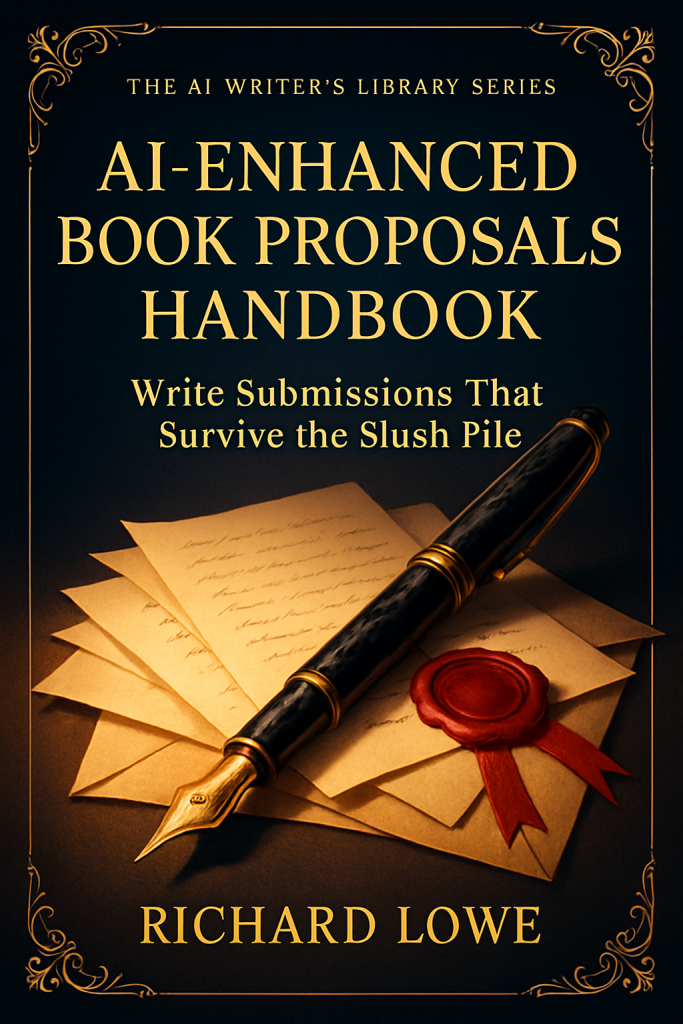
Book Proposals Handbook
Write Submissions That Survive the Slush Pile
The Professional Author’s Query and Proposal System
Fiction • Nonfiction • Memoir • Narrative Nonfiction
$29.95 • Instant digital download
What’s Inside • Query Examples • FAQ • Pricing
Agents Receive 200 Queries a Week. They Request Maybe Ten.
Your query has fifteen seconds to survive the slush pile.
That’s the difference between a form rejection and a request for your manuscript. Between years of trying and finally getting represented. Between a book that sits in your drawer and a book that sits on shelves.
Great queries get read. They get requests. They start careers.
Weak queries get deleted before the agent finishes the first paragraph. The manuscript might be brilliant. Nobody will ever know because the query killed it.
The Problem Nobody Teaches You to Solve
- Buried hooks. Your query hook buries the story in setup because nobody taught you that agents decide in fifteen seconds whether to keep reading.
- Wrong comps. Your comp titles are either mega-blockbusters that make you look delusional or obscure novels from 1987 that provide no positioning at all.
- Plot summaries. Your synopsis reads like a Wikipedia plot summary because you don’t understand that synopses sell stories instead of summarizing them.
- Missing components. Your nonfiction proposal lacks the platform section, market analysis, or competitive positioning that publishers require before they’ll consider acquisition.
Querying isn’t just sending emails. It’s craft. Learnable, systematic, improvable craft that determines whether your manuscript gets read or deleted.
Part of The AI Writer’s Library Series
Field manuals for writers who are done with advice that doesn’t work.
113+ Books. $30 Million in Client Deals. One System.
I’m Richard Lowe. My ghostwriting clients have secured over $30 million in venture capital with proposals developed using this exact methodology.
I’m also AuDHD. My brain doesn’t accept “just write something compelling” as instruction. When I realized most querying advice was vague inspiration instead of actionable system, I built the system myself.
I packed everything I learned into this handbook. Query psychology, synopsis architecture, proposal structure, agent targeting, rejection processing, and AI integration. No mystical advice about finding your voice. Just craft you can learn and apply.
What You’ll Walk Away With
- Query letters with hooks that make agents stop scrolling
- Synopses that sell stories instead of summarizing plots
- Comp titles that position without limiting or embarrassing
- Nonfiction proposals that demonstrate market viability
- Agent research methods that stop you wasting queries
- Rejection frameworks that turn feedback into improvement
This Handbook vs. The Alternatives
| Approach | Result |
|---|---|
| Generic querying advice | “Be compelling.” “Hook the agent.” Inspiration without instruction. |
| Asking AI to write your query | Generic templates appearing in thousands of slush piles. |
| Winging it | Fifty form rejections without understanding what’s wrong. |
| This handbook | Complete system covering query psychology, synopsis structure, proposals, agent targeting, and 100+ AI prompts. |
Category-Specific Approaches That Agents Expect
Fiction queries live or die on the hook. Agents receive hundreds weekly and skim by query forty. Your first sentence creates a question they want answered or it doesn’t. This handbook breaks down hook construction, summary structure, and the psychology of what makes agents request manuscripts.
Nonfiction proposals require proving market viability before anyone reads your sample chapters. Overview, competitive analysis, platform documentation, chapter outlines, marketing plans. Publishers make acquisition decisions based on proposals, not finished manuscripts. This handbook covers every component.
Memoir proposals occupy uncomfortable middle ground. You need the voice-driven query approach of fiction writers plus the business documentation of nonfiction writers. The handbook covers the hybrid strategy memoir requires.
Narrative nonfiction demands proving both storytelling ability and research access. Can you write scenes? Do you have sources? Will the story actually be there when you dig? This handbook addresses the specific concerns publishers have about narrative nonfiction acquisitions.
Synopsis writing tortures every fiction writer. Compressing 90,000 words into two pages feels impossible. The trick is understanding that synopses sell stories instead of summarizing them. Different document, different purpose, different craft.
Built for Writers Who Use AI
AI can accelerate query development. It can also produce the same generic templates flooding every agent’s inbox.
Ask AI to write a query hook and you’ll get setup instead of story. Ask for a synopsis and you’ll get plot summary instead of sales document. Ask for comp titles and you’ll get Harry Potter and Gone Girl, the same unusable suggestions everyone else receives.
This handbook teaches you to use AI as a querying tool while avoiding the traps. Specific prompts for hook generation, synopsis drafting, comp research, and proposal development. Verification methods that catch problems before you submit. Techniques for pushing past generic output to find material worth sending.
AI is your research assistant, not your query writer. This handbook shows you how to keep it that way.
Sample Prompt from the Handbook:
“Analyze this query hook for a [genre] novel: [your hook]. Does it create a question the reader wants answered? Does it establish character, situation, and stakes within two sentences? What specific words could be cut or strengthened? Suggest three alternative versions that maintain my voice while increasing urgency.”
What’s Inside the Handbook
- Query Letter Anatomy and Psychology — What each paragraph must accomplish, reading order versus writing order, and the psychology of first sentences that make agents keep reading
- The Hook That Makes Agents Stop Scrolling — Character plus situation plus stakes, creating urgency, genre-specific strategies, and testing hooks before sending
- Comp Titles That Position Without Limiting — Finding comps that help, avoiding comps that hurt, the age and sales problem, and genre-specific comp strategies
- Synopsis Psychology — Why synopses sell instead of summarize, emotional arc versus plot summary, and what agents actually look for
- The Nonfiction Proposal Package — Overview, market analysis, competitive positioning, chapter outlines, author platform, and marketing plans
- Agent Research and Targeting — Finding agents who want what you’ve written, evaluating legitimacy, personalization that works, and query batching strategy
- Rejection Psychology and Strategic Revision — Types of rejection and what they mean, when to revise versus persist versus move on
Plus 21 more chapters covering the traditional publishing landscape, agents and editors and publishers, direct submission paths, scams and predatory actors, why most proposals fail, author bios, fiction synopsis construction, one-page versus extended synopses, memoir proposals, narrative nonfiction considerations, sample chapter selection, opening pages that demand more, submission tracking systems, and the complete process from manuscript to representation.
Genre-Specific Query Examples
- Psychological Thriller — Hook construction, stakes escalation, comp positioning for suspense. Complete query with analysis of why each element works.
- Literary Fiction — Voice-forward approach, credential building when you lack blockbuster comps, positioning for book club appeal.
- Romantic Comedy — Genre-appropriate tone, professional connection to material, comps that signal the right reading experience.
- Fantasy — Balancing world and character in limited space, research-backed authority, comps that position without overselling.
Plus synopsis examples for thriller, romance, and memoir showing how the same principles apply across categories. And nonfiction proposal excerpts demonstrating overview hooks, competitive analysis, and chapter outline structure.
Six Months From Now
You’re sending queries with confidence. Your hook creates a question agents want answered. Your comp titles position without embarrassing you. Your synopsis sells your story instead of summarizing it. Agents are requesting your manuscript. The form rejections have stopped.
That’s what systematic querying gets you.
Who This Is For
Writers ready to approach querying as craft instead of lottery.
You might be querying your first novel and want to get it right from the start. You might have collected rejections and suspect your query is the problem. You might be building a nonfiction proposal and need the complete package. You might be writing memoir and struggling with the fiction-nonfiction hybrid.
You’re ready to treat submission materials as seriously as you treat your manuscript.
Who This Isn’t For
- If you want someone to write your query for you, this isn’t it.
- If you think your manuscript is so good it doesn’t need a strong query, you’ll be disappointed.
- If you’re pursuing self-publishing exclusively, you don’t need this.
This is for writers pursuing traditional publishing who want their submissions to survive the slush pile.
Still Not Sure?
“I’ve already sent queries and gotten rejections.”
Good. You have data. This handbook helps you diagnose what’s not working and fix it systematically instead of guessing.
“I’m not sure my manuscript is ready to query.”
Fair concern. Chapter 2 covers how to know when you’re ready. But learning query craft now means you’re prepared when the manuscript is done.
“Can’t I just find query templates online?”
Templates are why agents see the same structures repeatedly. This handbook teaches you to understand query psychology so you can write something that stands out.
Frequently Asked Questions
How do I write a query letter that gets agents to request my manuscript?
Successful queries hook in the first sentence, summarize without spoiling, position with smart comp titles, and establish author credibility. Agents decide in seconds whether to keep reading. This handbook breaks down the psychology of what makes agents request manuscripts and gives you systematic methods for constructing queries that work.
Can AI help me write query letters and synopses?
AI can accelerate query development, but it defaults to generic templates that agents see constantly. Ask AI to write a hook and you’ll get setup instead of story. This handbook includes 100+ specific prompts designed to push AI past its defaults, plus verification methods to catch problems before you submit.
How do I choose comp titles that help instead of hurt my query?
Good comps were published in the last three to five years, sold well without being mega-blockbusters, and share meaningful DNA with your book. Comping Harry Potter makes you look delusional. Comping obscure titles provides no positioning. This handbook covers comp research, validation, and genre-specific strategies.
What’s the difference between a query letter and a book proposal?
Query letters are one-page pitches used primarily for fiction. Book proposals are 40-70 page business documents used for nonfiction, including overview, market analysis, competitive positioning, chapter outlines, author platform, and sample chapters. This handbook covers both, plus the hybrid approach memoir requires.
How do I write a synopsis that doesn’t feel like a boring plot summary?
Synopses sell stories instead of summarizing them. They prove your story works by showing emotional arc, character agency, escalating complications, and earned resolution. The handbook covers synopsis psychology, construction methods, and different length requirements.
How do I find agents who actually want what I’ve written?
Strategic targeting dramatically improves your odds. Research agents who represent your genre, are actively building their list, and have taste that aligns with your work. The handbook covers research resources, targeting methods, personalization strategies, and how to evaluate agent legitimacy.
What should I do when I keep getting rejected?
Rejection is the price of submission. The question is what to do with it. Form rejections mean nothing individually. Patterns across many rejections mean something. This handbook covers rejection psychology, when to revise based on feedback, when to persist without revision, and when to move on to a new project.
Your manuscript is finished. Your query shouldn’t kill it.
Every week you wait is another week of form rejections while writers with weaker manuscripts but stronger queries get requests.
28 chapters of submission craft. Query letters, synopses, and proposals. 100+ AI prompts. Genre-specific examples. Agent research and targeting. Rejection frameworks. From an author with 113 published books.
A query critique service costs $100+. A proposal consultant runs $500/hour. A professional proposal writer charges $15,000-$30,000. This is the complete system for less than a nice dinner.
Ready to Write Submissions That Get You Represented?
$29.95
One-time investment • Lifetime access • Instant download
30-Day Money-Back Guarantee
If this handbook doesn’t change how you approach querying and proposals, request a full refund. No questions. No hassle.
Your manuscript deserves better than a form rejection.
Part of the AI Writer’s Library Series. See also: Character Handbook | Book Promotion Handbook
P.S. — Still scrolling? The writers who need this most are the ones who think their manuscript is good enough that the query doesn’t matter. If that’s you, this is especially for you.