
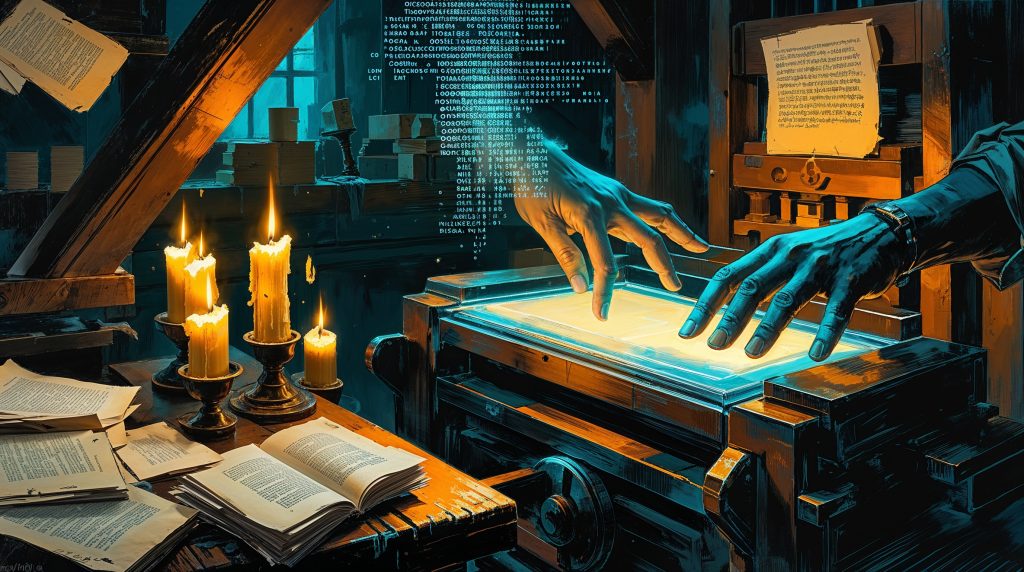
I’ve been writing for 45 years. I’ve watched word processors kill the typing pool, desktop publishing gut the typesetting industry, and the internet vaporize entire categories of magazine work that used to pay rent for thousands of journalists. Each time, the smart people said this is different, this time writers are done. Each time, they were wrong about writers being done and right that the world had changed permanently.
Now here we are again. AI is either going to save writing or destroy it, depending on which newsletter you read this morning. The reality, as usual, is messier and more interesting than either camp wants to acknowledge. So let’s go through it properly: the history, the psychology, the neuroscience, the legal battlefield, the actual data, and what’s likely to happen to you specifically.
The Pattern Is 600 Years Old and Nobody Learns From It
The printing press arrived in Germany in the 1440s. By the 1470s, the people whose livelihoods depended on hand-copying manuscripts had organized a coherent resistance movement. What happened next gets more interesting the closer you look.
In 1474, the scribes’ guild of Paris successfully delayed the printing press’s entry into France for nearly twenty years, not through logic or market competition, but through political maneuvering. They weren’t wrong that their world was ending. They were wrong about what that meant for writing as a human activity.
The most vivid document from this period is a letter from a Venetian scribe named Filippo de Strata, written to the Doge of Venice around 1473. De Strata wasn’t just opposed to printing. He was offended by it at a moral level. He called printers “whores of knowledge” and “asses” who were debasing the sacred work of hand-copying. He begged the Doge to ban printing presses from the Republic entirely. The Senate rejected his petition. De Strata spent the rest of his life copying manuscripts by hand for a shrinking clientele, which is historically poetic in a way that should feel familiar to anyone watching modern writers rail against AI on social media right now.
Meanwhile, a German monk named Johannes Trithemius wrote what became one of history’s most unintentionally funny documents: a lengthy treatise arguing that printed books could never match the spiritual value of hand-copied manuscripts. His argument wasn’t stupid. He claimed the physical act of copying scripture was itself a form of devotion, that monks who abandoned the scriptorium for printed books were losing something irreplaceable. He had a point about the contemplative tradition, actually. The treatise was printed and distributed widely across Europe. The irony apparently escaped him entirely.
The pattern repeats with tedious regularity. When the typewriter arrived in the 1870s, professional scribes argued that typed documents lacked the personal character of handwriting and would never be accepted in formal correspondence. The typewriter created an entirely new professional class, the typist, that hadn’t existed before. When word processors arrived in the 1980s, typing pools argued that authors couldn’t be trusted to format their own work. The typing pool vanished. When desktop publishing arrived in the late 1980s, professional typesetters argued that amateurs using PageMaker couldn’t produce publishable work. They were right about the quality of early desktop publishing work and completely wrong about whether that quality threshold would hold.
The internet is the most instructive example because it’s recent enough that people remember being wrong about it in real time. In 1994, newspapers and magazines were confident that people would pay for quality journalism online the same way they paid for it in print. Wrong. The classified advertising business, which had funded American journalism for a century, moved to Craigslist and never came back. Thousands of staff writing jobs disappeared permanently. The New York Times alone cut its newsroom from about 1,300 reporters in 2000 to under 800 by 2015.
But writing itself exploded. More people are producing more written content today than at any point in human history. The people who lost staff jobs at newspapers didn’t stop writing. Many found new audiences, new forms, new business models. The disruption was real and painful for specific people in specific roles. The death of writing as a human endeavor never arrived, and it never will, because writing is how humans think out loud.
What changed each time wasn’t whether people valued writing. What changed was which people got paid for which kinds of writing, and how much. That distinction is doing a lot of work in this article, so hold onto it.
The Numbers Tell Two Completely Different Stories
If you want to terrify yourself about AI and writing careers, the data is happy to oblige. A January 2026 analysis of 180 million job postings found writer job listings down 28% year over year. An Upwork study tracking platform data from late 2022 through early 2024 showed writing gigs down 33%. McKinsey research puts entry-level writing roles down 27% and freelance writing gigs down 35% since 2023. A peer-reviewed study published in ScienceDirect in July 2025 found writing and translation demand down 20 to 50 percent on short-term freelance platforms depending on category.
A University of Cambridge survey of 258 published novelists found that 51 percent believe AI will eventually replace their work entirely, 39 percent are already reporting income loss, and 85 percent expect their future income to be driven down. Genre fiction writers are most worried: 66 percent of romance writers, 61 percent of thriller writers, and 60 percent of crime writers believe their specific category is most threatened.
The Alarming Numbers (2024-2026)
Writer job postings: down 28% year-over-year (Bloomberry, 180M postings analyzed).
Upwork writing gigs: down 33%.
Entry-level writing roles: down 27%.
Freelance writing gigs: down 35%.
39% of published novelists already reporting income loss.
Now here’s what the same data actually shows when you look more carefully.
The job declines are concentrated in execution roles. Copywriters, copy editors, technical writers, content producers who generate volume output on assignment: those roles are declining steeply. Creative directors, content strategists, brand voice architects, editorial directors: those roles are holding steady or declining marginally. The split isn’t writer versus non-writer. It’s commodity execution versus strategic craft. That split maps almost exactly onto every previous technology disruption in the writing industry, because the pattern is not new.
Then there’s the correction data, which most AI-panic articles quietly ignore.
A University of Copenhagen study published in 2025 tracked 25,000 workers across 7,000 workplaces that had integrated AI writing tools. The average time savings across all those workers: 3 percent. Three. The researchers found that AI-generated content required extensive rewriting and editing, which eliminated most of the efficiency gains that had been projected. Income growth for workers who saw any benefit at all came in at 3 to 7 percent for a small fraction of the sample. This is the study that gets conveniently omitted from both the “AI will replace all writers” articles and the “AI is useless” articles, because it tells a story neither side wants to hear: AI is both disruptive and disappointing, often at the same time.
Freelance writing consultant Elna Cain reported in August 2025 that her client inquiries were up compared to 2024, with clients requesting original subject matter expert content with no AI generation. Those requests weren’t coming from clients who had never tried AI. They were coming from clients who had tried AI and watched their engagement metrics crater.
The Correction Numbers (2025)
Average AI time savings across 25,000 workers: 3% (University of Copenhagen).
Reader trust in AI content: 43% lower (Edelman 2025).
Social sharing of AI content: 41% lower (BuzzSumo 2025).
The story the data tells isn’t “AI will kill writing.” It’s “AI flooded the market with cheap content, the market immediately discounted cheap content, and the premium on authentic human voice went up.” Which is, again, almost exactly what happened with desktop publishing, with the internet, with every previous wave of disruption to the writing industry.
The Neuroscience of Why Readers Know
Here’s the question nobody in the “AI will save content marketing” camp wants to answer: if readers can’t tell the difference between human writing and AI writing, why do AI-generated articles get 43 percent lower trust ratings and 41 percent fewer social shares?
The answer connects to evolutionary biology, and it goes deeper than most people want to follow it.
In 1970, Japanese roboticist Masahiro Mori identified what he called the Uncanny Valley. As a robot becomes more human-looking, people like it more, up to a point. Then, in the zone where the robot is almost but not quite human, something flips. The slight wrongness becomes more disturbing than an obviously mechanical robot would be. Mori plotted this as a valley on a graph, hence the name. fMRI studies have since confirmed this is a real neurological response. The brain’s parietal cortex fires a perceptual conflict signal when appearance and behavior don’t align. The amygdala, the brain’s threat-detection center, activates. The reaction is evolutionary in origin: even monkeys show the same aversion response to near-but-not-quite realistic faces, which tells you this isn’t a culturally learned reaction. It’s wired in.
Researchers at MIT and UC San Diego have now confirmed that the Uncanny Valley applies to text. When readers encounter writing that is almost but not quite human, fluent, grammatical, coherent, but missing something they can’t name, they experience the textual version of the same effect. The brain flags a mismatch. Discomfort follows. Trust drops. The brain isn’t consciously analyzing the writing. It’s running a threat-detection subroutine that evolved to identify when something that appears human isn’t behaving quite right.
The mechanism is specific. Researchers at the Technical University of Denmark used eye-tracking technology to measure exactly how readers physically process AI-generated text versus human-written text. They found statistically significant differences in fixation patterns and pupil dilation. Readers moved through AI-generated text with shorter fixation durations: their eyes spent less time on each word cluster. Their pupils dilated more when reading AI text, indicating higher cognitive load despite the text being objectively easier to parse. The brain was working harder to find something it expected to be there and wasn’t.
What was it looking for? Evidence of a mind.
When a human writes, they model the reader’s internal state constantly. They ask themselves whether a joke will land, whether a metaphor will confuse, whether a particular word choice will feel condescending. That process of modeling another mind leaves traces in the writing: small asymmetries, unexpected turns of phrase, moments where the writer’s perspective collides with the subject in ways that couldn’t be predicted from the surrounding sentences. AI doesn’t do this. It models the statistical probability of the next token. It talks at you rather than to you, and something in the human nervous system registers the difference before the conscious mind does.
AI models string together sentences by predicting the next most likely word, which makes text more skimmable and requires less brain power to follow. — Per Baekgaard, Associate Professor, Technical University of Denmark
There’s also what one researcher calls the “retail voice” problem. AI defaults toward a customer-service tone: overly helpful, meticulously neutral, carefully inoffensive. Every edge gets sanded down. Every sharp opinion gets immediately balanced by a counterpoint. Humans write this way when they’re afraid. AI writes this way because it’s been trained to avoid controversy at all costs. Readers experience this flatness not as professionalism but as the absence of a person, because that’s exactly what it is.
The parasocial relationship research explains the downstream effect. Decades of media psychology research have established that readers, viewers, and listeners form genuine attachment bonds with media personalities they’ve never met. These bonds drive loyalty, sharing, trust, and purchasing behavior. They develop through repeated exposure to a consistent voice, authentic self-disclosure, and the perception that the person on the other end is actually thinking about you as they create. Donald Horton and Richard Wohl identified this dynamic back in 1956 studying television audiences, and every subsequent decade of research has confirmed it scales to any medium where personality is consistently present over time.
AI content cannot build these bonds because it cannot create the conditions for them. There is no personality consistently present across pieces. There is no self-disclosure because there is no self. No evidence exists that anyone thought about your specific situation, because no one did. UCL neuroscience research published in 2025 found that voices associated with intense parasocial interest activate brain reward regions in ways that unfamiliar voices simply don’t. The implication for writers is uncomfortable and clarifying: your audience’s attachment to your specific way of seeing the world is not a soft marketing concept. It’s a neurological event. And it’s the one thing AI cannot replicate, because it requires a self to be attached to.
The writers who will win the next decade are the writers whose audiences have formed genuine attachment to their specific perspective. That attachment is the moat. It cannot be automated, and it gets more valuable the more the market floods with content that has no self behind it.
The Legal Battlefield Nobody Is Winning
While writers argued about whether AI would kill their careers, the lawyers argued about something more foundational: who actually owns the material that makes AI work.
In June 2025, Judge William Alsup of the Northern District of California issued a landmark ruling in Bartz v. Anthropic. Authors had sued Anthropic for using their books to train Claude without permission or compensation. Alsup ruled that using books to train AI was “transformative, spectacularly so,” and that Anthropic’s use of legally acquired books constituted fair use. The ruling compared AI training to human learning: a human who reads widely doesn’t owe royalties to every author they’ve absorbed, and an AI trained on books doesn’t infringe the copyright of those books.
Alsup drew a sharp line at piracy. Anthropic had acquired approximately seven million books from pirate sites including Library Genesis and Pirate Library Mirror. That use was not protected. Facing potential damages at $3,000 per pirated work across roughly 500,000 registered titles, a total exposure running into the billions, Anthropic settled in September 2025 for a minimum of $1.5 billion, paid in installments through 2027.
The settlement covers past use only. It doesn’t protect against future claims, and it doesn’t address claims based on AI outputs that might infringe copyrighted works. Six authors including Pulitzer Prize winner John Carreyrou opted out and filed individual suits against Anthropic, OpenAI, Google, Meta, xAI, and Perplexity, seeking $150,000 per infringed work per defendant. Those cases are pending as of this writing, and the legal landscape around AI training data is going to keep shifting for years.
The Legal Landscape (as of early 2026)
52+ active AI copyright lawsuits in U.S. federal courts.
Anthropic settled for $1.5 billion minimum (pirated books only).
Fair use ruling: legally acquired training data is protected. Pirated training data is not.
AI output infringement: unresolved, next wave of cases forming.
The 59 percent of published novelists who know their work trained AI without their permission or payment feel powerless, and understandably so. But most of them are missing the more complicated picture.
The music industry fought this battle first and harder. When Napster arrived in 1999, the major labels sued everything that moved and lost most of what they sued over. Metallica became a punchline. The labels that eventually adapted, that moved toward streaming licensing models rather than continued litigation, ended up with a business model that generates more revenue per song played than the CD era ever did. It took fifteen years and enormous pain, and the settlement wasn’t fair to the artists who got steamrolled during the transition. But the adaptation happened, and a licensing ecosystem emerged.
The book world is five to ten years behind music in this transition. The Anthropic settlement at $1.5 billion is the Napster moment, the first major acknowledgment that training data has monetary value and that creators are entitled to a share of it. Universal Music Group settled its AI music lawsuit in October 2025 and reached licensing agreements giving artists opt-in control over whether their work trains AI. Warner Music settled a month later with similar terms. The publishing industry is heading toward the same framework.
Writers who understand that their back catalog may generate licensing revenue, and who register their copyrights properly with the U.S. Copyright Office, are positioned to participate in that revenue. Writers who don’t know this conversation is happening will find out about it after the framework is set.
Register your copyrights. This is not optional advice. Registration costs $65 per work for an individual online filing. The Anthropic class action excluded authors whose books weren’t registered. If your work isn’t registered, you don’t exist to the settlement administrator.
What AI Actually Does Well, and What It Can’t Touch
I use Claude Opus at $200 a month for my writing workflow, and I’m going to be specific about what it’s genuinely useful for and what it cannot do. The “AI is amazing” camp and the “AI is useless for real writing” camp are both describing real phenomena while ignoring the other side’s evidence.
AI genuinely accelerates research. Synthesizing existing literature, identifying patterns across multiple sources, generating structural options quickly, checking consistency across a long manuscript: these are legitimate time savers when the underlying research has already been done by humans who know the subject. For outlining, for generating options to choose from, for catching gaps in argument structure, a good AI model functions as a useful collaborator. I use it this way constantly.
What AI cannot do is produce voice. Not in the sense of a detectable stylistic signature, but in the deeper sense of earned observation: the specific way your particular experience of a specific thing shapes how you describe it. It cannot produce the moment where your personality collides with your subject in a way that creates unexpected insight. It cannot produce the sense that someone who has actually lived through something is telling you about it. These aren’t features that will arrive in the next model update. They’re absent because the model has no life to draw from. You can’t fake experience, and you can’t train around the absence of it. The full breakdown of what AI genuinely can’t do goes deeper on exactly why these limits are structural, not temporary.
The cleanup problem is real and understated. I’ve written with AI assistance in my workflow. The words that come out of an AI session that sound like me, that carry my voice, my irreverence, my way of building an argument, are the words I’ve substantially rewritten. The words that don’t sound like me are the words I left mostly alone. Readers can tell which is which, even when they can’t articulate why. The University of Copenhagen study’s finding that AI delivered only 3 percent average time savings matches my experience closely. The generation is fast. The cleanup that makes it actually yours takes as long as writing it from scratch would have, sometimes longer, because you’re fighting the AI’s instincts the whole time.
That’s not an argument against using AI tools. It’s an argument against believing that AI tools replace the need for a writer who has a genuine perspective and knows how to express it. The tools are genuinely useful for writers who already have those things. They don’t substitute for them, and anyone who tells you otherwise is selling something. If you want a practical framework for using AI in your writing workflow without losing your voice in the process, that’s a separate conversation worth having.
The Fault Line: What’s Under Threat vs. What’s Not
The 28 percent decline in writing job postings is real. The decline is not distributed evenly across writing work, and understanding the distribution clarifies what’s actually at risk.
The jobs disappearing are production writing jobs: content that exists to fill a slot, hit a keyword target, meet a publishing cadence, produce a required word count. Blog posts written by people who don’t know or care about the subject. Product descriptions produced by writers who’ve never used the product. Social media captions generated on deadline without editorial voice. Technical documentation written by contractors who don’t understand the technology. Newsletter content produced as obligation. These jobs existed because producing adequate text at volume required human labor. AI eliminated that bottleneck.
If your work was in that category, if you were being paid to produce adequate volume rather than distinctive quality, your market has contracted sharply and probably permanently. That’s not a comfortable sentence, but dancing around it doesn’t help anyone.
The jobs holding steady or growing are a different kind of work. Editor-level roles that require judgment about quality and audience. Brand voice work that requires maintaining a specific personality across channels. Subject matter expert content where the expertise itself is the product. Executive ghostwriting that requires understanding a specific human’s voice and reproducing it convincingly. Memoir and narrative nonfiction where the story is inseparable from who lived it. Fiction where voice is the point and readers came specifically for it.
The parallel to previous disruptions is exact. Desktop publishing didn’t kill graphic design. It killed low-skill paste-up work and amplified the premium on designers who could think conceptually. The internet didn’t kill journalism. It killed commodity journalism and amplified the premium on journalists who could build genuine audience relationships. The writers who figured out what the new premium was and pivoted toward it came through each disruption stronger than they’d entered.
What Happens in the Next 18 Months
Based on 600 years of historical pattern, current market data, and the specific shape of this disruption, here’s what I expect.
The content quality gap becomes commercially undeniable. It’s already showing up in engagement metrics and trust data. Within 18 months, the marketing industry will have developed a clearer vocabulary for distinguishing AI-generated content from human-authored content and will price the distinction into content budgets. Brands that flooded their channels with AI content in 2024 and 2025 are already seeing the consequences. Most will course-correct, not out of principle but out of self-interest, because the engagement numbers will force it.
The volume content market does not recover. The writing jobs that disappeared in 2024 and 2025 in the commodity content space are gone. AI handles that work adequately and will continue to handle it. Anyone making their living primarily on volume content for clients who cared more about word count than quality needs to have completed their pivot already.
The premium on authentic expertise rises. Subject matter experts who can write, not polished prose stylists, just people who genuinely know things and can communicate them clearly, will see increasing demand. The scarcest resource in content is genuine perspective informed by genuine experience. AI has made it scarcer by flooding the market with text that simulates perspective without having it. Scarcity raises prices. This is econ 101 with a literary twist.
The licensing framework starts taking shape. The Anthropic settlement won’t be the last. As more cases settle and the licensing model that Universal Music and Udio developed spreads to other creative industries, writers with registered catalogs will start seeing new revenue streams. Not enough to replace lost income from commodity writing, but enough to matter. The writers who positioned themselves now will be in the deal when it arrives.
The writers building genuine audience relationships right now, through Substack, through podcasting, through any medium where personality and consistency create the neurological bonds discussed in The Neuroscience of Why Readers Know, are building the most durable asset available in the current market. An audience that genuinely likes how you think is not substitutable. It cannot be automated. It compounds over time. And it is exactly as valuable as it has always been: completely.
The printers of the 1470s didn’t kill writing. They killed the scribes who were waiting for the world to stop changing. The writers who adapted, who figured out what the press could do that their hand couldn’t, and what their hand could do that the press couldn’t, built careers that Filippo de Strata couldn’t have imagined from his shrinking scriptorium.
Same story. Different century. Same choice.
If you want to go deeper on writing in an AI world without sounding like AI, the AI Writer’s Library covers the craft side of exactly this problem.
Free Stories, Straight to Your Inbox
Start with Nine Doors, nine short stories across nine genres, yours free the moment you sign up. After that, the occasional new collection and a note when there's a new book worth your time. No spam, no daily clutter. Just good stories.
We use MailerLite to manage our list and send these emails. Your address is used only to send you what you signed up for. We will not sell it, share it, or use it for anything else, and you can unsubscribe anytime.