
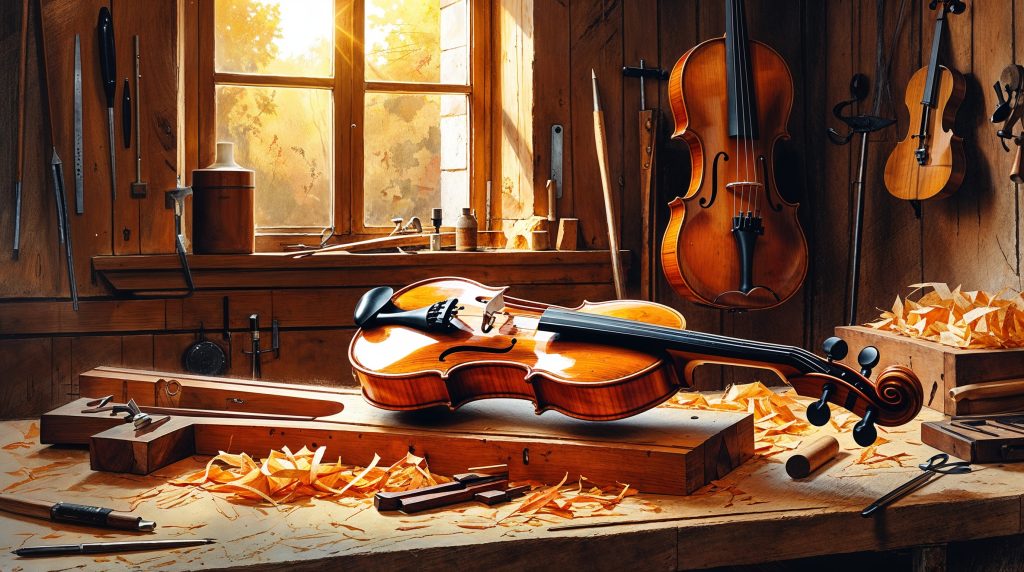
The violin was finished on a Friday in November, and Heinrich Baumann knew immediately that he’d made a mistake.
Not a flaw. The instrument was flawless. The spruce top had been carved to within a tenth of a millimeter of his specifications. The maple back and ribs were from a tree he’d been aging for twenty-two years. The varnish was his own recipe, five coats applied over six weeks, each one sanded by hand until the wood glowed like amber held up to firelight.
The mistake was that the violin was too good. He’d been building instruments in his Vienna workshop for forty-one years and he’d made perhaps six that he would call excellent. This one was beyond excellent. This one had crossed some line between craftsmanship and something else, something he didn’t have a word for, and when he drew the bow across the strings for the first time, the sound that came out made him set the instrument down and leave the room.
The sound was not what he’d played. He’d drawn a simple G. The violin produced a chord, rich and layered, that contained the G but also contained harmonics that shouldn’t have been possible from four strings and a wooden box. The sound filled the workshop and then filled Heinrich and then filled a space behind his eyes where he kept the things he didn’t think about: his daughter who’d stopped speaking to him. His wife who’d died six years ago in a hospital where he’d arrived twenty minutes too late. The morning he’d chosen to finish a commission instead of driving to the hospital because he’d thought there was more time.
The violin played what he carried. Not what he chose.
He sold it to a concert violinist named Katya Petrovna, a Russian woman living in Munich who had the technique to deserve the instrument and the reputation to afford it. She paid without negotiating, which was unusual. She played three notes in the shop, stopped, looked at Heinrich with an expression he couldn’t read, and wrote the check.
The call came two days later.
“What did you do to this instrument?”
“I built it.”
“I sat down to practice the Brahms concerto. The violin played Brahms. But between the movements, when I lifted the bow, the strings kept resonating. And the resonance was not Brahms. It was something from my childhood. A song my mother sang. I have not heard that song in thirty years and I could hear every note coming from the wood.”
“I’m sorry.”
“Don’t be sorry. Tell me how.”
“I can’t. I don’t know how. I’ve built instruments my entire life and this one came out different. The wood, the varnish, the dimensions are all within my normal parameters. Something happened that I didn’t intend.”
“It made me cry, Heinrich. I perform for thousands of people. I don’t cry. This instrument reached into me and found something I’d buried and played it back to me and I sat in my practice room and wept like a child.”
“I can take it back. Refund the purchase. I have other instruments that behave normally.”
A long silence. Heinrich could hear her breathing.
“No,” she said. “I’m keeping it. I’m performing with it Saturday night. Brahms, as scheduled. But I want you to know what might happen.”
“What might happen?”
“If this instrument plays what the player carries, and I carry what I carry, then two thousand people in the Gasteig are going to hear something that isn’t on the program.”
Heinrich went to the concert. He sat in the back row. Katya played the Brahms beautifully, technically perfect, emotionally precise. The audience listened with the respectful attention of people who’d paid good money for a cultural experience.
Between the second and third movements, she lifted the bow. The strings kept singing. The hall went silent. The sound that came from the violin was not Brahms and was not the song her mother sang. It was something else. Something that belonged to the room, to the two thousand people sitting in the dark, a collective chord made of everything they carried and couldn’t say.
Two thousand people sat in a concert hall and heard their own grief played back to them on four strings and a wooden box built by a man who’d arrived at a hospital twenty minutes too late.
No one moved. No one coughed. No one checked their phone.
The resonance faded. Katya lifted her bow and played the third movement, and the rest of the concert was Brahms, only Brahms, and it was magnificent.
Afterward, Heinrich waited by the stage door. Katya came out carrying the violin case like it was something alive.
“I’m sorry,” he said again.
She shook her head. “Don’t apologize for building an honest instrument, Heinrich. The world has enough violins that play what you tell them to.”
She walked into the Munich night. Heinrich stood by the stage door and listened to the city and thought about the wood, the varnish, the twenty-two years of aging, and the twenty minutes that had changed everything. He’d put all of it into the instrument without meaning to. The violin had taken what he gave it and turned it into something that made strangers weep in a concert hall.
He went home to Vienna and started another instrument. He used different wood. A different varnish recipe. Different dimensions.
It came out ordinary. He was relieved.
Free Stories, Straight to Your Inbox
Start with Nine Doors, nine short stories across nine genres, yours free the moment you sign up. After that, the occasional new collection and a note when there's a new book worth your time. No spam, no daily clutter. Just good stories.
We use MailerLite to manage our list and send these emails. Your address is used only to send you what you signed up for. We will not sell it, share it, or use it for anything else, and you can unsubscribe anytime.