
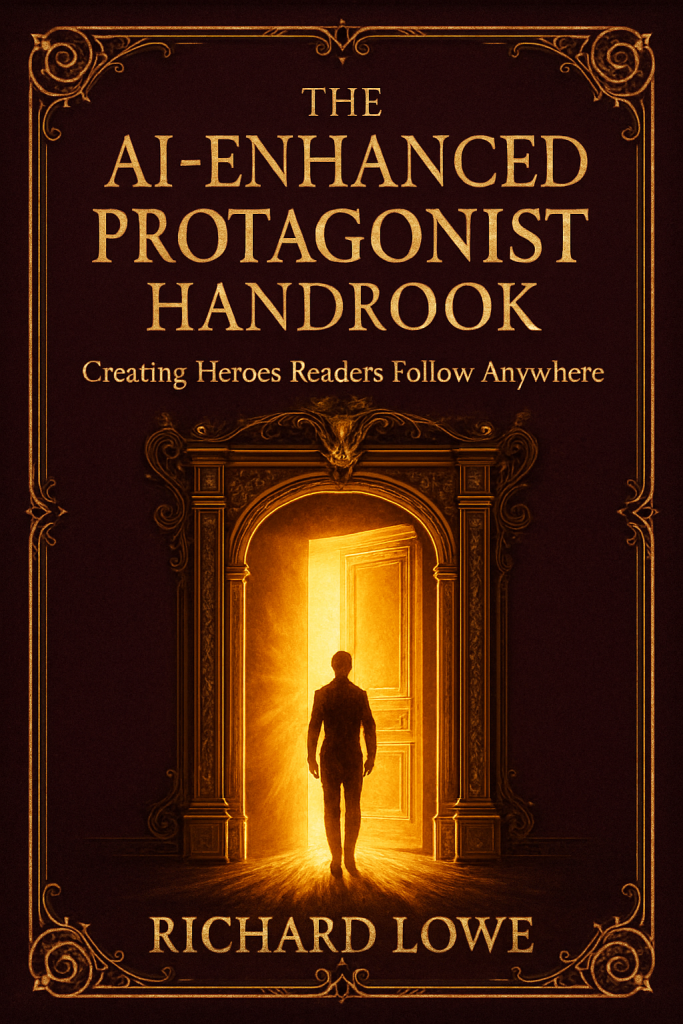
Protagonist Handbook
The scene that taught me the most about protagonist agency isn’t from a war novel or a thriller. It’s from Through the Looking Glass, a fictionalized memoir about a cam model in Bucharest.
Zeya thinks she’s in control. She’s the professional. She knows the rules. She’s handled difficult members before. Then she finds a ring in her nightstand drawer — an engagement ring a member arranged to have placed there. Then the door won’t open. Then the computer won’t respond to her commands. Then she watches a man hold a gun under his chin and tell her that if she doesn’t say she loves him, he’ll pull the trigger.
She says it. She says she loves him. He says he doesn’t believe her. He pulls the trigger.
Everything in that scene is outside Zeya’s control except one thing: what she chooses to say and how she says it. She can’t open the door. She can’t shut off the screen. She can’t make him believe her. Her agency is reduced to words, and the words aren’t enough. That’s not a passive protagonist. That’s a protagonist whose choices under maximum constraint define exactly who she is and what she’s capable of. Readers can’t look away because every word she says is a choice with irreversible consequences, and she knows it.
That’s the distinction this handbook is built around. Passive protagonists watch events unfold. Constrained protagonists make choices under impossible pressure. The constraint isn’t the same as passivity. Often the most active protagonist in a scene is the one with the least external power, because every decision they make costs something real.
Jake Martinez in Jake and the Bullies starts with even less power. He gets hit by a dodgeball, the video goes viral, and the internet turns on him. He’s twelve. He gets pulled into the internet itself by forces he doesn’t understand. Everything happens to him, until the moment it doesn’t — until he has to choose whether to fight the Hate Engine the way it fights him, or find a different weapon. That choice, made under maximum pressure, is the whole book. Take it away and you have a kid things happen to. Give it to him and you have a protagonist.
The difference between those two versions of Jake is the difference between a story and a sequence of events. This handbook teaches you to build the first kind.
$9.95
One-time investment • Lifetime access • Instant download
14-Day Money-Back Guarantee
If this handbook doesn’t change how you develop protagonists, request a full refund. No questions.
Questions
What stays with me about that scene in Through the Looking Glass isn’t the violence. It’s the moment before it. Zeya says the words. She says everything he needs to hear. She gives him what he came for. And he says he doesn’t believe her.
There was nothing left for her to do. She made the choice and it wasn’t enough, not because she chose wrong, but because the situation was already beyond what any choice could fix. That’s what maximum constraint looks like from inside a protagonist’s consciousness. Not action-movie heroics. The specific weight of making the only available choice and watching it fail anyway.
Readers follow protagonists into that territory because they recognize it. Not from cam studios in Bucharest. From every situation where they had no good options and had to choose anyway. Build your protagonist from that psychology and readers will follow them anywhere.
$9.95
One-time investment • Lifetime access • Instant download
14-Day Money-Back Guarantee
If this handbook doesn’t change how you develop protagonists, request a full refund. No questions.
Part of the AI Writer’s Library Series. See also: Antagonist Handbook | Deep Character Handbook