
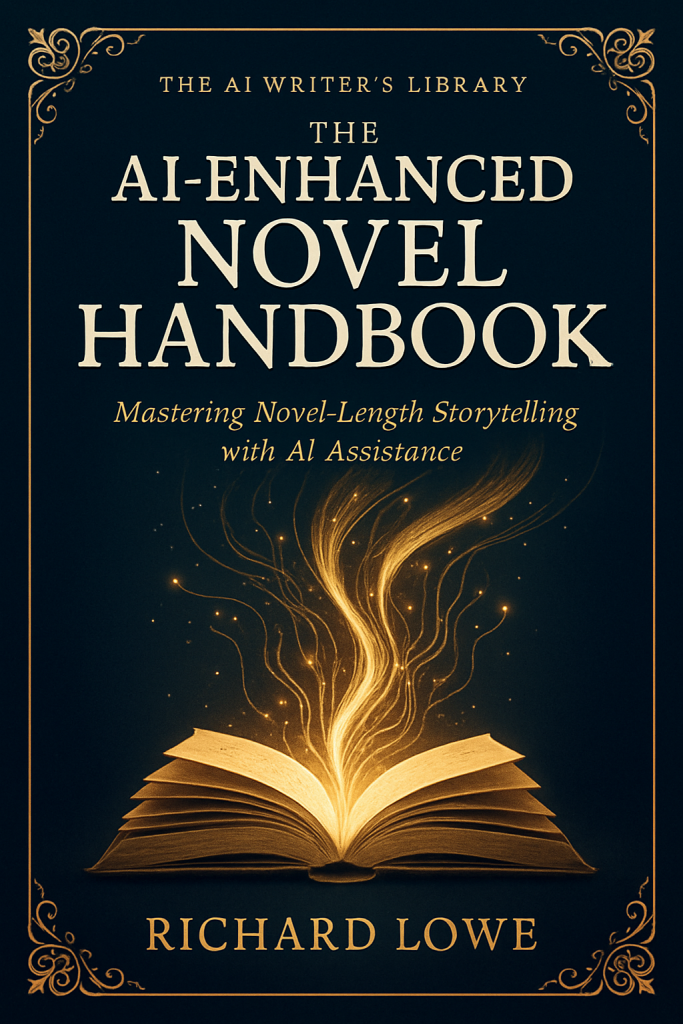
Novel Handbook
I’ve been working on Peacekeeper for forty-five years. Sixteen books following Admiral Jessica Lang across 200,000 years of human history. The series taught me things about novel-length storytelling that quick projects never reveal, and the hardest thing it taught me was also the most specific: how do you write a character who is 200,000 years old and make her believable?
Not ancient. Not mythic. Believable. A woman who still functions, still leads, still cares about people she knows she’ll outlive. Again. The wound isn’t one thing. It’s the accumulation of 200,000 years of watching everyone she’s ever loved die. Every relationship she forms, she already knows how it ends. That’s not a character trait. That’s an architecture problem.
I solved it with dream sequences. Not as literary decoration. As the only place her accumulated grief could surface without breaking the functional person she has to be in every waking scene. She can’t fall apart on the bridge. She can’t let her crew see what’s underneath. So it comes out in the dreams, where she has no control over what her mind shows her.
What she dreams: walking through a garden of millions of skulls. All of them looking at her. Every person she ordered killed in the name of the empire. She didn’t just outlive people. She made choices. The skulls aren’t casualties of time. They’re hers. And they look at her forever in the only place she can’t control.
That image is what made her believable across sixteen books. Not her age. Not her credentials. The specific weight underneath the competent admiral. Readers feel it even in scenes where it never surfaces directly, because it’s built into her foundation. That’s the novel-scale principle: wounds have to be structural, not decorative. At short story length, you can get away with a character whose depth is implied. At novel length, across sixteen books and 200,000 years, implied depth collapses. You have to build the architecture underneath or the character drifts into someone else by book three.
I’m AuDHD. My brain doesn’t accept “just keep writing” as methodology. When my novels kept dying in the middle despite strong openings and clear endings, I dug until I found the systems underneath. This handbook is what I found.
$29.95
One-time investment • Lifetime access • Instant download
14-Day Money-Back Guarantee
If this handbook doesn’t change how you approach novel-length fiction, request a full refund. No questions.
Questions
The dream sequence solution wasn’t clever. It was structural. Jessica needed a place where 200,000 years of accumulated grief could surface without destroying the functional person she has to be every waking hour. The bridge of a starship is no place for that kind of reckoning. Her dreams are the only uncontrolled space she has left.
Every novel has that problem at smaller scale. Your character needs somewhere to be what they can’t be in the scenes where the story is moving. If you don’t build that place deliberately, the wound stays decorative. Readers sense it but never feel it. That’s the difference between a character who’s interesting and a character who haunts you after you’ve closed the book.
That’s what this handbook teaches.
$29.95
One-time investment • Lifetime access • Instant download
14-Day Money-Back Guarantee
If this handbook doesn’t change how you approach novel-length fiction, request a full refund. No questions.
Part of the AI Writer’s Library Series. See also: Pacing Handbook | Conflict & Tension Handbook