I prowled a used bookstore as a kid buying old mystery magazines for a dime each.
Not assigned. Not recommended. I went looking. I’d work through whatever I could find — pulp magazines, old paperbacks, anything with a crime and someone trying to solve it — and I read everything cover to cover. That’s how I found Sherlock Holmes, which hit differently than anything else on those shelves. Not because the plots were more clever, though they were. Because Holmes himself was the story. The way he saw what everyone else missed. The way observation became a form of justice. The way a crime wasn’t just a puzzle to solve but a human situation to understand.
That distinction took me years to fully articulate, but I felt it immediately at whatever age I was haunting that bookstore. The magazines I bought for a dime were puzzles. Holmes was something else. The crime was the occasion. The psychology was the point.
Most mystery writing advice never makes that distinction. It teaches clue placement, red herring construction, timeline management — the puzzle mechanics — without addressing why some mysteries stay with readers for decades while others are forgotten by the time the book hits the return pile. Christie’s Poirot and Marple. Sayers’ Lord Peter Wimsey. Chandler’s Marlowe. These aren’t remembered for their solutions. They’re remembered because the detective was a person readers cared about, and the crime was a lens that revealed something true about human nature in every case.
The Detection Club established fair play principles in 1930 — no withholding crucial clues, no solutions that depend on information readers couldn’t access — not because mysteries are games with rules, but because readers come to mysteries hunting justice, and justice requires that they had a genuine chance to find the truth themselves. Violate that and you haven’t written a mystery. You’ve written a trick.
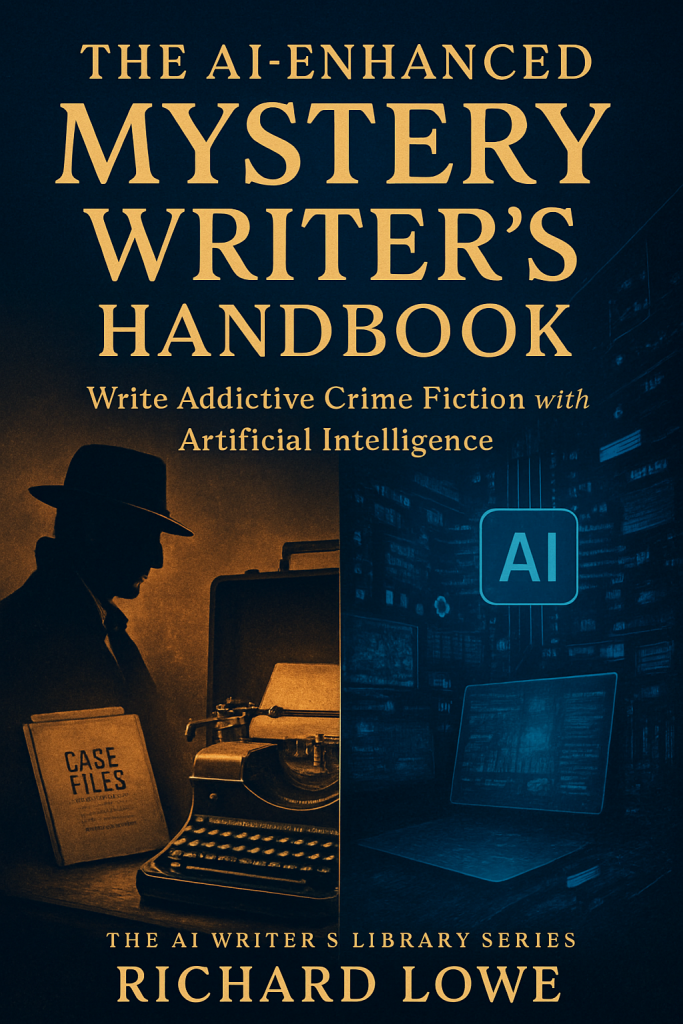
I’m Richard Lowe. 113 published books, a childhood spent working through every mystery I could find for a dime, and decades of understanding why some of them stuck and most of them didn’t. This handbook is built on that distinction — crime that serves character instead of replacing it, puzzles that become mysteries when the psychology is real.
$29.95
One-time investment • Lifetime access • Instant download
Get The Handbook →
14-Day Money-Back Guarantee
If this handbook doesn’t change how you approach mystery character psychology, request a full refund. No questions.
Puzzles vs. Mysteries
The difference between mysteries readers solve and forget versus mysteries readers remember for years.
Puzzles (Forgettable)
Mysteries (Memorable)
Clues planted to be found
Clues emerge from character behavior
Suspects exist to be eliminated
Suspects are complex humans with real motives
Detective solves the case
Detective is changed by the case
Murder method showcases cleverness
Murder feels psychologically inevitable
Readers want the answer
Readers need justice
Questions
What separates a mystery from a puzzle?
A puzzle has a solution. A mystery has a detective worth caring about who is changed by finding it. The dime magazines I read as a kid were mostly puzzles — crime as intellectual exercise, detective as mechanism, solution as payoff. What made Sherlock Holmes different was that Holmes himself was the story. His observation wasn’t just a technique for solving crimes. It was a way of seeing that revealed something true about human nature in every case. The crime was the occasion. The psychology was the point. Most mystery writing advice teaches puzzle mechanics — clue placement, red herring construction, timeline management. This handbook teaches the psychology underneath, which is what determines whether readers remember your detective or forget them by the time the book hits the return pile.
What is fair play and why does it matter?
Fair play means giving readers access to the same clues the detective uses to reach the solution. No withholding crucial evidence until the final chapter. No solutions that depend on information readers couldn’t have known. The Detection Club established these principles in 1930 — Christie, Sayers, Chesterton — not because mysteries are games with arbitrary rules, but because readers come to mysteries hunting justice, and justice requires that they had a genuine chance to find the truth themselves. When you violate fair play — introduce the killer in the final act, make the solution depend on a fact the reader never had access to — readers feel the betrayal even when they can’t articulate it. They didn’t just lose a puzzle. They were denied justice they came for.
How do I make my detective memorable rather than just competent?
Detectives become memorable when cases change them. Holmes is remembered not because he solved crimes but because his relationship with Watson, his methods, his worldview were all illuminated through the work. A detective who solves cases without being affected is an investigation machine. A detective whose sense of justice complicates over time, whose relationships strain under the weight of what the work reveals about human nature, whose worldview shifts case by case — that’s a character readers return to. The crime is the pressure. The detective’s psychology under that pressure is the story. Your reader should care less about whodunit and more about what solving it does to the person doing the solving.
What makes a red herring fair rather than cheap?
A fair red herring misleads while remaining honest. It points toward an innocent suspect for legitimate reasons — they had motive, opportunity, and genuinely suspicious behavior — but a careful reader could eliminate them through evidence that’s available. Cheap misdirection withholds key information, makes innocent characters behave inexplicably, or relies on coincidences that only make sense in hindsight. The test is whether readers, looking back after the solution, feel they were skillfully misdirected or simply cheated. Fair red herrings produce the “I should have seen that” response. Cheap ones produce the “that wasn’t fair” response that damages trust in everything you write after it.
What makes a murder motive feel psychologically real?
Motive works when murder feels like the only option the killer could see — not the logical option, the psychological one. Generic motives like greed, jealousy, and revenge become compelling when you show the specific wound and worldview that made this person commit this crime against this victim at this moment. The killer needs to feel like a person for whom violence was a coherent response to their situation, even if that response was monstrous. When readers reach the solution and think “I understand how someone could do that even though it’s terrible,” the motive has worked. When they think “why would anyone do that,” you’ve written a mechanism, not a person.
How does AI actually help with mystery writing?
Timeline management is where AI genuinely earns its place. Tracking multiple suspects’ movements during the murder window, verifying transportation logistics, catching contradictions between what characters said they were doing and what the timeline allows — these are tasks where human writers miss things during creative flow that AI catches reliably. AI also helps with fair play verification: does the reader actually have access to all the clues the detective uses? Red herring testing: could a careful reader eliminate this suspect with available evidence? The limitation is that AI generates logically consistent puzzles, not psychologically authentic mysteries. The psychology has to come from you. AI is your timeline tracker and logic checker, not your crime author.
Refund policy?
14 days. If it doesn’t change how you approach mystery character psychology, full refund. No questions.
The dime magazines were puzzles. Holmes was a mystery. I understood the difference before I had words for it, standing in that bookstore with whatever change I had. The handbook gives you the words — and the system for writing toward the thing that made the difference.
Readers don’t come back for solutions. They come back for detectives worth following into the next case. Give them that.
$29.95
One-time investment • Lifetime access • Instant download
Get The Handbook →
14-Day Money-Back Guarantee
If it doesn’t change how you approach mystery character psychology, request a full refund. No questions.
Part of the AI Writer’s Library Series. See also: Genre Mastery Handbook | Pacing Handbook