
The thermometer on Eddie Kucharski’s watch fob read minus thirty-two, and the watch had stopped, so he had no way of knowing if it was getting colder. He assumed it was. In the Ardennes, in January, the cold only ever moved one direction.
He had been walking since the shelling separated him from his squad. North, he thought, though the snow had erased the difference between one direction and another. The trees were black columns. The sky was the color of dishwater. He could not feel his feet, which frightened him less than it should have. A man who can still be frightened by his feet is a man whose feet still have a chance.
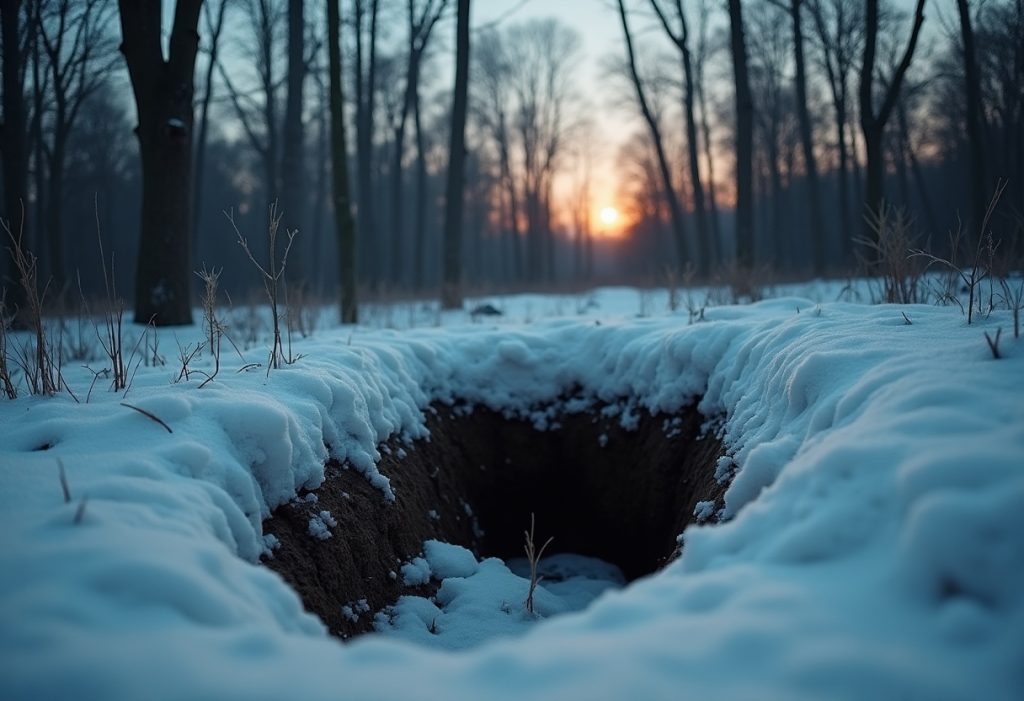
The hole was the kind of thing you only find when you fall into it. A shell crater, deep, half-roofed by a fallen pine. Eddie went in face first and lay there deciding whether to get up. The decision took a long time.
When he lifted his head, there was a German in the hole with him.
The German had a pistol. Eddie had a rifle he’d dropped somewhere in the last mile. They looked at each other across four feet of frozen mud, and Eddie understood that the German was doing the same arithmetic he was. A gunshot would bring people. People meant warmth, food, a fire. People also meant the kind of attention that got a man shot in a hole in the woods.
The German lowered the pistol. He set it in the snow beside his leg, where he could reach it and Eddie couldn’t.
“Kalt,” the German said.
Eddie knew that one. “Cold,” he agreed.
They sat. The wind found the gap under the pine and came through it like a blade. Eddie pulled his knees to his chest and put his hands in his armpits and shook. Across the hole, the German did the same. Two men curled into the same shape, four feet apart, shaking in time.
Eddie did the math again. A man freezes faster alone. Two bodies make more than one, and the gap between them was four feet of nothing doing neither of them any good.
He moved first. He didn’t decide to. His body decided, the way it had decided not to be frightened by his feet. He slid across the frozen mud until his shoulder was against the German’s shoulder, and he waited to be shot.
He wasn’t shot. The German shifted, and the pistol stayed in the snow, and the two of them fit themselves together back to back, spine against spine, the way men do when the only warmth left in the world is the warmth still inside another man.
“Hans,” the German said.
“Eddie.”
That was the whole conversation. There was nothing else to say that either of them could have said, and the cold took the breath you’d need to say it. They sat spine to spine and gave each other the only thing they had, which was the heat their own dying bodies made, and it was enough and it was not enough.
Eddie thought about his mother’s kitchen in Hamtramck. The radiator that knocked. He had spent his boyhood too warm and complaining about it, and he would have given a hand, the actual hand, to be too warm again.
Behind him, Hans had gone still. Not dead-still. Sleeping-still. The slow even shudder of a man whose body had given up fighting the cold and started conserving instead. Eddie elbowed him, hard, in the spine.
“No,” Eddie said. “You sleep, you die. No sleep.”
Hans said something in German. Eddie didn’t understand the words. He understood the meaning, which was the same thing he’d been telling himself for an hour: I know. I know. Let me anyway.
“No,” Eddie said again, and dug his elbow in, and kept it there.
The night went on. Eddie measured it in the things that stopped hurting. First his feet, then his hands, then the tip of his nose. Each thing that stopped hurting was a thing he was losing.
He kept Hans awake by talking, in English, about nothing. The Tigers. His sister’s wedding. A girl named Dorothy who’d written him twice and stopped. Hans couldn’t understand a word and stayed awake to the sound of it. Past the worst hour he talked back, in German, and the two of them lay spine to spine and narrated their lives to each other in languages neither one could follow.
Gray came into the sky so slowly that Eddie missed the moment it started. The trees turned from black to charcoal. Somewhere east, an engine.
Hans felt it too. The body against Eddie’s back went tense. The arithmetic had changed. Daylight meant patrols, and a patrol would belong to one army or the other, and either way it would find an American and a German wrapped around each other in a hole, keeping each other alive.
They came apart. The cold rushed into the space where the other man had been, and it was worse than before, because now Eddie’s body remembered what warm had felt like.
Hans picked up the pistol. He looked at it. He looked at Eddie.
Then he set it back down in the snow, stood on legs that barely held him, and climbed out of the hole, east, toward the engine and his own people, leaving the pistol behind in case Eddie’s patrol came first and a man in a hole needed something to surrender.
Eddie kept it. Years later, in Hamtramck, in a kitchen with a radiator that knocked, he would take it out of a drawer and hold it and fail to explain to anyone why a man would carry his enemy’s gun across an ocean and keep it oiled for fifty years.
He knew why. He just couldn’t say it. The cold takes the breath you’d need, and some breath never comes back.
Free Stories, Straight to Your Inbox
Start with Nine Doors, nine short stories across nine genres, yours free the moment you sign up. After that, the occasional new collection and a note when there's a new book worth your time. No spam, no daily clutter. Just good stories.
We use MailerLite to manage our list and send these emails. Your address is used only to send you what you signed up for. We will not sell it, share it, or use it for anything else, and you can unsubscribe anytime.