
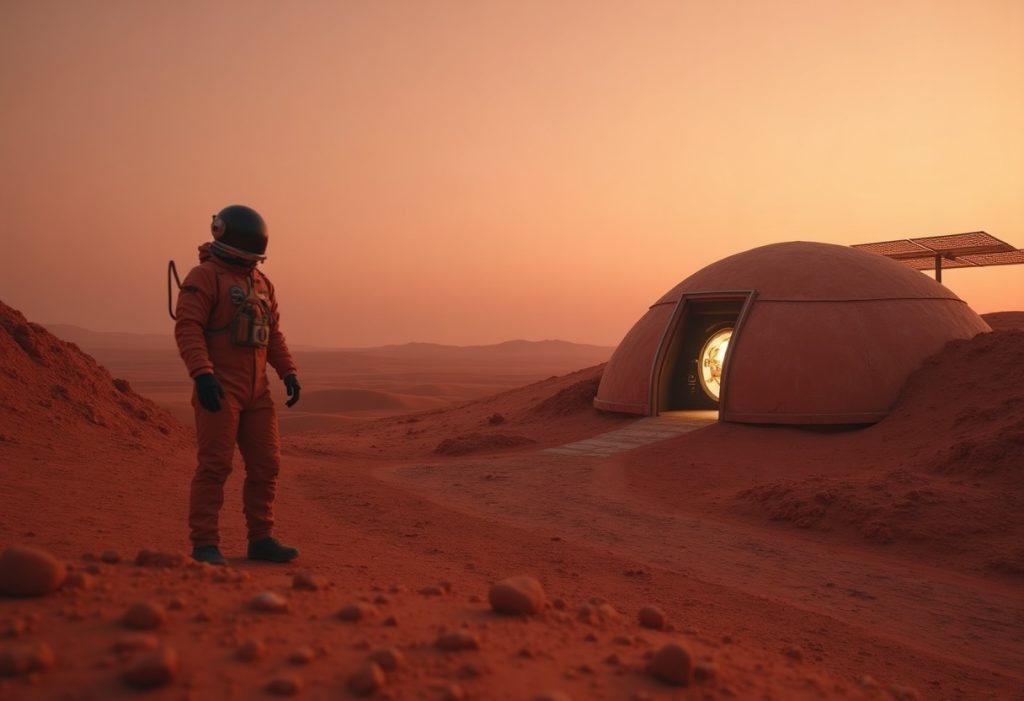
Forget the picture in your head. The Mars colony in the movies is a gleaming dome of glass, full of green plants and people in white jumpsuits looking out at a red sunset through floor-to-ceiling windows. That colony will not exist, because that colony would kill everyone in it inside a week. The real thing will be uglier, stranger, and mostly underground, and it is worth knowing what it will actually look like, because the gap between the fantasy and the reality says a lot about how hard this is.
Here is the honest version, built from what engineers are actually planning, not what looks good on a poster.
A promise that took fifty years
I want to start with something personal, because it shapes how I read all of this. When I was young, the books and the magazines and NASA and the government all promised the same thing. We would have a base on the Moon, and colonies on Mars, by the year 2000, or the early 2000s at the latest. This was not wild speculation. It was the official plan. We had just walked on the Moon, and the obvious next steps seemed to be a Moon base, then Mars, on a clear schedule. If you were a kid then, you fully expected to watch the first Mars landing the way your parents watched the first Moon landing.
Then it stopped. The Moon program got cancelled with missions still built and paid for. Human spaceflight pulled back to low orbit and stayed there for forty years, going in circles a few hundred miles up while the deep-space work went to robots. The robots were genuinely impressive, and they did real science, but it was not the thing we were promised. Nobody grew up dreaming of being a probe. For a long stretch it felt like we had quietly given up on sending people anywhere that mattered, and that was a real disappointment to anyone who had been told, as a child, that they would live to see it.
What stalled it was not that Mars got harder. It was always this hard. What stalled it was that the money and the will dried up once there was no race to win. Going to Mars properly costs a fortune and risks lives, and for decades no one was willing to own that. So the promise sat on the shelf, and a couple of generations grew up watching the future they were sold fail to arrive.
And now, finally, it is happening. Hardware is being built and tested. Landings are being attempted. The thing that seemed permanently stuck has started moving again, within the lifetime of the people who were promised it the first time. That is worth sitting with for a moment before we get into the dust and the radiation, because the story of the Mars colony is not only an engineering story. It is also a story about a promise made to a generation, broken for fifty years, and now, at last, being kept.
Mars is trying to kill you, specifically
Before you can picture the colony, you have to understand what it is defending against, because every design choice is an answer to a way Mars can kill you.
The air will not keep you alive. The Martian atmosphere is about one percent as thick as Earth’s, and what little there is is mostly carbon dioxide. You cannot breathe it, and the thinness means there is almost no protection from above. Step outside without a suit and your blood would not boil dramatically the way films show, but you would be unconscious in seconds and dead in a couple of minutes, from a mix of no oxygen and pressure so low your body cannot function.
The cold is severe. Mars runs far colder than Earth, with temperatures that swing wildly between day and night because the thin air holds no heat. A warm afternoon at the equator can drop to deep freezing by nightfall. Whatever the colony is made of has to survive that thermal swing over and over, day after day, which slowly cracks and stresses materials in ways that matter over years.
But the real killer, the one that shapes everything, is radiation. Earth has a strong magnetic field and a thick atmosphere, and together they form a shield that soaks up most of the dangerous radiation from space and from the sun. Mars has neither. Its magnetic field died long ago, and its atmosphere is too thin to help. So the surface is bathed in cosmic radiation all the time, with occasional bursts from solar storms that would be quickly lethal. A person standing on the open surface is being slowly cooked at the cellular level, and over a long stay the cancer risk climbs to something no one would accept.
That single fact, the radiation, is why the gleaming glass dome is a death trap and why the real colony will look the way it does.
The colony will be buried
Here is the first big surprise for anyone expecting windows and sunlight. The colony will mostly be underground, or buried under several meters of Martian dirt, because dirt is the cheapest radiation shield available and there is an unlimited supply of it lying around.
The Martian surface is covered in a layer of loose rock and dust called regolith, and piling two or three meters of it over a habitat blocks a large fraction of the radiation. So the realistic early colony is not a dome. It is a structure that gets covered in soil until it looks like a low hill, or it is dug into the ground entirely, or it is tucked into a natural feature like a lava tube, which is an underground tunnel left behind by ancient volcanic activity. Some of the most protected real estate on Mars is inside these tubes, where the rock overhead does the shielding for free.
This means the colony’s relationship to the famous red country outside is mostly indirect. People will not be gazing out picture windows at the sunset. They will be living in shielded boxes under the ground, looking at screens that show them the outside, going up to the surface only in suits and only for as long as the radiation budget allows. The view everyone imagines is the one thing the real colony cannot afford to give them.
How it gets built, and by what
The colony will not be assembled by astronauts with wrenches. The early construction will be done by machines, before any humans arrive, because it is too dangerous and too slow to have people do it by hand.
The plan most groups are converging on works in stages. First, robots and automated equipment land and begin preparing the site. Inflatable habitats, which pack small for the trip and expand once deployed, get set up and then buried under regolith for shielding. Other approaches use 3D printers that mix Martian soil into a kind of concrete and print the structure layer by layer, walls thick enough to double as radiation protection. There is even research into making a kind of glass or solid building material out of melted regolith, so that almost everything is built from what is already on Mars rather than hauled from Earth at enormous cost.
That last point drives the whole design. The phrase the engineers use is in-situ resource utilization, which is a clumsy way of saying use what is already there. Every kilogram shipped from Earth costs a fortune, so the colony has to make as much as it can on site. The dirt becomes the building. The frozen water in the ground becomes drinking water, breathable oxygen, and rocket fuel. The carbon dioxide in the air becomes more fuel and feedstock for chemistry. A colony that depends on regular deliveries from Earth is a colony one missed launch away from death, so the entire goal is to need Earth as little as possible.
Keeping people alive inside
Once you are in the buried box, staying alive is a closed-loop problem, which means almost nothing can be thrown away, because there is nowhere to throw it and no store to replace it.
The air has to be recycled continuously, scrubbing out the carbon dioxide people breathe out and putting oxygen back in. The water has to be recycled almost completely, including from sweat, breath, and waste, because every drop is precious and importing more is not an option. These closed-loop life support systems are the hardest part of the whole enterprise, harder in some ways than getting there, because they have to run for years without failing, and a serious failure does not mean discomfort, it means everyone dies.
Food is its own problem. The colony cannot ship in groceries, so it has to grow them, which means farming under artificial light in sealed rooms, using methods that grow plants without much soil, fed by recycled water and nutrients. Early colonists will eat a monotonous diet of whatever grows reliably in those conditions, supplemented by shipped supplies until the farms can carry the load. The lush green gardens of the fantasy will, in reality, be cramped racks of crops under purple grow lights in a buried room, tended like the lifeline they are.
Where the power comes from
None of this runs without electricity, and a lot of it. Recycling air and water, heating the habitat against the cold, growing food under lights, melting ice, making fuel and oxygen out of the ground, all of it is hungry for power, and Mars is a hard place to get it.
There are two real options, and the colony will probably use both. Solar panels work, but Mars gets less than half the sunlight Earth does, the dust keeps coating the panels and cutting their output, and the worst dust storms can dim the sky for weeks, which is a serious problem for a base that runs on sunlight. The other option is nuclear, a small reactor that produces steady power regardless of weather or time of day, which is why most serious plans lean on nuclear for the baseline and treat solar as a supplement.
The scale of the need is easy to underestimate. Keeping people alive in a sealed box on a frozen, airless world is enormously energy-intensive, far more than running a house on Earth, where the air and warmth and water are free. On Mars nothing is free. Every breath, every degree of warmth, every glass of water has an energy cost attached, and the power system that pays those costs has to keep running without interruption, because the day the power fails is the day everything else fails with it.
The dust gets into everything
One detail that rarely makes the movies but dominates the engineering is dust. Martian dust is extremely fine, statically charged, and abrasive, and it gets into everything. It clogs machinery, coats solar panels and cuts their power, wears down moving parts, and is probably toxic to breathe. A huge amount of the real work of running a colony will be the unglamorous business of keeping the dust out and cleaning it off, day after day, because the dust never stops and never quits, and equipment that fails on Mars cannot be easily replaced.
This is the texture of the real colony that the fantasy leaves out. It is not a gleaming future. It is a constant, grinding fight against a hostile environment that is trying, through a dozen small mechanisms, to break your machines and end your life, and most of daily life will be maintenance, repair, and vigilance.
When, and how big
Be careful with the timelines, because they have a long history of slipping. Uncrewed test landings are being attempted in the near term, with the goal of proving that large craft can land on Mars at all and begin pre-positioning equipment. Crewed missions are talked about for the late 2020s or the 2030s, but the gap between an early crewed mission and an actual self-sustaining colony is enormous, and anyone giving you a confident date is selling something.
It is worth understanding why it is moving now when it sat dead for so long, because the reason is not what people assume. Nothing changed about the physics. Mars is exactly as far and as hostile as it was in 1975. What changed is the economics and who is willing to carry the risk. The cost of getting to orbit came down hard, which makes everything past orbit cheaper too. And private money with a long time horizon entered the picture, money that can absorb failures and dead ends in a way a government answerable to voters never could. A space agency that loses a crew faces hearings and cancellation. A private effort can fail, learn, and fly again. That difference in tolerance for risk, more than any new invention, is why the thing that was frozen for half a century has finally thawed.
The first real outpost will be tiny. A handful of people, then a few dozen, living in buried habitats, dependent on Earth for the things they cannot yet make, spending most of their effort just staying alive and expanding the base a little at a time. The image of a thousand-person city is a long-term dream resting on solving problems we have not yet solved, including how to shield that many people, how to power them, and how to grow enough food. A solar farm to feed a city of a thousand would need to cover an area as large as the colony itself, and that is just the electricity.
The honest near-term picture is small, buried, fragile, and heavily dependent on Earth, with self-sufficiency as a distant goal rather than a starting condition.
Why bother at all
Given all that, a fair question is why anyone would go. The answer that gets given most is insurance. Right now every human being lives on one planet, and one planet is one accident away from extinction, whether by asteroid, war, or something we have not thought of. A second, independent home for the species, however hard, removes that single point of failure. That is the serious argument, and it is a real one.
The other answers are older and harder to put in a spreadsheet. People go to hard places because the places are there, and because doing the hardest thing available is something humans have done since they first walked out of Africa. A Mars colony is the hardest thing currently available. Whether that justifies the cost and the risk is a real debate, with thoughtful people on both sides, and anyone who tells you the answer is obvious in either direction is not thinking hard enough.
The real picture
So here is the colony, stripped of the poster art. A cluster of buried habitats under several meters of red dirt, or dug into a lava tube, built mostly by machines out of Martian soil before the people arrived. Inside, cramped sealed rooms with recycled air and water, racks of crops under artificial light, and a small crew spending most of their days fighting dust, maintaining systems, and watching their radiation exposure. Outside, a beautiful, lethal country they can only visit in suits, for a little while, before the radiation drives them back underground.
It is not the gleaming dome. It is more like a frontier mine or a deep-sea station than a future city, a hard, practical, dangerous place where survival is the daily work and the view everyone imagines is the one luxury the planet refuses to allow.
That is what a Mars colony will actually look like, and the strange thing is that it is more impressive than the fantasy, not less, because the fantasy is easy and the reality is the hardest thing our species has ever tried to do.
And for those of us who were promised this as children and watched it not come for fifty years, the buried, dusty, fragile reality is better than the glossy magazine version ever was, for one simple reason. The magazine version was a painting. This one is being built. I would rather see the real thing start, ugly and hard and behind schedule, than spend another fifty years looking at pictures of a dome that was never going to be real. The promise is finally being kept, and a painting never kept anyone alive on Mars.
Free Stories, Straight to Your Inbox
Start with Nine Doors, nine short stories across nine genres, yours free the moment you sign up. After that, the occasional new collection and a note when there's a new book worth your time. No spam, no daily clutter. Just good stories.
We use MailerLite to manage our list and send these emails. Your address is used only to send you what you signed up for. We will not sell it, share it, or use it for anything else, and you can unsubscribe anytime.