
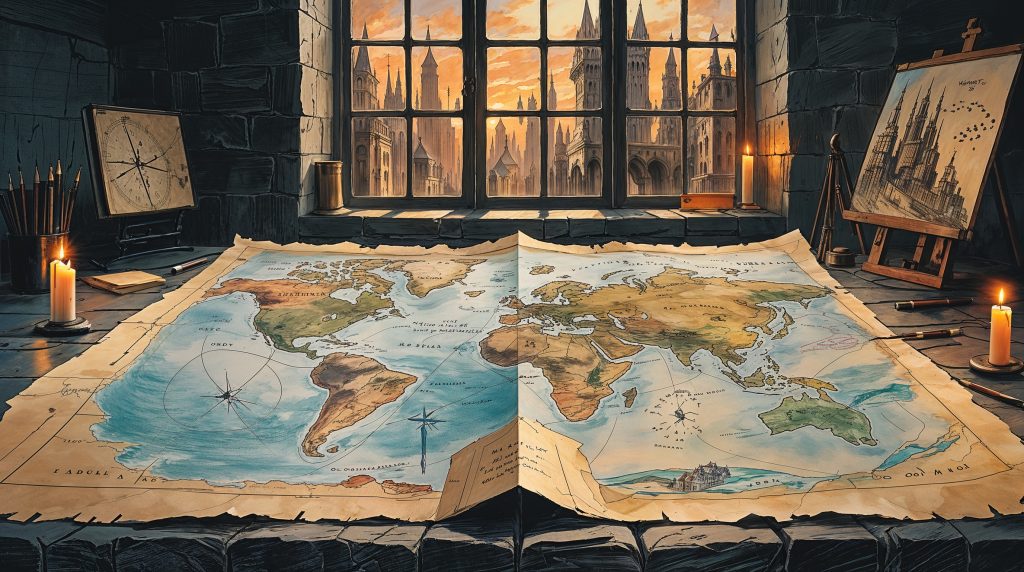
20 Worldbuilding Writing Exercises with Craft Mechanics
TL;DR: Worldbuilding exercises that ask you to “design a magic system” give you homework, not craft instruction. These 20 exercises target the mechanics that make fictional worlds feel inhabited: economic logic, cultural collision, environmental consequence, institutional memory, and the specific ways people adapt to extraordinary circumstances. Each exercise builds a world through the human behavior it produces, not the Wikipedia entry it would generate.
Worlds Are Not Maps
A map tells you where things are. A world tells you why things are where they are and what it costs to live there. The best worldbuilding is invisible — the reader never notices it because it’s embedded in character behavior, economic decisions, and social habits that feel inevitable rather than invented. If you have to stop the story to explain the world, the world isn’t built into the story. These exercises force you to build worlds through consequence rather than description.
Each exercise gives you a single worldbuilding element and asks you to trace its effects through economy, culture, politics, and daily life. The Worldbuilding Handbook covers systemic construction, cultural logic, and the integration of world details into narrative.
1. A City Built Around a Natural Phenomenon Nobody Can Explain
Mystery as Infrastructure
The Hum has existed for as long as anyone can remember. A low resonance emanating from beneath the central plaza. It modulates with the seasons. Buildings constructed near it last longer. Crops planted within its range grow faster. The city was built around the Hum because the Hum provides, and nobody knows what it is, what generates it, or whether it can stop. Three religions, two scientific institutions, and a thriving tourist industry have formed around a sound nobody understands.
The craft underneath: Unexplained phenomena create layered societies. The exercise forces you to build competing interpretations of the same event — religious, scientific, commercial — and show how each interpretation shapes a different sector of the city. The temples are near the plaza because proximity to the Hum confers spiritual authority. The university is near the plaza because studying the Hum requires access. The hotels are near the plaza because tourists pay premium rates. Write the zoning disputes as theology, science, and commerce fighting for the same real estate. The Hum itself doesn’t need an explanation. The society built around it does.
2. A World Where the Dead Can Be Consulted But Lie Frequently
Unreliable Afterlife and Institutional Adaptation
Necromantic consultation is legal, common, and problematic. The dead can speak, but death changes them — they lose context, hold grudges, and sometimes lie for entertainment. A deceased witness in court might be genuinely helpful or might be settling a score from beyond the grave. The legal system has adapted: dead testimony requires corroboration, posthumous bias is a recognized legal concept, and necromantic advocates specialize in cross-examining people who have nothing left to lose.
The craft underneath: Take a fantasy element and push it through institutional logic. If the dead can speak, every institution — legal, medical, familial — must adapt. The exercise is building those adaptations in specific detail: the court procedures, the family inheritance disputes where Great-Aunt Gertrude changes her mind posthumously, the insurance companies that consult the dead about their own cause of death and get contradictory answers. Write the necromantic advocate’s training manual — the techniques for establishing posthumous credibility and identifying dead-witness bias. The world becomes real when its institutions have developed procedures for handling the impossible.
3. A Civilization Where Music Is the Primary Technology
Alternative Technological Base
Sound replaces electricity. Resonance frequencies power machines. Harmonic structures replace mathematics. The civilization developed acoustic technology instead of electronic technology — not because they lack intelligence but because their physics works differently. Doors open to specific tones. Communication happens through melodic encoding. Warfare uses dissonance as a weapon. The tone-deaf are disabled in the way the blind are in our world.
The craft underneath: Alternative technology bases create worlds that feel genuinely alien rather than medieval-Europe-with-dragons. The exercise is tracing a single technological substitution through every aspect of daily life: how do people lock their doors if the key is a melody? How do you keep secrets if the encryption is harmonic? What does an arms race look like when the weapons are frequencies? Write the tone-deaf character navigating a world designed for hearing: the doors they can’t open, the conversations they can’t have, the accommodations that exist or don’t. The disability angle reveals the world’s values through what it accommodates and what it ignores.
4. An Empire Held Together by a Road System That’s Alive
Infrastructure as Entity
The Imperial Roads were not built. They grew. Organic pathways of compacted stone and something that might be bone, extending from the capital to every provincial border. The roads repair themselves. They redirect around obstacles. They’ve been observed growing new branches toward towns that reach a certain population threshold. The empire’s unity depends entirely on the road network, and the roads have started refusing passage to certain travelers for reasons nobody can determine.
The craft underneath: Living infrastructure creates a dependency relationship between civilization and something it doesn’t control. The exercise forces you to build the political consequences of roads that have opinions. Provincial governors who displease the roads find their towns disconnected. Merchants whose goods the roads refuse to carry lose their businesses. The empire’s engineers aren’t engineers — they’re diplomats who negotiate with pavement. Write the road’s refusal scene: a caravan approaches and the surface softens to impassable mud, or the path curves away from the destination. The civilization can’t exist without the roads, and the roads can’t be coerced. That power dynamic is the world.
5. A Society Where Dreams Are a Shared Public Space
Collective Unconscious as Infrastructure
When citizens of Somnara sleep, they enter a shared dreamscape. It has geography — districts, landmarks, institutions built from collective imagination. Dream-architects design the public spaces. Dream-police patrol for nightmares. The economy includes dream-commerce: experiences, sensations, and memories traded as goods. Privacy doesn’t exist in sleep. Your dreams are visible to anyone in the same district, and the wealthy live in private dream-enclaves while the poor dream in public view.
The craft underneath: Shared dreaming creates a privacy crisis that shapes every social interaction. The exercise forces you to build a culture where people’s unconscious lives are public, which changes what they repress, what they express, and how they manage their inner lives. Write the dream-district as a neighborhood with its own culture: the embarrassments that become public entertainment, the secrets that can’t be hidden, the therapeutic infrastructure for people whose nightmares affect their neighbors. The class division — private versus public dreaming — maps onto real economic inequality but through a uniquely intimate dimension.
6. A Desert Civilization That Measures Wealth in Water and Treats Gold as Worthless
Environmental Economics
In the Karath Expanse, water is currency. Coins are hollow glass vials of purified water in standardized volumes. Banks are cisterns. Theft of water carries the death penalty. Gold, abundant in the desert’s geology, is used for children’s toys and road paving. A merchant from a water-rich nation arrives with gold and discovers that the most valuable thing he owns is his canteen.
The craft underneath: Environmental scarcity determines value systems. The exercise forces you to reimagine every economic and social institution through the lens of water scarcity. Marriage contracts specify water-sharing ratios. Funerals involve reclamation of the body’s moisture. Hospitality means offering water, and the amount offered indicates social status. Write the foreign merchant’s economic education as culture shock: every assumption about wealth is inverted, and the adaptation process reveals both cultures’ values. The gold-paved streets aren’t decadent — they’re practical use of an abundant, worthless material.
7. A Floating City That Must Constantly Sacrifice Weight to Stay Aloft
Resource Scarcity and Aerial Sociology
Aethon floats on principles nobody alive fully understands. What they understand is the weight limit: exceed it and the city descends. Every birth adds weight. Every import adds weight. Every building, every meal, every object has a gravitational cost. The Bureau of Mass manages the city’s weight budget, and their decisions — what gets jettisoned, who gets the weight allowance for a new child, which district loses a building to save the altitude — are the most consequential governance in the world.
The craft underneath: Weight-as-currency creates a society where physicality is political. The exercise forces you to build institutions around a constraint that affects every human activity: reproduction is licensed by mass allowance, immigration requires someone else’s weight to be removed, and obesity is a civic offense rather than a health concern. Write the jettisoning ceremony — the monthly event where excess weight is dropped over the edge — as a cultural ritual that’s simultaneously practical and spiritual. The objects thrown overboard tell a story about what the city values enough to keep.
8. A World Where Language Physically Reshapes Reality
Linguistic Causality and the Danger of Speech
Words have weight. Literal weight. Describing something causes it to become more like the description. Calling a river “slow” makes it slow. Calling a person “kind” increases their kindness. The effect is cumulative and permanent. The civilization has developed a precise, minimal language to avoid accidental alteration — every word is chosen with the care of a surgeon because careless speech reshapes the world. Poets are either revered artists or dangerous criminals, depending on what they describe.
The craft underneath: Language-as-power creates a world where communication is inherently risky. The exercise forces you to build a culture of linguistic precision: schools teach children to speak carefully before they teach them to speak expressively. Compliments are gifts. Insults are assault. The legal system prosecutes harmful speech with the same severity as physical violence. Write the poet’s position in this society — someone who deliberately reshapes reality through art, which makes them either a hero or a weapon. The tension between necessary speech and dangerous speech shapes every conversation, and silence becomes the safest form of communication.
9. A Civilization Living Inside a Massive Clock Mechanism
Mechanical Cosmology and Temporal Culture
The city of Hora exists within the gears, springs, and mechanisms of a clock so large that its exterior has never been seen. Citizens live on gear platforms that rotate predictably, with districts connected by bridges that align only at specific times. The “day” is one full rotation of the Great Gear. Neighborhoods are close or distant depending on the current gear alignment, and the social geography changes hourly. The clockmaker, if one ever existed, is absent. The clock runs itself.
The craft underneath: Architecture-as-cosmology. The exercise forces you to build daily life around mechanical rotation: the school that’s accessible for three hours before the gears rotate it away, the market that only connects to the residential district during certain alignments, the lovers who live on gears that bring them together once a day for forty minutes. Write the religion of the clock — the priests who maintain the mechanisms without understanding them, the heresy of suggesting the clock was built versus the orthodoxy that it always existed, and the small growing faction that wants to stop the mechanism and see what is outside.
10. A World Where Emotions Are Visible as Colored Auras
Emotional Transparency and Social Adaptation
Everyone radiates color based on their emotional state. Red for anger, blue for sadness, green for envy, gold for joy. The colors can’t be hidden, faked, or suppressed. Diplomacy is impossible in the traditional sense — you can’t bluff when your aura shows your hand. Poker doesn’t exist. Lying is functionally extinct. The civilization has adapted: instead of hiding emotions, they’ve developed elaborate social rituals for managing visible feelings in public.
The craft underneath: Emotional visibility destroys privacy and creates a completely different social contract. The exercise forces you to build the customs that emerge: the socially acceptable response when you see someone’s grief aura on the street, the workplace policies around anger display, the dating culture where attraction is literally visible. Write the outlier — a person born without an aura — and the social suspicion that attaches to emotional invisibility in a world where transparency is the norm. The invisible person is the most frightening figure in this world because they’re the only one who can lie.
11. A Civilization Built on the Bones of a Larger, Older Civilization They Don’t Understand
Technological Inheritance and Archaeological Dependency
The current civilization uses the infrastructure, tools, and buildings of a predecessor culture without understanding the technology. The plumbing works but nobody knows how. The lights glow but nobody can repair them. The buildings are structurally sound but made of a material that current science can’t identify. The civilization is a tenant in a building they didn’t construct, using amenities they can’t maintain, and the slow failure of the predecessor’s technology is a clock they can hear ticking.
The craft underneath: Technological inheritance without understanding is a worldbuilding goldmine. The exercise forces you to build a culture of reverse engineering, sacred maintenance, and the anxiety of dependency. Write the maintenance guilds — the closest thing to scientists, who’ve spent generations learning to repair without understanding — and the political power they wield because they’re the only ones who keep the lights on. When a predecessor technology fails permanently in a district, write the cascading consequences and the social reckoning with how fragile their civilization actually is.
12. A World Where Distance Is Measured in Danger Rather Than Miles
Threat-Based Geography
The map doesn’t show kilometers. It shows risk gradients. Two cities might be physically close but separated by a zone of such environmental or creature-based danger that the “distance” is measured in mortality rates. A safe path between two points might be three times the physical distance but a fraction of the danger-distance. Navigation isn’t about direction — it’s about threat assessment, and cartographers are more valuable than generals.
The craft underneath: Alternative measurement systems restructure how characters think about space. The exercise forces you to build the commerce, communication, and culture that emerge when travel is measured in survival probability rather than distance. Write the merchant who takes the long-safe route and arrives weeks later, versus the courier who takes the short-deadly route and might not arrive at all. Trade goods are priced not just by scarcity but by the danger-cost of transporting them. Write the insurance market for travelers and the actuarial tables that make the world feel bureaucratically real.
13. An Underground City Where Sunlight Is a Controlled Substance
Light Scarcity and Photonic Class Structure
The city exists beneath the surface. Sunlight reaches it through engineered shafts controlled by the Light Guild. Access to natural light is rationed: the wealthy live in districts where the shafts are wide and frequent, the poor live in perpetual bioluminescence. Full-spectrum natural light is a luxury good. Seasonal Affective Disorder is the default human condition, and the black market for unauthorized light access is the city’s most profitable criminal enterprise.
The craft underneath: Light as resource creates class structure through a need that’s biological rather than economic. The exercise forces you to build the health, cultural, and psychological consequences of light deprivation: the medicines that replace vitamin D, the art that uses bioluminescence instead of natural color, the festivals where the shafts are opened briefly and the entire city remembers what the sun looks like. Write the black-market lightrunner who smuggles solar panels and mirrors into the dark districts, and the Light Guild enforcer who hunts them.
14. A Nomadic Culture Whose Entire History Is Stored in Textiles
Material Memory and Portable Civilization
The Weavers don’t write. They encode history, law, genealogy, and scientific knowledge in textile patterns. A single tapestry might contain three generations of family history in its color sequences and a treaty’s legal terms in its knot spacing. The Weavers’ most skilled artisans are simultaneously their historians, judges, and scientists, and the destruction of a textile is the erasure of everything it recorded.
The craft underneath: Alternative record-keeping creates a different relationship with knowledge. The exercise forces you to build the consequences of portable, physical memory: the theft of a tapestry is the theft of history itself, and the weaving of a false tapestry is the forgery of reality. Write the master weaver who discovers an ancient textile that contradicts the accepted history — the pattern says something happened that the elders deny. The material record and the oral tradition conflict, and the culture must decide which form of memory has authority.
15. A City Where Architecture Responds to the Emotions of Its Inhabitants
Empathic Infrastructure
The buildings of Resonara were grown, not built. They respond to the collective emotional state of their occupants: a happy household has high ceilings and warm walls; a grieving one contracts, darkens, becomes cave-like. Public buildings reflect civic mood — the courthouse narrows its corridors during contentious trials. The architecture can’t be overridden. A house knows when you’re lying about being fine.
The craft underneath: Empathic architecture externalizes what characters hide. The exercise forces you to build social consequences of buildings that expose emotional reality: the neighborhood that darkens during a divorce everyone pretends isn’t happening, the office building that expands when the team is genuinely collaborative and shrinks when the culture is toxic. Write the real estate market — a happy home sells for more not because of square footage but because the architecture proves the inhabitants were content. The house is the ultimate honest narrator.
16. A World Where Birth Order Determines Social Class Across All Cultures
Biological Determinism and Cross-Cultural Constraint
Firstborns rule. Secondborns serve. Thirdborns create. Every culture on this world independently developed the same class structure based on birth order, which suggests the pattern isn’t cultural but biological — something in this world’s genetics or metaphysics locks personality and capability to birth sequence. The system works well enough that most people don’t question it. The fourth child — the unlicensed, unclassified anomaly — is the world’s most dangerous social position.
The craft underneath: Deterministic social systems create pressure at the exceptions. The exercise forces you to build the world through its orthodoxy and then find the cracks. Write the firstborn who can’t lead, the secondborn who refuses to serve, the thirdborn whose creativity is weaponized. The fourth child is the worldbuilding engine: every family with four or more children produced someone the system can’t classify, and those people either hide, rebel, or are institutionalized. The world is stable because the system mostly works, and unstable because the exceptions are accumulating.
17. A Civilization That Farms the Sky
Aerial Agriculture and Vertical Society
The surface is uninhabitable. The civilization lives on mountain peaks and plateaus connected by cable systems, and their agriculture happens in the clouds — crops grown on suspended platforms in the moisture-rich upper atmosphere, pollinated by trained birds, harvested by climbers who spend their working lives at altitudes that would kill lowlanders. The farmers are the most physically elite class. Ground-dwellers are the poor. Height is status, literally.
The craft underneath: Vertical civilization inverts assumptions about agriculture, labor, and class. The exercise forces you to build an economy where the most physically demanding work is the most prestigious, and where “looking down” on someone is both metaphorical and geographic. Write the harvest season: the climbers ascending in teams, the cable systems ferrying produce downward, the cloud-farming techniques that require reading weather the way surface farmers read soil. The altitude sickness that kills new climbers is the entry barrier to the elite class, and the families who’ve adapted over generations have a biological advantage that functions as hereditary nobility.
18. A World Where Shadows Are Separate Entities from Their Owners
Dual-Entity Cosmology and Shadow Politics
Every person has a shadow, and the shadow is a separate being with its own personality, memories, and agenda. Shadows can’t speak, but they communicate through gesture and movement. Most shadows cooperate with their owners. Some don’t. A hostile shadow can sabotage, embarrass, and endanger the person it’s attached to. Shadow courts exist to adjudicate disputes between people and their shadows. Divorce from one’s shadow is technically possible but leaves both parties diminished.
The craft underneath: The shadow-as-separate-entity externalizes the unconscious. The exercise forces you to build social norms around a dual-entity existence: the etiquette of shadow behavior in public, the therapy for shadow-owner conflict, the legal framework for when a shadow commits a crime its owner didn’t sanction. Write the person whose shadow has stopped moving — either perfectly still or subtly wrong — and the social alarm this triggers, because a misbehaving shadow is the most visible sign that something is deeply wrong with its owner.
19. A Civilization Where Death Is Not Permanent but Resurrection Has a Queue
Resurrection Bureaucracy and the Politics of Priority
Death is a temporary condition. The Resurrection Temple processes the dead and returns them to life, but the queue is long — currently forty-seven years — and the wealthy can pay for priority placement. A dead farmer waits five decades. A dead senator waits five months. The system works efficiently, is transparently unequal, and has created a civilization where death isn’t feared but the queue is, because forty-seven years of missed life is functionally the same as permanent death for anyone who can’t afford the skip.
The craft underneath: Resurrection with scarcity creates every real-world inequality through a fantasy lens. The exercise forces you to build the economic, social, and emotional consequences of queued immortality: the families waiting decades for a loved one, the career interruption of dying at the wrong time, the insurance industry built around resurrection priority. Write the queue administrator — the bureaucrat who decides the order — as the most powerful and most hated person in the civilization. The system isn’t broken. It’s working exactly as designed, and the design favors wealth. That makes it commentary without preaching.
20. A World Where Memory Can Be Physically Extracted and Stored
Externalized Memory and the Commodification of Experience
Memories can be pulled from the brain, preserved in crystalline vials, and either stored or implanted in another person. The technology is precise: you can remove the memory of a specific Tuesday afternoon without affecting Wednesday. Memory banks store personal histories the way safety deposit boxes store valuables. The economy includes a thriving trade in experiences — someone else’s first kiss, a war veteran’s survival memories, an artist’s moment of inspiration — sold as luxury goods.
The craft underneath: Memory extraction changes identity because identity is memory. The exercise forces you to build the consequences: the person who sold their happiest memory to pay rent and now can’t remember joy, the collector who lives in a mansion of other people’s experiences and has none of their own, the legal system grappling with whether a memory sold under duress is a valid transaction. Write the memory bank heist — not for money but for experiences — and the existential theft of taking someone’s only copy of their mother’s face. The world is built through what memory means when it’s portable.
FAQ
How much worldbuilding should go on the page?
Ten percent of what you know. Build the world completely in your notes, then reveal it through character behavior and environmental detail. If a character mentions the water tax while complaining about the cost of dinner, the reader learns the world without a lecture. The iceberg principle applies: the reader feels the mass beneath the surface without seeing it.
How do I avoid info-dumping?
Never explain something the character already knows. If your protagonist has lived in the floating city their entire life, they don’t think about how it floats any more than you think about gravity. Reveal world details through newcomers, conflicts, and breakdowns — moments where the normal needs explaining because something went wrong.
Do I need consistent rules for magic or technology?
You need consistent rules for anything the reader is expected to anticipate. If magic has no rules, the reader can’t predict outcomes, which means they can’t feel tension. The rules don’t need to be simple, but they need to be inferable from the story. Every time magic solves a problem, it should create a new one. That’s your rules working.
How do I make fictional cultures feel distinct?
Give each culture a core value and trace it through everything. A culture that values memory will have different architecture, different art, different taboos than a culture that values novelty. The core value shapes food, clothing, insults, compliments, and courtship. If you can swap two cultures’ customs without noticing, neither culture is built deeply enough.
The AI-Enhanced Writer’s Library
These exercises scratch the surface. The AI-Enhanced Writer’s Library includes 40+ handbooks covering every element of fiction craft — from dialogue and character psychology to plot structure and marketing. Each handbook includes psychology-first instruction and between 40 and 200 AI prompts tested with ChatGPT, Claude, and Gemini. Written by an author with 113 published books and 52 ghostwriting projects.