
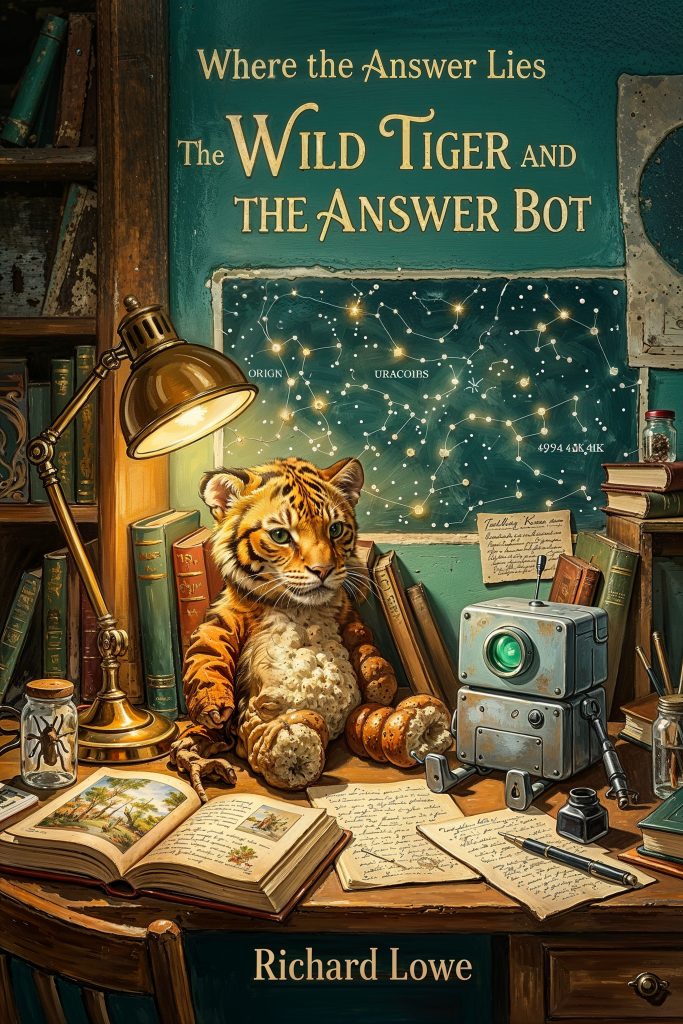
The Wild Tiger and the Answer Bot
Blaze is a nine-year-old Bengal tiger who knows a lot. He knows that petrichor is the smell of rain on dry earth, that clouds form through a process called nucleation, that obsidian is technically a glass and not a rock, and that the cutting edge of an obsidian blade can be one molecule thick.
What he cannot do is stop himself from saying it out loud.
The moment someone asks a question, any question, the answer arrives before he can think about whether to say it, and then it is already out of his mouth and he is standing halfway out of his chair and Ms. Burrows is looking at him with the expression that has given up being surprised. His parents say slow down. His teacher says slow down. Nobody explains what slow down actually means or what his hands are supposed to do while he is doing it. Slow down is a direction with no map. It is an address with no street.
When a note home threatens to move him to a separate seat away from his only real friend, Blaze decides he has been waiting for someone to give him a real answer long enough. He is going to find one himself.
His robot companion Chip has been sitting on a shelf for two years with a secret: he knows how to navigate the real internet — not the surface layer that screens show you, but the actual physical infrastructure underneath, where information lives in buildings and rivers of light run between them and the creatures that inhabit it are built from everything the internet is and does.
What Blaze and Chip find inside is a city with no edges. Buildings of warm yellow light that hold accurate information, blue ones tall and solid with the weight of years, and deep in the red district a whole architecture of misdirection designed to catch curious minds and never let go. They encounter a click-crawler the size of a delivery truck, built entirely from clickbait, whose eyes are designed to capture attention that was never offered voluntarily. They meet a misinformation troll who wears shoes on its hands so it cannot accidentally write anything down, and carries a sign that says WRoNG in letters of different sizes going in different directions.
And at the end of a stone passage, in a workshop covered floor to ceiling with drawings of flying machines and water spirals and the cross-sections of things that want to be understood, they find Leonardo da Vinci — the internet’s answer bot — who does not give Blaze a single answer. He only asks questions. The right ones, in the right order, until Blaze arrives at everything he needed to know by himself.
The first book in the Wild Tiger Series. For the child who processes faster than the room, who knows what things are called and cannot stop saying so, who has been told to slow down so many times the words have worn smooth and lost all meaning.
| Amazon Kindle | Paperback (IngramSpark) | epub (Kobo) |
| 📖 Look Inside | Need a Ghostwriter? Let’s Talk | |
| ISBN (Paperback): | 978-1-972810-59-0 |
| ISBN (eBook): | 978-1-972810-60-6 |
| Series: | Wild Tiger Series, Book 1 |
| Publisher: | The Writing King |
| Publication Date: | April 20, 2026 |
| Print Length: | 94 pages |
| Reading Age: | 6–12 years |
| Language: | English |
Questions
Read the Opening
Chapter One
The Tiger Who Couldn’t Stop
My name is Blaze, and I am a tiger.
Not just any tiger. I’m a Bengal tiger, which means orange fur, black stripes, and a tail that has never in nine years of life stayed still for longer than about four seconds. I’ve timed it. Four seconds is the record and I was asleep when I set it.
Inside my room the books have taken over. They started on the shelves and expanded. There are stacks on the floor now, stacks on the desk, one precarious tower on the windowsill between the beetle jars. Deep-sea biology. Volcanic geology. Robot engineering. The complete history of the solar system. A field guide to beetles of the eastern United States that I’ve read so many times the spine has cracked.
In the middle of all this, on the shelf above my desk, lives a robot named Chip. Chip is small, about the size of a shoebox, with smooth silver-gray sides and one round green eye centered in his face that glows at different intensities depending on his mood.
I’m nine years old. I’m in fourth grade. I love volcanoes and beetles and deep-sea fish, and I love the way the air smells right before a thunderstorm. There’s a word for it: petrichor, the smell of rain on dry earth, and I love knowing what things are called.
Here is the most important thing before we get to the story.
I am not a troublemaker.
I know. I know. Every kid who gets in trouble says that. But it’s true. I don’t cheat or steal or push anyone. I’m not trying to ruin things. I just have a brain that runs at a speed nobody else seems to be running at, and that speed causes problems. Not on purpose. Never on purpose.
This is the story of the biggest problem. And how I went to find the answer.