
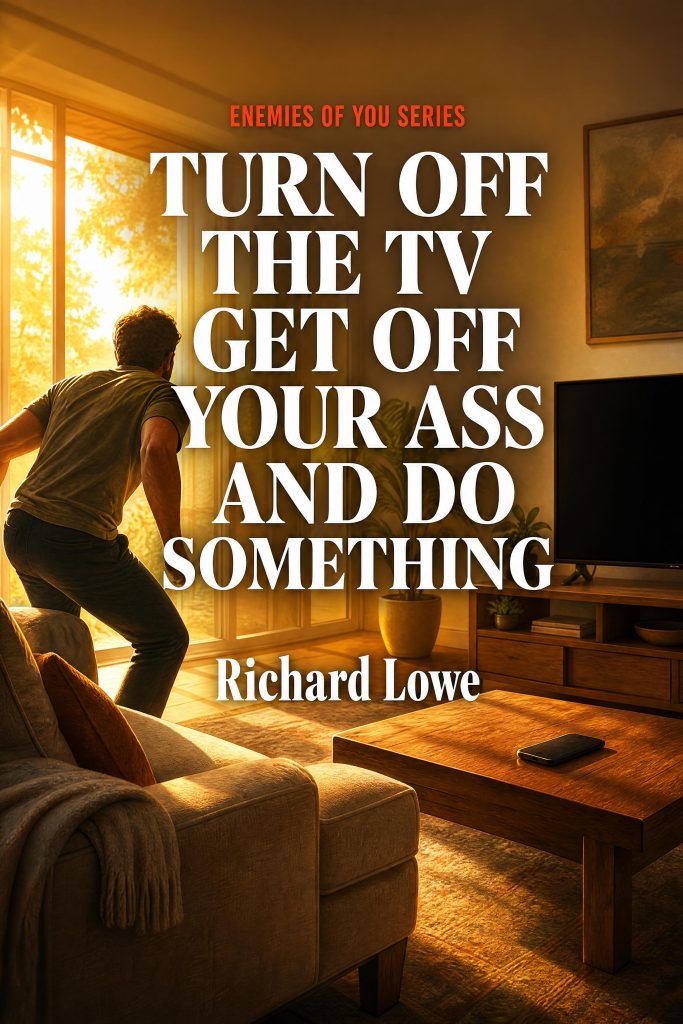
Turn Off the TV, Get Off Your Ass, and Do Something
You say you don’t have enough time. You also watch Netflix for four hours a night. Something doesn’t add up.
Turn Off the TV, Get Off Your Ass, and Do Something is not an anti-technology book. It is an anti-passivity book. Those are different things, and the difference matters. Richard Lowe is not asking you to throw your smartphone in a lake or move to a cabin. He uses digital tools from the moment he wakes up until the moment he goes to sleep. The argument of this book is not that screens are the problem. The argument is that every platform you use has two sides: a consuming side, where you are the product being sold to advertisers, and a contributing side, where you are using the same tools to produce something real. The device is identical. The relationship to it is not.
In 2014, Lowe unplugged his cable box and put it in a closet. What he did that night was not turn off technology. He stopped being an audience member and started being a producer. That is the only change this book is about — and it turns out to be sufficient.
The first half of the book diagnoses the specific mechanisms of passive consumption: the TV that is not your friend, the news that is breaking your brain, the echo chamber, the smartphone reflex, the social media antisocial machine, the inbox that never empties, the YouTube rabbit hole, the TikTok attention destruction device. Each platform has its own design and its own specific cost. Lowe names them directly.
The second half is practical. What to build instead. How to move your body, make something, learn a skill that takes years, build real friendships, have actual conversations with actual people, and be somewhere without documenting it. How to construct a financial position that is real. How to use technology without being used by it. What intentional looks like in practice.
This is not a productivity hack book. It is not a minimalism guide. One change made and held is worth more than ten changes planned and abandoned. The goal is a single adjustment that produces a different default, repeated until the default holds. Everything else follows from that.
Part of the Enemies of You series.
| Amazon Kindle | Paperback (IngramSpark) | epub (Kobo) |
| 📖 Look Inside | Need a Ghostwriter? Let’s Talk | |
| ISBN (Paperback): | 978-1-946458-16-2 |
| ISBN (eBook): | 978-1-972810-13-2 |
| Publisher: | The Writing King |
| Publication Date: | April 20, 2026 |
| Print Length: | 270 pages |
| Language: | English |
Questions
Read the Introduction
Introduction
Why This Book Is Not What You Think It Is
Let me tell you what this book is not.
It is not a manifesto against technology. It is not asking you to throw your smartphone in a lake, cancel your subscriptions, and move to a cabin. It is not written by someone who thinks the internet was a mistake or that your life would be better if you went back to writing letters by candlelight.
I am not your enemy.
As of the time this book was written, I have over fifty books published, a ghostwriting business, a book coaching practice, a newsletter with tens of thousands of subscribers, and a full-time operation built on digital tools. I use AI for research, drafting, and editing. I publish through digital platforms. I communicate with clients through apps and messaging software. I have never once suggested that any of this was a mistake. The argument of this book is not that technology is the problem. The argument is that passivity is the problem, and that the tools most people are using primarily as an audience are the same tools others are using to build something.
In 2014, I unplugged my cable box and put it in a closet. People have been citing that fact ever since as evidence that I am anti-technology. They have it backwards. What I did that night was not turn off technology. What I did was stop being an audience member and start being a producer. The screens stayed on. The relationship to them changed entirely.
That is the only thing this book is about.
There is a line that runs through every digital medium. On one side of that line, you are consuming. On the other, you are contributing. The screen is the same. The platform is the same. Your posture is not.
You can use YouTube to watch other people demonstrate skills you will never practice. Or you can use YouTube to teach the skills you have to an audience that cannot find them anywhere else. You can use social media to scroll through other people’s edited lives and feel quietly inadequate. Or you can use it to build the audience for work you are making. You can use AI to have it think for you, write for you, and make decisions you were capable of making yourself. Or you can use it to amplify your own thinking.
The platform is neutral. Your relationship to it is not.
Most people are on the consuming side of every platform they use. Not because they are lazy or stupid. Because the algorithm has one job, and that job is to keep you there. Every feed, every recommendation engine, every autoplay feature is engineered to convert you into an audience member and keep you that way. The consuming side is the profitable side. The contributing side is where you stop being the product.
I did not become productive by giving things up. I became productive by changing what I was doing with the same hours. Before 2014, I spent roughly a thousand hours a year watching other people’s creative work. After 2014, I spent those hours producing my own. The outputs are not the result of unusual discipline or talent. They are the result of redirecting a thousand hours a year from the consuming side to the contributing side, consistently, for a decade.
You do not need to write fifty books. But if you are reading this and you have something you have been meaning to make, the reason you have not made it is not that you lack the ability or the ideas. It is that a thousand hours a year are going somewhere else. This book is about where they are going, why, and what happens when you redirect them.
The line is there. You can step over it whenever you want.