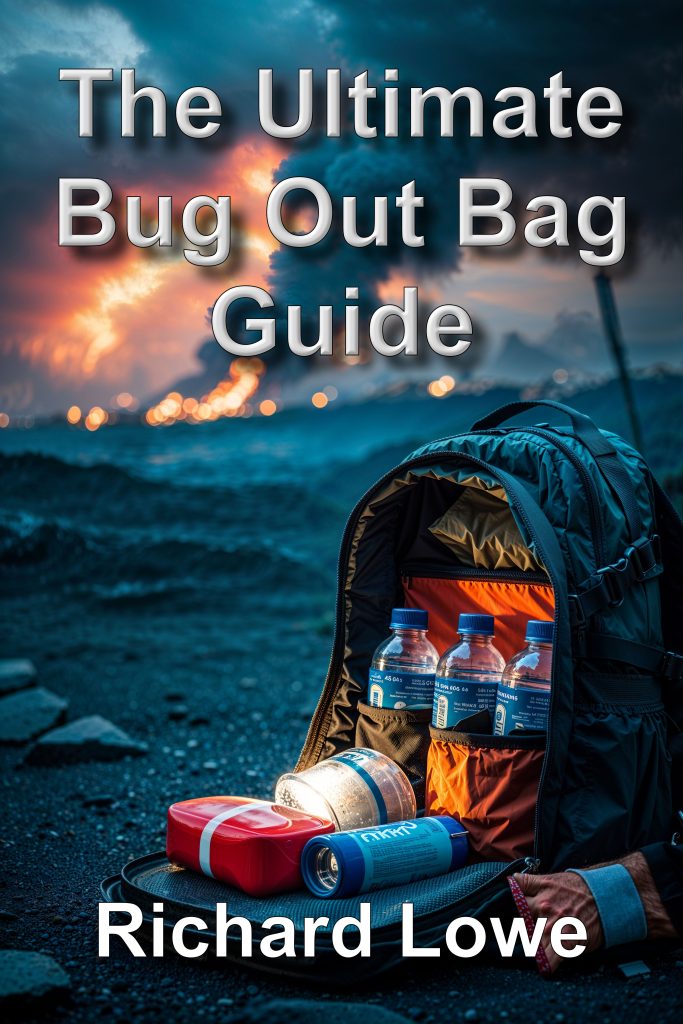
Most emergency preparedness guides are written by people who have read about disasters. This one is written by someone who has survived them.
At 4:31 AM on January 17, 1994, the Northridge earthquake threw Richard Lowe out of bed and into a damaged city with no power, no phones, and a missing teenage son. He and his wife spent twenty-four hours not knowing if their child was alive. They had no emergency supplies, no communication plan, and no first aid kit — not even enough to treat his wife’s feet after she ran barefoot through broken glass. That experience started four decades of learning how emergency preparedness actually works when a disaster doesn’t follow the script.
The Ultimate Bug Out Bag Guide is the product of that education. Lowe survived a wildfire that trapped him on a mountain road between burning trees until a firefighter pulled him out. He climbed out of a snowbound canyon in the San Bernardino Mountains after his father suffered a cardiac event, then waited while the fire department airlifted his father from a location they named Lowe’s Meadow. He managed disaster recovery operations for a major national retailer for twenty years. He earned CERT certification and trained in search and rescue, incident command, and emergency medical response. And in 2024 he rode out Hurricane Milton alone in his Florida apartment, managing a five-day power outage that tested every principle in this book.
What he learned across all of it is that most emergency preparedness fails for the same reason: it assumes you’ll have time to think. Real disasters don’t work that way. They hit fast, they separate families, they knock out power and communications simultaneously, and they leave you making life-or-death decisions with whatever you prepared in advance. A bug out bag that isn’t packed before the emergency is a bag you won’t have. An evacuation plan you haven’t practiced is a plan you won’t execute. The confidence that matters in a crisis comes from handling the gear, not owning it.
This guide covers the full scope of practical emergency preparedness centered on the portable go-bag: choosing the right bag for your situation and physical capability, water storage and every major purification method, emergency food selection and long-term rotation, portable power and communication systems, shelter and thermal regulation, first aid and hygiene, documentation and identity protection, personal security with and without firearms, special considerations for children, elderly family members, pets, and people with disabilities and medical equipment dependencies. Regional chapters address Florida and the Gulf Coast, California earthquake and wildfire country, the Pacific Northwest Cascadia zone, Tornado Alley, the Desert Southwest, mountain environments, dense urban areas, and the Northeast. Separate chapters cover shelter-in-place, clothing systems, cooking systems, signaling and rescue, everyday carry, vehicle preparedness, a complete medication kit system with the emergency pharmacy law framework most people never learn, and building a complete kit on a budget.
Every recommendation comes from gear used, techniques practiced, and lessons learned during actual emergencies. This is not a theoretical survival manual. It is a practical field guide from someone who has needed this information and used it.
| ISBN (Paperback): |
978-1-946458-30-8 |
| ISBN (eBook): |
978-1-946458-82-7 |
| Publisher: |
The Writing King |
| Publication Date: |
April 20, 2026 |
| Print Length: |
182 pages |
| Language: |
English |
Questions
Is this for preppers or for regular people?
Regular people. The book is explicitly not about building an underground bunker or spending thousands of dollars. It’s about practical preparedness that fits into normal life — the kind that works when you have minutes to evacuate, your plans fall apart, and your family is depending on what you prepared in advance. FEMA and the Red Cross recommend this kind of preparation. The book takes their baseline and extends it with four decades of firsthand experience.
Does this cover my specific region?
Probably yes. The book includes dedicated regional chapters for Florida and the Gulf Coast, California earthquake and wildfire country, the Pacific Northwest Cascadia fault zone, Tornado Alley, the Desert Southwest, mountain and high-altitude environments, dense urban areas, and the Northeast. Each regional chapter addresses the specific threat profile — what disasters are most likely, what makes them different from other disasters, and what gear choices those differences require.
What about people with special needs — medications, mobility issues, pets?
All covered. The book includes dedicated sections for children, elderly family members, people with disabilities, people with medical equipment dependencies, and pets. The medication kit chapter covers the emergency pharmacy law framework that allows you to obtain emergency supplies of critical medications — something most preparedness guides skip entirely. The section on medical equipment dependencies addresses power-dependent devices specifically.
Can I build a decent kit on a limited budget?
Yes. There’s a full chapter dedicated to building a complete kit on a budget, including prioritization order (what to get first when you can’t get everything at once), where quality matters and where generic options are fine, and how to build toward a complete kit over time. The author built his first serious kit after the Northridge earthquake when money was tight, and the book reflects that experience.
Read the Prologue
At 4:31 AM on January 17, 1994, the Northridge earthquake threw me out of bed and changed everything I thought I knew about being prepared for emergencies.
I’d been hiking and camping for years. I had emergency supplies. I thought I understood disaster preparedness. But when the ground stopped shaking and we realized our son was missing, all that theoretical knowledge became worthless. We spent the next terrifying hours stumbling through a damaged city with no power, no phones, and no idea where to look for him.
That earthquake taught me the difference between having emergency gear and being prepared. It showed me that most emergency planning fails because it assumes you’ll have time to think, time to gather supplies, and time to make careful decisions. Real disasters don’t work that way. They hit fast, hit hard, and leave you dealing with chaos while making life-or-death decisions with whatever you can grab in the dark.
This book isn’t about building the perfect survival kit or preparing for the apocalypse. It’s about real emergency preparedness that works when you have minutes to evacuate, when your carefully laid plans fall apart, and when the only thing standing between your family and disaster is what you’ve prepared in advance.
Every recommendation in these pages comes from gear I’ve used, techniques I’ve practiced, or lessons learned the hard way during actual emergencies. Because when the ground starts shaking or the evacuation sirens start wailing, there’s no time for theory. There’s only what you know, what you have, and what you can do with both.
Your bug out bag might never save your life. But if the day comes when you need it, you’ll want it to work.
Amazon Kindle
Paperback (IngramSpark)
epub (Kobo)
×
Introduction
Understanding Emergency Evacuation
Disasters don’t wait for convenient times. I learned this during the Northridge earthquake early in the morning. My wife and I were jolted awake by what felt like the world ending. The furniture in our apartment became possessed, dancing and sliding across the floor like something out of a horror movie. Our kitchen table moved six feet on its own, the refrigerator relocated itself to the other side of the room, and books turned into missiles flying off the shelves.
The real terror came when we realized our teenage son was missing. He’d left the house earlier with his headphones on, as teenagers do, and we had no idea where he was. My wife ran barefoot through the broken glass from our shattered dishes, cutting up her feet because we didn’t even have a basic first aid kit. We spent twenty-four agonizing hours not knowing if our child was alive or dead. When we finally found him, he’d been stranded miles from home in downtown Hollywood when the power went out, with no way to contact us and only a few dollars in his pocket.
That wasn’t my only brush with disaster. A few years earlier, I was driving down the mountain from Lake Arrowhead when I suddenly realized the forest around me was on fire. Trees and shrubs were burning on both sides of the road, and when I looked back, I saw the fire had jumped the road behind me. I was trapped with fire in every direction, honestly thinking I was going to die. A firefighter ran up to my car, jumped in, and directed me to drive to a specific spot where a helicopter dumped water directly on us. That’s the only reason I survived.
Then there was the Christmas hike in 1986 when my father and I decided to explore a canyon in the San Bernardino Mountains. What started as a simple morning hike turned into a nightmare when we got lost, my father had what appeared to be a heart attack, and I had to climb out of the canyon in the snow to get help. The fire department airlifted my father out the next day from a spot they named “Lowe’s Meadow.”
These experiences, along with my twenty years managing disaster recovery for Trader Joe’s, taught me that preparation isn’t paranoia — it’s practical common sense. The world has only become more unpredictable since I first started thinking about emergency preparedness. We now face not just traditional natural disasters, but cyber attacks that can shut down power grids, supply chain disruptions that empty store shelves, and extreme weather events that seem to happen with increasing frequency.
A bug out bag is a portable survival kit containing everything you need to sustain yourself for 72 hours if you have to evacuate your home quickly. The “72 hours” isn’t arbitrary — it’s based on emergency management research showing that’s how long it takes for organized relief efforts to reach disaster areas and begin providing assistance to displaced residents.
This guide takes everything I’ve learned from both personal disaster experiences and professional emergency management training and updates it for 2026 realities. Every recommendation comes from either personal experience or professional research. The goal isn’t to turn you into a survival expert overnight. It’s to help you think through emergency scenarios systematically so you can prepare for your situation.
Because as I learned during that earthquake, when disaster strikes, you don’t get to choose the timing or the circumstances. You only get to choose how ready you are.
— End of Introduction —
Amazon Kindle
Paperback (IngramSpark)
epub (Kobo)