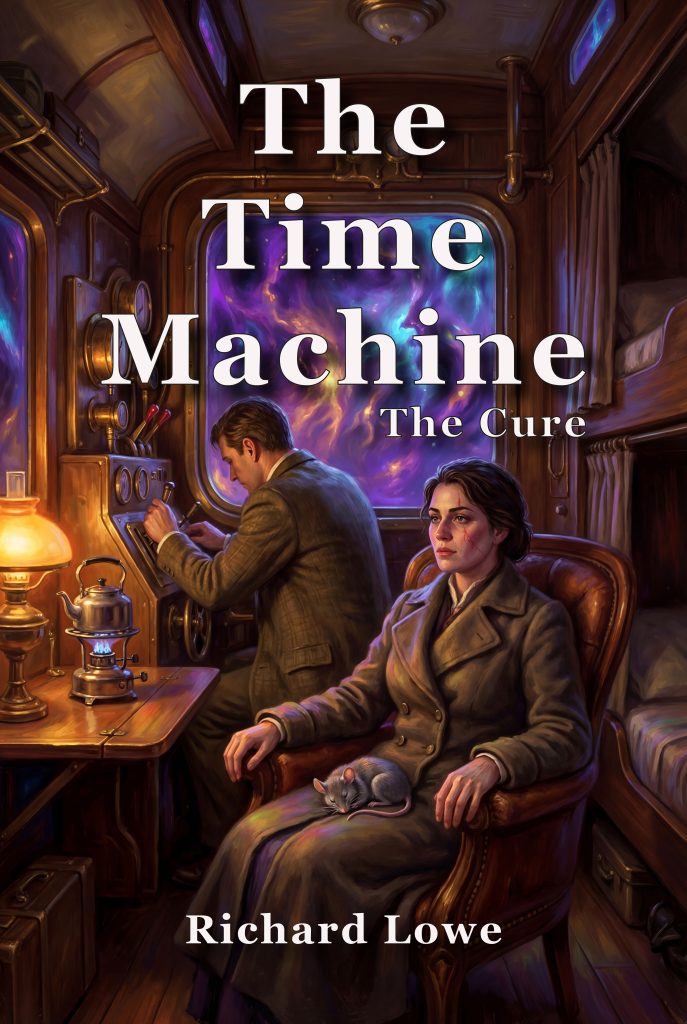
A Victorian scientist builds a time machine not out of curiosity but because his wife is dying of smallpox and he believes the future holds a cure. He finds it. Then he keeps going, because he cannot bring himself to face the moment he has to return to.
What follows is a journey through five hundred million years of scientifically grounded future. A world war witnessed from the streets. Hiroshima, one week after. The slow drowning of coastlines. The engineering responses humanity attempts and partially achieves. The gradual thinning of human presence across the planet as language drifts, biology shifts, and civilization makes choices that leave the Earth quieter with each passing millennium. The departure of humanity to the stars, carrying nothing the traveler would recognize. And at the end of everything, a monument built by a civilization that left before he arrived, patient and vast and willing to engage with the strange Victorian gentleman who has appeared out of nowhere with a theory about time and a cure in his pocket.
The monument tells him that returning to the past is impossible. That any change to what has already happened, even the movement of a single air molecule, destroys the universe and rebuilds it without the traveler in it. He argues the many-worlds interpretation. The monument is not convinced but gives him the cure anyway, to humor him. He goes back. The universe does not end. It branches. His wife lives in one timeline. He carries the memory of both.
Inspired by H.G. Wells’s 1895 classic but rebuilt from the foundation, The Time Machine: The Cure replaces Wells’s Eloi and Morlock class allegory with a story driven by grief, deep time science, and the most human of questions: what would you risk, and what would you become, to save the person you loved most? Every stop is grounded in actual climate science, biology, geology, solar physics, and cosmology. The Traveller is no longer a hobbyist demonstrating a parlor invention. He is a man who built the machine because she was dying and he thought he could outrun it.
The Victorian Era Series.
| ISBN (Paperback): |
978-1-972810-57-6 |
| ISBN (eBook): |
978-1-972810-58-3 |
| Series: |
The Victorian Era Series |
| Publisher: |
The Writing King |
| Publication Date: |
April 20, 2026 |
| Print Length: |
278 pages |
| Language: |
English |
Questions
Do I need to have read Wells’s original?
No. The novel is fully self-contained. Readers who know Wells will recognize the bones: the dinner party frame, the testimony structure, the far future, the dying sun. Everything else is rebuilt. The Eloi and Morlocks are gone. The class allegory is gone. What replaces them is a story about grief, deep time, and a man who kept going because stopping meant going back.
Who is Tatiana Volkova?
Victor’s neighbor, and not a character Wells had. She started as a passenger and became the person actually running the expedition: managing provisions, reading the machine’s routing patterns, keeping Victor alive through the stops, writing the twelve notebooks that make the journey mean something beyond one man and one dead woman. She is Russian, she carries a sketchbook, she has a scar the full length of her face that nobody in the novel ever asks about. Victor was looking for the cure. Tatiana was looking at everything else. What she was looking at turned out to be the point.
How scientifically grounded are the future stops?
Every stop is grounded in actual climate science, biology, geology, solar physics, and cosmology. The drowning coastlines, the Saharan solar belt, the biological drift across millennia, the engineering responses humanity attempts, the long silence that follows: all of it follows from real science extended across deep time. The book does not invent futures for convenience. It extrapolates from what the science actually says.
Is there a chapter about Hiroshima?
Yes. August 6, 1945, one week after. The author’s note addresses it directly. Victor goes in. Tatiana stays in the machine. The chapter shows a specific horror from a Victorian medical viewpoint and does not look away. The author’s note explains the historical argument about the bombs and why the chapter is written the way it is.
Is this part of a series?
Yes, the Victorian Era Series. The series takes Victorian-era source novels seriously as architecture, asks what is missing, and rebuilds them. The Mysterious Island corrects Verne’s erasure of Neb. 20,000 Leagues Under the Sea gives the story to Ned Land and adds Lakara. The Time Machine: The Cure adds Tatiana and replaces Wells’s class pamphlet with a novel about grief and deep time.
Read the Opening
Chapter One
The Dinner Party
The invitations went out on Monday. No explanation, just dinner, Thursday, seven o’clock, come at seven. They came because they always came, because he was their friend, because five years of watching the light burn in Victor’s laboratory at two in the morning had made them careful about the invitations he did issue. When Victor issued an invitation it meant something was happening.
Eleanor Whitmore was the first through the door. In forty dinners at this house she had never once arrived to find Victor already seated. He was always in the laboratory. He always appeared late with something on his hands that wouldn’t quite wash off, trailing apologies he didn’t mean, dropping into a chair with the distracted energy of a man whose mind was still among the instruments.
Tonight he was sitting at the head of the table in his good coat, clean-shaven, still. His hands were folded on the table in front of him. He was looking at the far wall.
She had known Victor for eleven years. She knew his face well enough to read it without appearing to read it. Something was different. Not tired — she knew what tired looked like on Victor. He looked like a man who had been somewhere and come back. He looked like a man who had a great deal to tell and was deciding how to begin.
And then, perhaps two minutes after the last expected guest, Tatiana Volkova came through the door. She came into the dining room without being announced and without hesitation and took the chair to Victor’s left as though she had been assigned it. As though she had always been going to be here. She sat down, picked up her wine glass, examined it briefly, and set it down.
“I have something to tell you this evening. I would like to get through dinner first,” Victor said.
“That’s somewhat ominous,” Arthur said.
“It is extraordinary. Whether it’s ominous depends on your disposition,” Victor said.
Tatiana said, without looking up from the wine she was examining: it is both.
Eleanor picked up her spoon and the spell broke and everyone began to eat, and the evening began.
Amazon Kindle
Paperback (IngramSpark)
epub (Kobo)
×
Chapter Two
Oxford, 1895, Departure
Catherine has been dead five years. I want to say that plainly at the start of this account because everything else follows from it, and because I have spent five years not saying it plainly in rooms like this one with people like you, and I am tired of the omission. The omission has become a kind of bad manners. You are my friends. You deserve the plainness.
She died of smallpox in November of 1889. She was thirty-four. Edmund was there. I was in the laboratory.
I want you to understand what that means and what it does not mean. I was not absent because I did not care. I was absent because I had been absent for three years by that point, in the way that a man is absent who has found a problem and cannot put it down. She knew this about me before she married me and she married me anyway, which was either the greatest act of faith or the greatest act of foolishness I have ever witnessed, and I have never been able to decide which. I think she had decided it was both and found that sufficient.
The problem I could not put down was time.
Not time in the philosophical sense. Not the question of what time is or whether it flows or what the relationship between past and present and future might be in the fundamental structure of the universe. Those are interesting questions and I have views about them and I will get to them in the course of this account. The problem I could not put down was simpler and more urgent: I wanted to go there. I wanted to go forward, into what had not happened yet, and bring something back.
I wanted to bring back a cure.
The first machine took three years to build. It did not work. The second machine took eighteen months. It worked once, went forward eleven minutes, and came back with the machine slightly warm and a dead spider on the seat. I spent four months trying to understand the spider. I never did. The third machine took eight months because I understood by then what I had been getting wrong, which was everything about the field geometry. The third machine went forward six hours and came back with me in it, which was the first time I had gone with it, and I sat in my laboratory at eleven o’clock in the morning looking at the clock that said five in the afternoon and understood that I had done it.
Catherine had been dead for two years by then. I had built the machine to save her and she had died while I was building it, and I had kept building it anyway because there was nothing else to do and because stopping would have meant accepting that I had failed at the only thing that mattered, and I was not prepared to do that.
I went to tell Tatiana. She was the only person I had told about the machine. She was my neighbor, and she was someone who understood what it meant to have a thing you were building and could not stop building, and she had never once told me to stop or that it couldn’t work or that I was spending my grief badly. She had drunk my tea and looked at the schematics and asked questions about the field geometry and gone home. That was the kind of neighbor she was.
I knocked on her door at five-fifteen in the afternoon and she opened it and looked at me and said: it works.
I said yes.
She said: when do we leave.
— Continue reading —
Amazon Kindle
Paperback (IngramSpark)
epub (Kobo)