
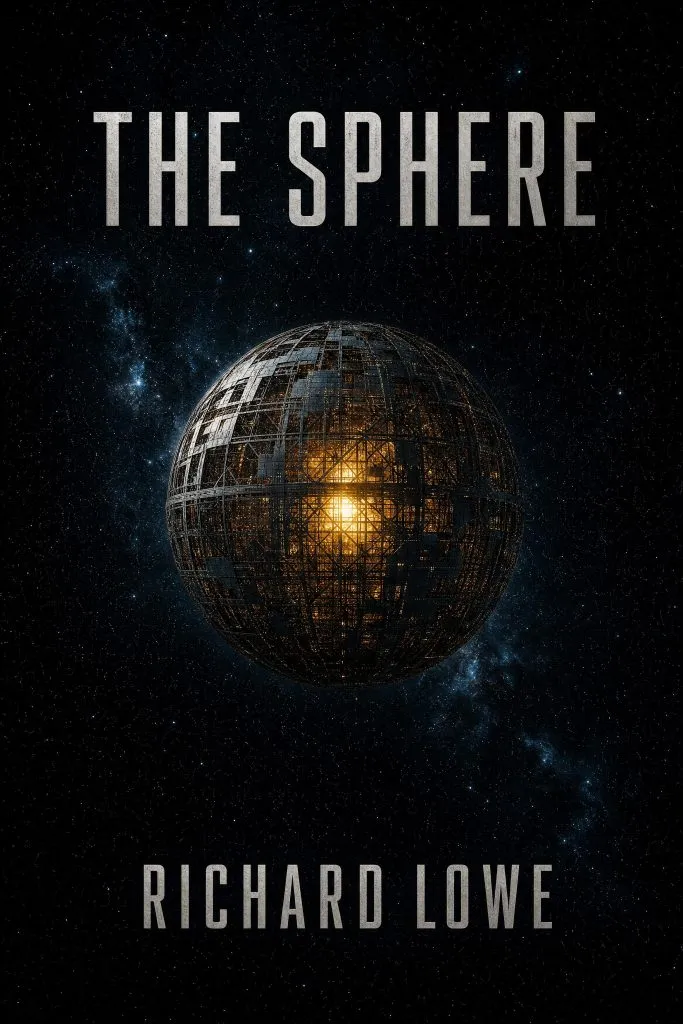
The Sphere
Earth is dying. Not in a generation. Not in a century. Now, while the man at the podium is still speaking. Humanity’s answer is the largest thing any species has ever built: a sphere enclosing the sun, forty thousand years in the making, its inhabited surface sixteen million times the area of the world being quarried to build it. Generations are born, spend a lifetime on it, and die with the work at five percent. Seven. Twelve.
Then it is finished. And every civilization within reach understands what it means.
The galaxy humanity arrived in was neither empty nor young. The others had been doing the work of being sentient far longer, and they had agreements, a coalition, and a long memory. They watched the construction the way you watch a child who has found fire and not yet found burning. Then they convened. Ten thousand and forty-two species were contacted by the Peace Initiative across ten thousand years, and not all of them attacked immediately. Some declined politely. Some negotiated for decades. But every single one of them, in the end, treated the Sphere as a problem that needed to be solved.
After the siege, after a war fought with four million construction ships converted to weapons, humanity’s Council receives a survivability assessment four pages long. A physicist sets the pages on the table one at a time, squaring each to the edge before he sets down the next. Nobody finds an error in it. Every line follows from the line before. And the conclusion, arrived at by steps none of which are wrong, is that the only permanent guarantee is to send out self-replicating ships and make certain, forever, that nobody can ever come again.
Told across half a million years by Orin, born in the eighth year of the surface and alive for nearly all of what follows, The Sphere runs from a kitchen on a dying Earth to the last survey of the last ship at the end of the universe. Nobody breaks the speed of light in it. No warp drive, no jump gate, no fleet arriving in the nick of time, because there is no nick of time when the nearest help is forty years away at the speed the universe actually allows. A message takes years. A war is fought by mail. A man gives an order at fifty-three and grows old and dies before anyone learns whether it worked.
Orin voted yes. He has lived long enough to be ashamed of the yes, long enough to understand why he gave it, and long enough to know that neither of those cancels the other. He is not writing a history. Histories are built by people who were not there. This is the other thing.
What does a species owe the rest of creation for its own safety? The book takes the question all the way down, past the people who asked it, past the species that asked it, to whatever is left.
| Amazon Kindle | Paperback (IngramSpark) | epub (Kobo) |
| 📖 Look Inside | Need a Ghostwriter? Let’s Talk | |
| ISBN (Paperback): | REPLACE-ISBN-PB |
| ISBN (eBook): | REPLACE-ISBN-EB |
| Publisher: | The Writing King |
| Publication Date: | July 19, 2026 |
| Print Length: | 590 pages |
| Language: | English |
Questions
Read the Opening
Prelude
The First to Look
On a planet which circled a star some 2,000 light years from Earth, there lived a race of creatures. An extremely old and wise species. They bore no resemblance to humanity.
Their thought patterns were totally different. Their motivations, hopes, and desires would have baffled a human psychologist. Human scientists would have had difficulty determining that they were even living beings, much less intelligent.
One day one member of this species was studying the stars, and happened to align its instruments toward the galactic center. Within a short time it was gasping uncontrollably. For the first time in its life, this creature felt fear.
After it communicated its findings to the government of its planet, the entire species became gripped with that unfamiliar emotion. They were afraid. Something would have to be done, and soon.
Fifty Years Later
On a planet about 1,550 light years from Earth, a young and aggressive species suddenly ceased a millennia-long war of extermination. One of their observation platforms had accidentally oriented upon an object far in the depths of space.
Suddenly, this species felt the cold stab of fear. They quickly settled their disagreements and began working together for the first time in their history.
Seventy-Five Years After That
On another planet, roughly 2,400 light years from Earth, another species turned its eyes toward the heavens. When they examined one particular patch of sky, the entire species recoiled in anger.
Sacrilege, they cried in unison. They must be punished.
Two Thousand Years On
For the first time in the history of the galaxy, hundreds of different species from thousands of planets worked together toward a common goal. Virtually every space-faring species was represented, and all were determined to see that the conference was successful.
The greatest minds in the galaxy cooperated, examined all available data, and came to a decision. This decision changed the course of galactic history forever. Nothing would ever be the same again.