
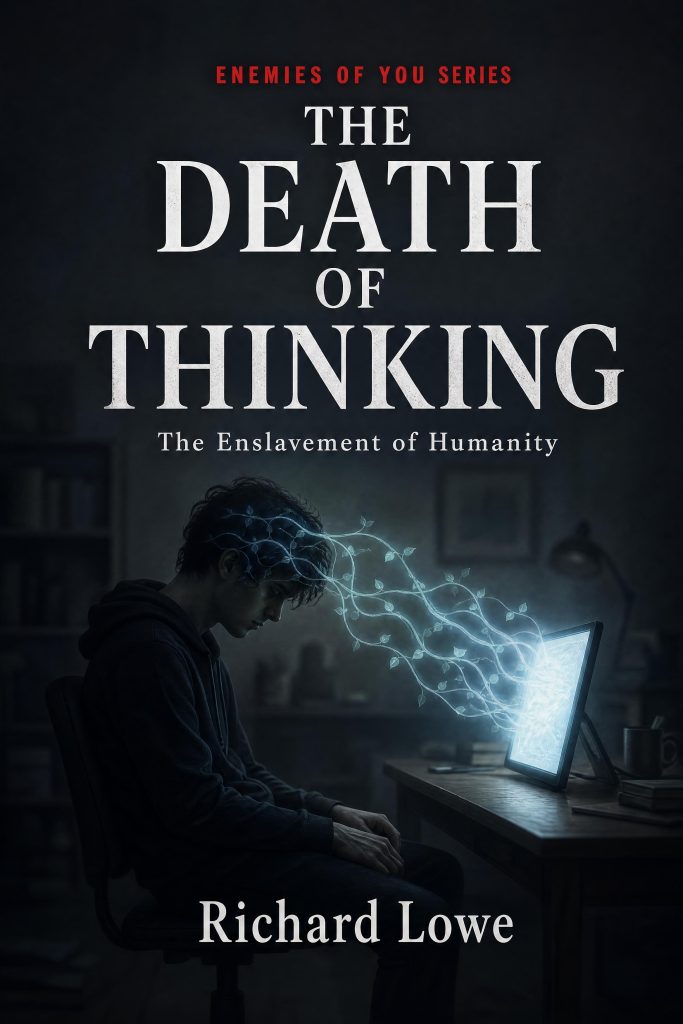
The Death Of Thinking
People worldwide are losing their ability to think critically at an alarming rate. College students show no improvement in reasoning skills after four years of education. Workers can’t solve problems without step-by-step instructions. Citizens fall for obvious misinformation while carrying the world’s information in their pockets. This isn’t an accident or a generational quirk. It’s the predictable result of systematic changes to how we learn, work, and live.
This comprehensive examination reveals how our education systems, technology dependence, and information overload have systematically undermined human reasoning abilities across the globe. Standardized testing has replaced critical thinking with bubble-filling expertise. Social media algorithms exploit our cognitive biases to keep us engaged while making us more polarized. Artificial intelligence handles our mental heavy lifting, leaving our reasoning skills to atrophy like unused muscles.
Richard Lowe combines research from cognitive psychology, educational studies, and neuroscience to explain why smart people make increasingly dumb decisions and how we arrived at this crisis point. Through engaging examples and sharp analysis, he exposes the forces making us mentally lazy and shows why traditional approaches to fixing the problem have failed.
But this isn’t just a diagnosis of what’s wrong. Lowe presents practical, evidence-based solutions for educators, parents, policymakers, and individuals who want to rebuild their mental defenses. From classroom techniques that actually work to personal strategies for navigating information chaos, this book offers concrete hope that we can reclaim our capacity for clear thinking before it’s too late.
Because in a world where machines can memorize everything, the most valuable human skill just might be the ability to think.
This is not an anti-AI book. The author uses AI tools every day — but did not use them to write this book, specifically to demonstrate the argument. The companion volume, The Birth of the Augmented Human, maps the other path. This book is the diagnosis.
| Amazon Kindle | Paperback (IngramSpark) | epub (Kobo) |
| 📖 Look Inside | Need a Ghostwriter? Let’s Talk | |
| ISBN (Paperback): | 978-1-946458-97-1 |
| ISBN (eBook): | 978-1-972810-00-2 |
| Publisher: | The Writing King |
| Publication Date: | April 11, 2026 |
| Print Length: | 314 pages |
| Language: | English |
Questions
Look Inside
Preface
How This Book Started
This book started as a shorter thing. An essay, maybe, about something I had been noticing in my own work and in the work of the writers and programmers I know: a specific kind of softness that had developed in the two or three years since AI tools became genuinely capable. Not laziness. Not incompetence. A softness in the instrument itself. The part that thinks.
It kept getting longer because the problem kept getting bigger.
I kept noticing it and then did not want to say anything about it, because saying something about it required claiming that the people I was watching, myself included, were doing something wrong. And what we were doing did not look wrong. It looked efficient. The work was getting done. The clients were satisfied. The code was shipping.
What alarmed me was simpler and more widespread than anything about AI itself. I started noticing that people had lost the ability to see outside their own echo chamber. They cannot identify a logical fallacy when they encounter one. They cannot get past their own cognitive biases to evaluate an argument on its merits. Instead of thinking through a question, people go ask AI and take the first answer without going any further. They are outsourcing the one thing they should never outsource.
Public discourse is mostly about jobs. Which ones will survive, which will be replaced, what a displaced workforce will do. This book is not about that. Economies adjust. The thing that does not adjust easily, once it is damaged, is the human capacity to think independently. That capacity is what this book is about.
Introduction
What Was Lost Before Anyone Noticed
The thing about a slow loss is that you do not feel it going. You feel its absence when something requires it and it is not there. The writer who opens a document and finds the blank page harder than it used to be. The programmer who sits in an interview and cannot fully explain why the system was built the way it was. The analyst who publishes a report and later discovers that the structural error in it was present from the beginning, baked into the AI’s framing, invisible because the analyst had stopped standing outside the structure and examining it.
None of these people decided to lose anything. They made a series of reasonable decisions, each one defensible in isolation, that accumulated into a pattern with consequences they did not anticipate.
This book is about the pattern. What happens to a practitioner’s cognitive capacity when they consistently outsource the parts of their work that require the most genuine thinking. Not in one session. Over months and years of a daily practice that removes the cognitive demands that were building something.
The building that was happening is not obvious when it is happening. It is only obvious in retrospect, or under specific conditions of pressure that reveal what is and is not there. You don’t notice the door closing until you try to go back through it.