
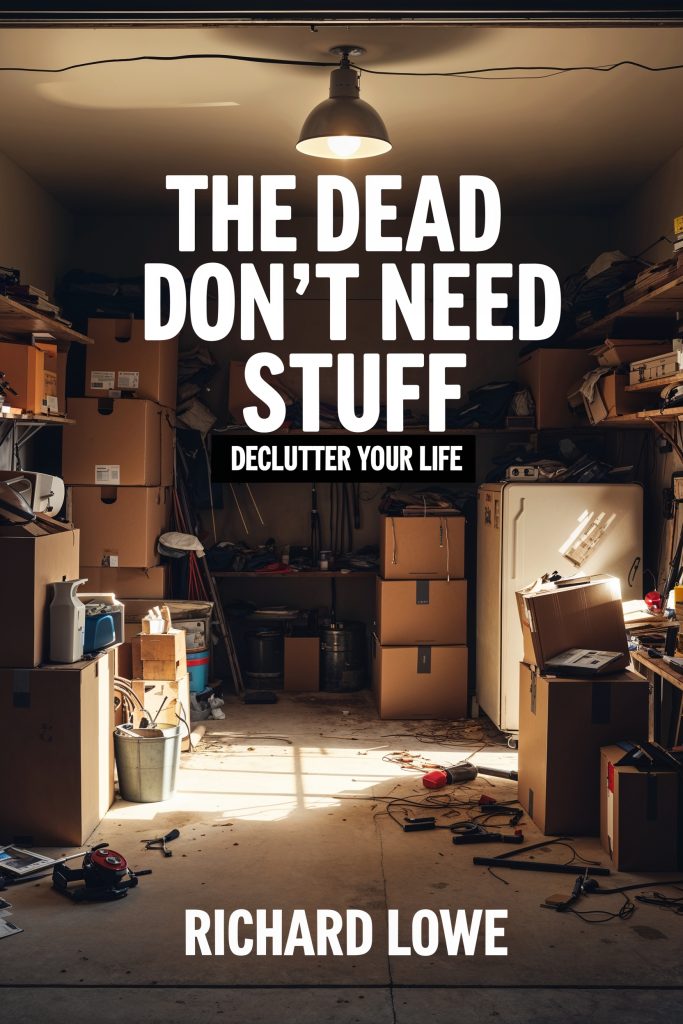
The Dead Don’t Need Stuff
Richard Lowe grew up in a hoarding household. By the time his parents died, they had a one-bedroom apartment packed floor-to-ceiling with pathways to navigate between the piles, plus two storage units full of “valuable” items they paid monthly rent on but never saw again. When his father died, Lowe was 3,000 miles away. A social worker called, described the apartment, and asked what to do with everything. He told her to donate it all. That was the estate settlement.
This is the book he wishes someone had put in his parents’ hands thirty years earlier.
Lowe has executed seven major decluttering campaigns over his lifetime. He made thirty-five thousand dollars in his first serious eBay purge. He also nearly destroyed a prized collection of Tournament of Roses pins because he got so deep into purge momentum that he stopped being able to tell the difference between clutter and the things that actually mattered to him. Both experiences taught him something most decluttering books miss entirely: knowing when to stop is harder than knowing when to start.
Dead People Don’t Need Stuff is not a minimalism manifesto. It does not ask you to own fewer than a hundred things, photograph your belongings while thanking them for their service, or live in a space that looks like a waiting room. The goal is not to own less. The goal is to own honestly, which is a different thing entirely.
The book covers the psychology underneath accumulation, because no practical system sticks without it. Lowe explains why your brain is wired to keep everything, how objects absorb the emotional context of how you acquired them, and why a houseful of stuff bought during depressive episodes quietly generates a low hum of bad feeling you stop noticing until it’s gone. Then it walks through the practical systems: the four-pile sorting method, the emergency purge of items that could ruin your marriage or get you arrested if the wrong person found them, twenty decluttering excuses and why every one of them is costing you something right now, a room-by-room approach that accounts for the specific psychology of each space, and maintenance habits that prevent the whole thing from quietly rebuilding itself within a year.
The family in these pages is real. Jerry’s garage full of outdoor gear for activities he never did. Valerie’s kitchen packed with appliances bought for the person she thought she would become. A maternal grandmother with filing cabinets of UFO research she was convinced would matter when the aliens arrived. These are not cautionary tales invented for the book. They are the destination that road leads to, described in enough detail that you can see it clearly and choose a different direction.
You are alive. Dead people don’t need their stuff because they are finished. The question this book keeps asking is what you are doing with the time, space, and attention your accumulated possessions are currently consuming on your behalf.
| Amazon Kindle | Paperback (IngramSpark) | epub (Kobo) |
| 📖 Look Inside | Need a Ghostwriter? Let’s Talk | |
| ISBN (Paperback): | 978-1-946458-33-9 |
| ISBN (eBook): | 978-1-946458-78-0 |
| Publisher: | The Writing King |
| Publication Date: | April 7, 2026 |
| Print Length: | 168 pages |
| Language: | English |
Questions
Read a Chapter
Chapter 8
The Psychology of Letting Go (Or: Why Your Brain is a Hoarder’s Best Friend)
Welcome to the part of the book where we talk about feelings. I know, I know. You thought this was going to be a practical guide about sorting boxes and labeling bins. That voice telling you to skip this chapter? It’s not your practical side talking. It’s the voice of a hoarder who has taken up residence in your skull and convinced you that keeping seventeen extension cords is just sensible preparation.
Getting rid of your stuff is going to mess with your head in ways that Instagram decluttering influencers don’t warn you about. They show you the satisfying before-and-after photos, but they skip the part where you spend forty-five minutes arguing with yourself about whether to keep a broken lamp “just in case.”
Your possessions aren’t just objects sitting around taking up space. They’re emotional support systems, security blankets, trophies, insurance policies, and time machines. No wonder most people make it through one closet and then give up. Their brain starts screaming, and they surrender.
The Stories Your Stuff Tells About You (All of Them Are Fiction)
Every item in your house comes with a story. Not the boring story about where you bought it or how much it cost, but the elaborate fiction your brain has constructed about what it means that you own it.
Take Michael’s collection of computer manuals from the 1990s. He had an entire bookshelf dedicated to software that stopped existing during the Clinton administration. He knew he’d never use them again. But getting rid of them felt like admitting something he wasn’t ready to admit.
The manuals represented Michael’s expertise. They were proof that he was a serious computer person who understood technology. Getting rid of them felt like getting rid of that identity. The manuals weren’t preserving his expertise. They were preserving his anxiety about not being an expert anymore.
I had the same problem with my photography equipment graveyard. I’d gone through a phase where I was convinced I was the next Ansel Adams — portrait sessions, wedding gigs, gallery exhibitions. I invested $4,000 in serious equipment. The portrait sessions never materialized. Neither did the wedding gigs. What materialized was a closet full of expensive cameras and lenses and lighting equipment that I shuffled around every time I needed something else.
For years, I kept all that equipment because getting rid of it would mean accepting that I’d wasted $4,000 on a fantasy. But keeping it wasn’t saving me from that truth. It was just making me look at the evidence of it every single day. When I finally sold everything, I got maybe $1,200 for gear that had cost me $4,000. It hurt, but it was $1,200 more than I had when the stuff was taking up space, and the closet was suddenly useful again.
The Sunk Cost Fallacy Has Moved Into Your House
You keep the exercise bike that you rode exactly three times because you paid $600 for it. You keep the hobby supplies for the crafting phase that lasted a month because throwing them away would mean admitting the phase was a waste. You keep the gadgets that seemed brilliant at the time because getting rid of them feels like writing off the money you spent.
The money is gone. The bike didn’t magically become worth $600 again because you let it serve as a clothing rack for another six months. Linda was the queen of sunk cost hoarding. She kept a bread maker that she used twice because “it was expensive.” She kept a treadmill she hadn’t used in four years because “it cost a lot of money.” The bread maker cost her $89 in 1997. By 2015, she had spent more on storing it and moving it from house to house than the original purchase price.
The Museum of All Your Past Selves
One of the cruelest tricks your brain plays is convincing you to maintain a museum dedicated to every person you used to be. I had boxes of elaborate costumes from my masquerade ball phase — Victorian gowns, Renaissance doublets, steampunk accessories. These weren’t Halloween costumes from a discount store. These were museum-quality reproductions that cost hundreds of dollars each.
Then life moved on. The events became less frequent, my interest in elaborate historical costuming faded, and the costumes got packed away. But I couldn’t get rid of them because they represented a whole version of myself that I had apparently decided needed to be preserved in storage. Keeping the costumes wasn’t making me more artistic or sophisticated. They were just reminding me that I used to do something interesting and now I didn’t.
The “What If” Warehouse in Your Head
The most persistent voice in the hoarder’s chorus is the one that whispers “but what if I need it someday?” Michael’s garage was a perfect example of “what if” thinking taken to its logical extreme. The garage looked like a hardware store that had been hit by a tornado and then abandoned. Michael couldn’t find anything when he needed it. The “what if” supplies weren’t making Michael more prepared. They were making him less functional.
The Guilt Industrial Complex
Guilt is the emotion that keeps more clutter in houses than sentiment, fear, and laziness combined. Gift guilt is the most powerful weapon in the clutter army. Someone gave you that decorative bowl, that picture frame, that book you’ll never read. Getting rid of it feels like rejecting the person who gave it to you. This is emotional blackmail disguised as gratitude. The purpose of a gift is to make you happy. If a gift isn’t making you happy, it’s failed at its only job.
Linda had accumulated enough guilt-driven gifts to stock a small gift shop. Coffee mugs with inspirational sayings that didn’t inspire her. Decorative items that matched nobody’s aesthetic. Duplicate kitchen gadgets that she already owned better versions of. She was keeping all of it out of obligation to people who had probably forgotten they gave it to her.
The Breakthrough Moment
For me, the breakthrough happened during my fourth move in six years. I was packing boxes of items that I hadn’t unpacked from the previous move. I was wrapping bubble wrap around objects I hadn’t touched in years. As I wrapped bubble wrap around a decorative bowl that I’d never used and didn’t particularly like, I realized I’d been running a personal storage facility — paying to move, store, and manage things that added nothing to my life.
Every item in my house was an employee that I was paying to do nothing. Most of them needed to be fired immediately.
Start with the obviously useless stuff. The items that are clearly broken, clearly outdated, or clearly taking up space without providing any value. Then move to the items with simple stories. Save the sentimental stuff for last. Once you’ve developed your decluttering muscles on easier items, you’ll be stronger for the emotional heavy lifting.
Your house should serve your life, not the other way around. Every item you keep should earn its place by adding value to your daily existence. The stories your possessions tell about who you are or who you might become are fiction. The only story that matters is the one you’re living right now.