
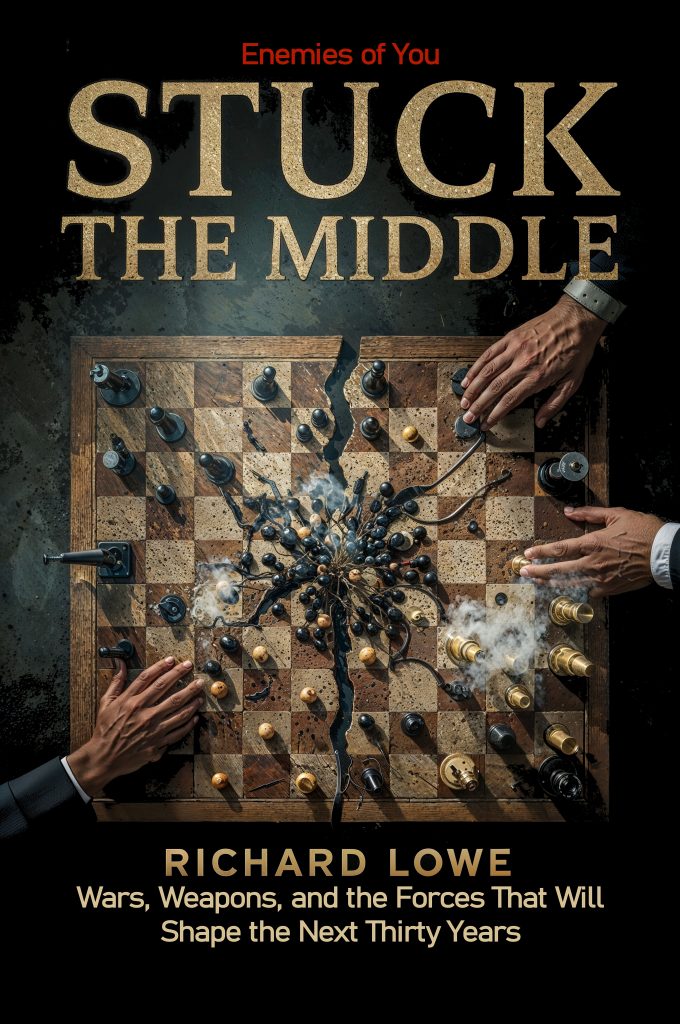
Stuck in the Middle: Wars, Weapons, the Next Thirty Years
The United States built the most powerful military in human history. Then it spent thirty years hollowing out everything that made it work.
Stuck in the Middle is a ground-level examination of American military and geopolitical power written for readers who want the truth without the translation. Richard Lowe connects four structural forces — demographic collapse, industrial decay, political dysfunction, and strategic overreach — and makes the case that no amount of defense spending fixes problems this deep.
The book opens with the Iran war as a stress test. Not a prediction. A lens. When you run American military capacity against a real adversary under real conditions, the cracks show fast. Missile stockpiles that take years to replenish. Supply chains that route through the country you’re supposed to be competing with. A defense industrial base that lost the ability to surge production decades ago and never got it back. An army that can’t recruit its way to full strength because the population it draws from is too sick, too heavy, and too poorly educated to qualify.
Meanwhile, China has been watching. Taking notes. Building for a thirty-year horizon while Washington cycles through two-year electoral logic. Beijing doesn’t need to beat the United States in a straight fight. It needs to outlast American political will, outpace American industrial capacity, and out-position the United States in the regions that matter before the window closes. That strategy is already in motion.
The structural forces shaping the next thirty years aren’t going to wait for the next election. Demographics don’t reverse on a campaign promise. Industrial capacity doesn’t rebuild in a single appropriations bill. Climate pressures, water scarcity, and global food instability don’t care which party controls the Senate. These forces operate on timelines that dwarf the American political attention span, and they’re compounding.
The second half of the book covers what could actually change the math. Autonomous systems, directed energy weapons, AI-driven logistics, and distributed manufacturing offer real paths forward, if the political will exists to move fast enough and smart enough to apply them. That’s the if this book is honest about.
Stuck in the Middle is the book for anyone who suspects things are worse than the headlines admit, and wants to understand exactly how bad it is, why it got this way, and whether there is still a way through.
| Amazon Kindle | Paperback (IngramSpark) | epub (Kobo) |
| 📖 Look Inside | Need a Ghostwriter? Let’s Talk | |
| ISBN (Paperback): | 978-1-972810-03-3 |
| ISBN (eBook): | 978-1-972810-04-0 |
| Publisher: | The Writing King |
| Publication Date: | April 10, 2026 |
| Print Length: | 362 pages |
| Language: | English |
Questions
Look Inside
Preface
How This Book Came to Exist
Four books ago, I sat down to write about why Americans had stopped thinking. That turned into a book about why they’d stopped participating. That turned into a book about the technologies changing what humans can do. That turned into an investigation of how private equity gutted twelve industries people depend on to get through the day. And now here we are.
Each time, the research dragged me somewhere I didn’t expect. The cognitive decline wasn’t a cultural problem. It was producing citizens who couldn’t govern themselves. The civic collapse wasn’t laziness. It was a sane response to captured institutions. The technology story was really a geopolitical story about who builds the tools and who doesn’t.
This book is what’s coming. Stuck in the Middle connects all four books into one argument. Cognitive decline feeds political dysfunction. Political dysfunction feeds military overreach. Military overreach feeds the great power competition. The competition collides with the structural forces reshaping the planet. And all of it points back to the technologies that could save us or destroy us, depending on who builds them.
I’m not a foreign policy expert. I’m a writer who reads too much, asks questions that make people uncomfortable, and refuses to believe that complicated things can’t be explained to normal people. Every expert I’ve met can explain their field to another expert. Almost none of them can explain it to a plumber, a teacher, or a retired electrician. That’s my audience.
Introduction
The Shape of the Trap
On February 28, 2026, the United States and Israel launched coordinated strikes against Iran. Within a week, the Strait of Hormuz was effectively closed, oil prices had spiked past $120 a barrel, American warships were burning through missile stockpiles faster than the defense industry could replace them, and a war that the majority of Americans opposed was consuming the military assets the country needs for a threat everyone agrees matters.
That situation, by itself, would be enough for a book. But the Iran war isn’t the subject of this book. It’s the entry point. The symptom that reveals the disease.
The disease is structural. The United States built the most powerful military in human history and then hollowed out the industrial base that sustains it. It built the world’s greatest innovation engine and then defunded the research that feeds it. It built a global alliance system and then withdrew from it so gradually that nobody noticed until the system started breaking.
Meanwhile, on the other side of the world, a country with an older civilization and a longer time horizon has been watching, taking notes, and building. Not a military to match America’s. An empire. Railroads instead of aircraft carriers. Loans instead of missiles. Infrastructure instead of ideology.
You are in that space. You are stuck in the middle.