
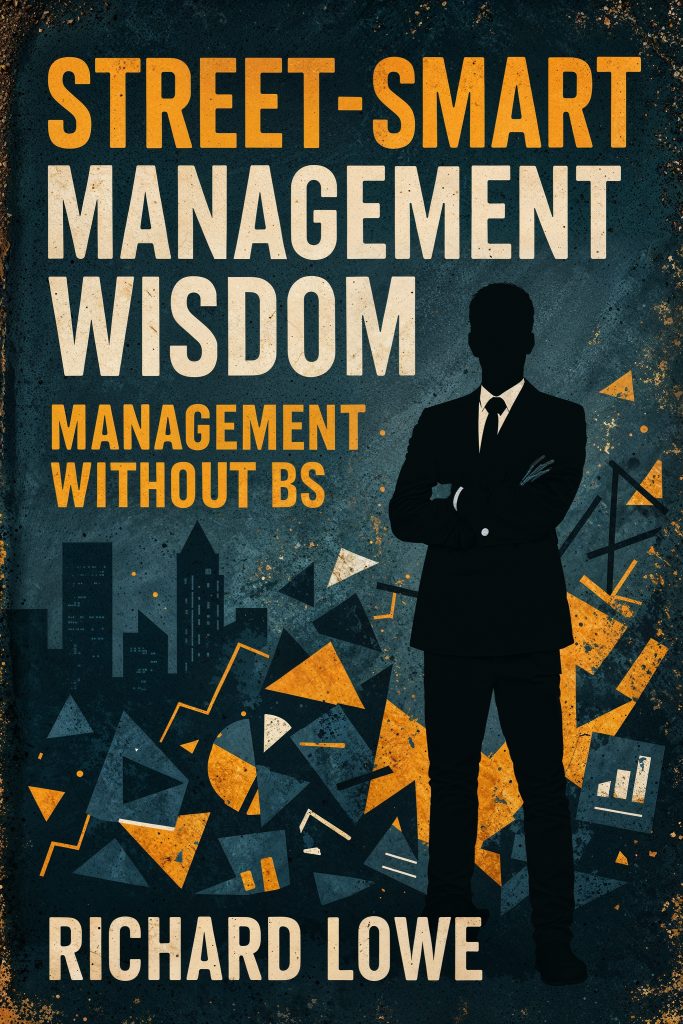
Street-Smart Management Wisdom
Most people become managers by accident. They excel at their individual contributor roles, get promoted to lead teams, and suddenly find themselves responsible for people, budgets, and outcomes they’re completely unprepared to handle.
Street-Smart Management Wisdom tells the story of three such accidental managers who learned leadership not through MBA programs or corporate training, but through surviving the kind of organizational chaos that separates competent leaders from overwhelmed casualties.
David Rodriguez runs a creative team at a marketing agency where everything goes wrong in the same week: major client crisis, key employee departure, campaign failure, harassment complaint, and budget cuts. Maya Delacroix leads an engineering team where a new hire’s work style threatens to destroy the collaborative culture she spent months building. Keisha Williams manages operations at a manufacturing company, only to watch her successor dismantle years of her work, forcing her to rethink how to create lasting institutional change.
These aren’t sanitized business school case studies. They’re authentic scenarios based on the gritty reality of management where multiple crises compound simultaneously, stakeholders have conflicting demands, and perfect solutions don’t exist. Each character’s evolution demonstrates how real leadership capabilities are forged: through crisis triage when everything demands immediate attention, through team chemistry management when personalities clash, through knowledge transfer systems that survive leadership transitions, and through institutional change that outlasts individual champions.
The book provides practical frameworks tested under fire: crisis management triage systems, people-reading diagnostics for team chemistry, decision authority distribution methods, and institutional embedding strategies for lasting change. But more importantly, it shows that management mastery isn’t about avoiding difficult situations — it’s about building the judgment, resilience, and systematic thinking that can turn inevitable organizational challenges into competitive advantages.
Written with brutal honesty about the real difficulties of leadership, this book cuts through the motivational BS that fills most management literature. It’s for managers who want street-smart wisdom that works in the real world, not feel-good theories that fall apart under pressure.
| Amazon Kindle | Paperback (IngramSpark) | epub (Kobo) |
| 📖 Look Inside | Need a Ghostwriter? Let’s Talk | |
| ISBN (Paperback): | 978-1-946458-48-3 |
| ISBN (eBook): | 978-1-946458-74-2 |
| Publisher: | The Writing King |
| Publication Date: | April 10, 2026 |
| Print Length: | 124 pages |
| Language: | English |
Questions
Read the Introduction
Nobody warned me that becoming a manager would feel like being handed the keys to a spaceship and told to figure out how to fly it while already in orbit. One day I was debugging code and architecting systems. The next I was trying to figure out why two engineers who sat six feet apart in a Slack channel had somehow developed the kind of mutual resentment that required a mediator, a retrospective, and a conversation I had no idea how to have.
When I first became a manager in 1981, the biggest challenge was delegating work to people who sat ten feet away. Fast forward to now, and everything we thought we knew about management has been turned upside down, shaken vigorously, and handed back to us by people who never had to manage anything more complex than their Netflix queue.
The traditional management playbook assumed you could read body language, have impromptu hallway conversations, and build culture through shared coffee and proximity. That playbook is now roughly as useful as a fax machine. We’re all figuring this out as we go. Some of us have just been doing it longer and made more spectacular mistakes along the way.
This book follows three managers navigating real challenges in real organizations. You’ll follow their stories across fourteen chapters, watching them fail, adapt, and eventually figure it out. They’re not archetypes. They’re people.
Maya Delacroix is twenty-six, first-generation Haitian-American. She was one of the best engineers at FinTechFlow. Then her manager quit and everyone assumed she’d be fine. She was not fine, at first.
David Rodriguez is thirty-four, third-generation Mexican-American. He managed his creative team at Meridian Marketing for five years by being likable and getting out of the way. It worked beautifully until it didn’t. The week everything broke simultaneously is Chapter 2.
Keisha Williams is fifty-two, Black Southern, raised in Birmingham. Her grandmother marched. Her mother was a union steward for thirty years. Keisha grew up understanding how institutions work from the inside. She is, by any measure, excellent at her job. That excellence turns out to have a shadow side.
The old model of management was simple: smart people at the top made decisions, communicated them downward, and everyone else executed the plan. It falls apart completely when your company needs to pivot strategy every quarter, your best developer is working from Lisbon, and your newest hire expects to have input on major decisions within their first month.
This book won’t tell you management is easy or that there’s a formula. It won’t give you a leadership philosophy that requires personality traits you don’t have. It won’t pretend that the hard parts get easier. They don’t. What changes is your capacity to handle them.
The transition from individual contributor to manager is one of the hardest career moves you’ll make. The skills that got you promoted are not the skills the new job requires. Nobody tells you this clearly enough, early enough. Maya, David, and Keisha figured it out. Not gracefully. Not fast. But they figured it out, and the path they took is navigable.