I was on the deck of the Queen Mary when I finally understood what the genre was actually about.
Not the first time I’d been to a steampunk festival in Southern California — I’d done several by then, the whole circuit. People in magnificent costumes, airship captains and lady inventors and clockwork automatons, brass everywhere, goggles on every forehead. It’s genuinely beautiful. I love the aesthetic and I’m not pretending otherwise. But standing on the Queen Mary specifically, this massive 1936 ocean liner that was requisitioned as a troopship in World War II and carried over 800,000 soldiers across submarine-infested Atlantic waters, I felt the disconnect between the celebration happening on its decks and what the ship actually was. A machine that cost something to build and something more to operate and was then pointed at a war. History is thick in the steel of that vessel. You can feel it if you’re paying attention.
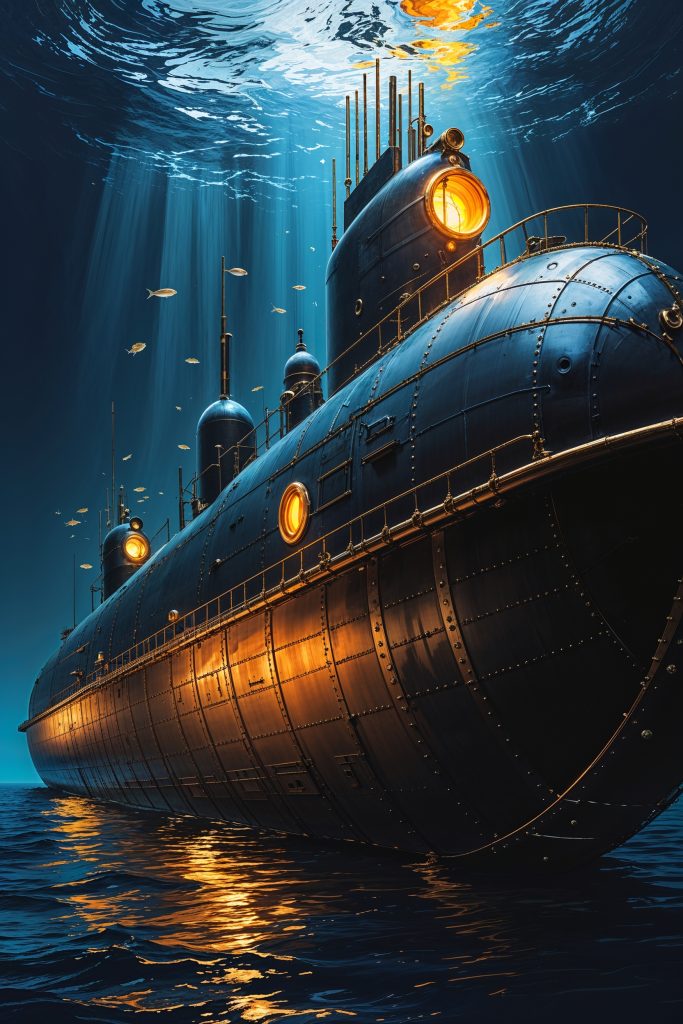
That’s what Jules Verne understood. I grew up on his Captain Nemo — 20,000 Leagues Under the Sea, then The Mysterious Island, then Master of the World — and what got me about those books wasn’t the submarines or the flying machines. It was that the technology always belonged to someone who had a reason for it. Nemo in the original isn’t a scientist who built a neat submarine. He’s a dispossessed prince whose family was destroyed by colonial forces, and the Nautilus is the expression of his grief and his politics and his decision to remove himself from civilization while waging private war against the powers that unmade him. The technology is an argument. The 1954 film with James Mason captured it — Mason played Nemo as genuinely haunted, capable of real violence, not a straightforward hero. The machine was magnificent. The cost of it was real.
Most steampunk writing never reaches this. It gets distracted by the aesthetic — which is glorious — and forgets that the aesthetic was never the point. The goggles and the brass gears are a delivery mechanism for a question the genre has been asking since Verne: what does it cost to build a world with this technology, and who pays? That question is why the genre has lasted. It’s what I built this handbook around.
I’m Richard Lowe. 113 published books, a childhood spent in Captain Nemo’s submarine, and more Southern California steampunk festivals than I can count, including one on a ship that knew exactly what technology costs. This handbook is built on all of it.
$25.95
One-time investment • Lifetime access • Instant download
Get The Handbook →
30-Day Money-Back Guarantee
If this handbook doesn’t change how you approach steampunk, request a full refund. No questions.
Nineteen Chapters. One Question Running Through All of Them.
Every chapter in this handbook comes back to the same thing Verne understood: who built this, who maintains it, what did it cost, and who got crushed when progress decided to modernize. The aesthetic is the entry point. This is what’s underneath it.
Chapter
What It’s Actually About
Inventors and Engineers
Whose invention gets patented and whose gets stolen — and what the inventor does about it
Airship Crews and Sky Pirates
Hierarchy, loyalty, and what happens when a closed society has to make a decision its chain of command can’t make cleanly
The Underclass and Factory Workers
Economic survival and collective action when you have less power than the problem requires
Clockwork Automatons
What it means to build something that thinks — and what you owe it
Lady Adventurers
Competence in a world designed to discount it, and the specific cost of being right when the institution insists you’re wrong
Empire, Colonialism, and Resistance
The specific machinery of extraction — and what resistance looks like when the empire controls the technology
Mad Scientists and Dangerous Discoveries
The scientist who is right about the discovery and wrong about who has the right to deploy it
Class Warfare and Social Mobility
The specific texture of moving between classes in a world where your vowels can determine whether you die in a workhouse or a country house
The Ethics of Technology
When does the invention become the inventor’s responsibility — and when does it stop being theirs?
Antagonists: The Institutional Enemy
The villain whose mandate is genuine — and who creates the conditions for your hero without intending to
Plus nine more chapters: Secret Societies, Gaslamp Mystery, Military and Warfare, Street Life, Explorers and Expeditions, Political Intrigue, Romance Across Class Lines, The Occult and the Mechanical.
Nine Case Studies
Each case study examines a specific work that got something right, something wrong, or both — and what writers can take from the craft decisions it made.
Twenty Thousand Leagues Under the Sea
The technology as political argument — Nemo’s submarine isn’t an invention, it’s a manifesto
The Mysterious Island
What the same character looks like when the war is over and the argument has to become something else
The Time Machine
Class warfare as evolutionary consequence — what Wells actually built underneath the time travel premise
Penny Dreadful
Gothic atmosphere as serious craft — how the series uses Victorian mythology to examine what the era’s contradictions actually cost specific people
The Difference Engine
How to build a counterfactual world where the technology changes everything systematically, not just decoratively
Boneshaker
Steampunk with genuine consequence — what it looks like when the inventor’s failure shapes the entire world of the story
Mortal Engines
Taking the genre’s central metaphor — cities as machines, progress as consumption — and making it literal, then following it to its honest conclusion
Wild Wild West
What happens when the aesthetic is present and the argument is absent — and what the failure teaches
Sucker Punch
A more complex version of the same lesson Wild Wild West teaches — when spectacle substitutes for the question the genre is supposed to be asking
Questions
Why do most steampunk stories feel like costume parties instead of novels?
Because the writer started with the aesthetic and never got to the question underneath it. Airships, clockwork, brass fittings, top hats — none of that is a story. It’s a setting. The story begins when you ask who built the airship and what it cost them, who maintains it and what they earn, who gets to ride it and who watches it pass overhead from a factory floor. Verne didn’t write about submarines because submarines were cool. He wrote about a man who built a submarine because civilization had destroyed everything he loved and he needed a way to wage war against it from outside its reach. The technology was the argument. When steampunk forgets that technology is always someone’s argument, you get a gorgeous costume party with no one home inside it.
What did growing up on Jules Verne teach you about writing steampunk?
That the inventor is never just an inventor. Captain Nemo is a dispossessed Indian prince whose family was killed by British colonial forces. He didn’t build the Nautilus because he loved engineering. He built it because he needed a weapon that operated outside the world that had destroyed him, and he needed to be the only person who could use it. That’s the character underneath the technology. The Mysterious Island showed the other side — what Nemo looks like when the war is over and the weapon has to become something else, when isolation stops being a solution and starts being its own kind of trap. These are the questions steampunk is built to ask, and they’re available in every story if you start with the person rather than the machine.
How do you handle the colonialism problem in steampunk without writing a lecture?
By writing characters whose specific situation is shaped by the colonial system, rather than characters who exist to explain or oppose it. The empire is most powerful in fiction when it’s not the villain in the frame — when it’s the water the characters swim in, the assumption that shapes what’s possible and impossible, the thing that made certain people wealthy and certain people expendable and now everyone is just living in the world that produced. A character who is navigating those conditions, making specific choices within specific constraints, teaches readers more about how empire operates than any character who exists to critique it. The handbook spends considerable time on this because it’s the question the genre can address better than almost any other, when it’s willing to do the work.
Does steampunk have to be set in Victorian England?
No, and some of the most interesting work in the genre deliberately isn’t. The Victorian period is the default because it’s when the industrial transformation happened in England and when the contradictions of that transformation were most visible. But the same questions — who benefits from technological progress, who gets crushed, what does the technology actually cost — are available in any setting where those conditions existed. Ottoman steampunk, Meiji-era Japan, the American frontier, colonial India with the colonized building the technology rather than being subjected to it. The period gives you the backdrop. The questions give you the story. You can ask the questions anywhere the backdrop supports them.
How do AI tools help with steampunk research specifically?
Steampunk research is primarily historical, technological, and social — which is exactly where AI delivers consistently. What were actual factory wages in 1880? How did the patent system work and who could access it? What diseases were common in overcrowded working-class districts and what did Victorian medicine believe caused them? What were the legal restrictions on women’s property ownership before specific reform acts passed? These are answerable questions that AI handles efficiently. The handbook includes 216+ prompts designed for steampunk specifically — not generic “help me write a scene” prompts, but targeted questions that pull the historically grounded detail that makes the technology feel real and the social conditions feel lived-in. The aesthetic is easy. The texture that makes readers believe in the world requires research, and AI accelerates it.
What’s the difference between steampunk and gaslamp fantasy?
Steampunk puts technology at the center of the story’s argument. The machines matter because they represent something — progress, power, exploitation, liberation — and the story examines what they represent. Gaslamp fantasy uses the Victorian aesthetic as a backdrop for other kinds of stories: supernatural mysteries, romance, gothic horror, adventure. The technology is set dressing rather than argument. Both are legitimate. Knowing which one you’re writing shapes every craft decision, because steampunk without the argument is gaslamp fantasy that has confused its own aesthetic for its subject. The handbook addresses the distinction directly and gives you the tools for both — because understanding what distinguishes them helps you do either one deliberately.
Refund policy?
30 days. If it doesn’t change how you approach steampunk, full refund. No questions.
I still think about standing on the Queen Mary’s deck in the middle of that festival. The ship knows things the costumes don’t. It carried soldiers to a war. Its steel has weight that the aesthetic alone can’t account for. That’s what the genre is capable of when it’s paying attention — fiction with that kind of weight in it, where the technology is an argument and the argument costs something and the cost is real.
That’s what this handbook teaches you to write toward.
$25.95
One-time investment • Lifetime access • Instant download
Get The Handbook →
30-Day Money-Back Guarantee
If it doesn’t change how you approach steampunk, request a full refund. No questions.
Part of the AI Writer’s Library Series. See also: World Builder’s Handbook | Historical Writer’s Handbook