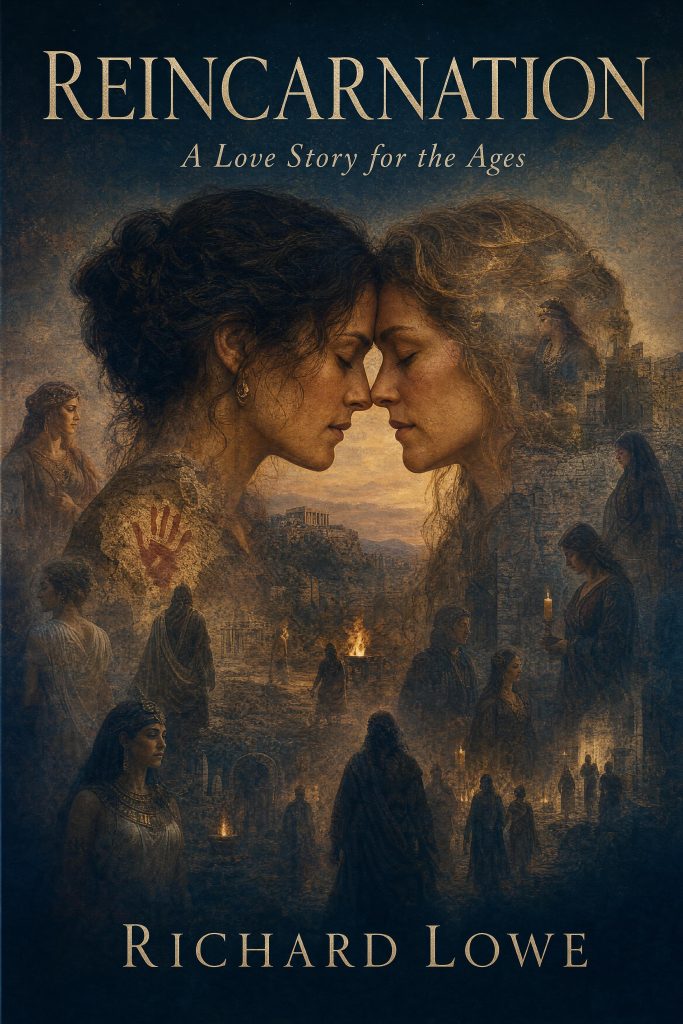
Two souls. Eighty-two thousand years. One connection that refuses to end.
In a New Haven therapy office in 1971, two women lie down for a regression session and begin to remember things that do not belong to this life. A green door. Stone steps. A collar heavy on the shoulders. Someone trained to be careful about what their body says. Someone who was supposed to come and did not.
What surfaces is not a clean historical record. It is memory, layered on memory, going back further than recorded history. A first meeting under a rock overhang in 78,000 BCE, blood still cooling on a hunter’s neck, a hand rising toward a stranger across the fire for a reason the body cannot explain. A toothache in 7th century Basra. The bad light on a Tuesday in 15th century Florence. A recognition in a Vienna consulting room in 1895 so precise and so old it had no name in any psychology Freud had yet invented.
Reincarnation is the longest love story Richard Lowe knows how to tell: two people finding each other again and again across hundreds of lives, carrying something they cannot consciously access but cannot put down. The historical chapters, the therapy sessions, and the soul sequences between them build a single accumulating recognition, from the first fire in East Africa to the last chapter on the Moon.
You do not have to believe in past lives to read this book. The novel does not ask for belief. It asks for the willingness to follow two people across a very long time and feel what it costs them to keep finding each other.
This is consciousness looking at itself across an enormous distance, the ordinary texture of extraordinary circumstances, and the question of what persists when everything else is lost.
| ISBN (Paperback): |
978-1-972810-73-6 |
| ISBN (eBook): |
978-1-972810-74-3 |
| Publisher: |
The Writing King |
| Publication Date: |
2026 |
| Print Length: |
532 pages |
| Language: |
English |
Questions
What genre is this book?
Reincarnation is literary fiction: a love story that moves across 82,000 years and hundreds of lives, structured around 1971 therapy regression sessions, historical chapters reaching from prehistoric East Africa to the present, and the soul sequences that connect them. It blends literary character work with a speculative premise about consciousness persisting across lifetimes.
Do I have to believe in reincarnation to read it?
No. The novel does not ask for belief in past lives, souls, or anything outside a conventional life. It asks only for the willingness to follow two people across a very long time and feel what it costs them to keep finding each other. The emotional truth carries the book whether or not you share its metaphysics.
How does the structure work?
Three threads braid together: regression sessions in a New Haven therapy office in 1971, historical chapters in the past lives those sessions surface, and the soul sequences between lives. The past is always refracted through the present. What Diana and Ruth access is real in its emotional truth and recognition, but the details are memory, compressed and filtered the way all memory is. Read it from the beginning. The first chapter is 78,000 BCE. The last is the Moon.
Is it a religious book?
It is not a sermon. Richard Lowe is a Christian and holds that alongside the novel’s premise without contradiction: God is everything, including the part of everything that persists across lives and reaches toward recognition across centuries. The book is open to readers of any belief or none, and never asks the reader to adopt a position.
Who would enjoy this book?
Readers who love literary fiction with emotional depth and an ambitious structure, who are drawn to stories about memory, time, and connection, and who appreciate a love story told on the largest possible scale. If you enjoy fiction that takes big questions seriously while staying grounded in intimate human moments, this is for you.
Read the Opening
Chapter One
The Overhang
78,000 BCE — East Africa
She came back to camp with a steenbok across her shoulders and the smell of blood worked deep into her hair.
The group had settled for the night already. She could hear the children before she saw the fire, their voices dropping as the dark came on and the bush pressed in close around the overhang the way it always did at this hour, patient and enormous. She ducked under the low shelf of rock and let the steenbok slide from her shoulders to the ground near the coals.
That was when she saw him.
He sat apart from the others, his back to the rear wall, his legs drawn up. The firelight caught one side of his face and left the other in dark. He was not from this group.
The space around him had stayed empty, none of the others had pulled in close. He was reading the fire and reading the people around it, and she knew that look because she had worn it herself three seasons ago when she’d first come to this place.
She stood with the blood cooling on her neck and looked at him.
He turned his head. Not quickly. The way you turn when you’ve already known something was there.
His eyes found her across the fire and her hand came up, not fully, not reaching, just lifting, her right arm rising from her side until her palm was level with her ribs and angled toward his face, toward the space between them. She didn’t know she’d done it until she felt the cooler air on her palm and saw the firelight on the back of her own wrist.
She lowered her arm.
He had gone still. Not the stillness of a man deciding something.
His hands lay open on his knees and he looked at her and the fire moved between them and the man beside him said something and it took him a moment to turn his head. She crouched by the fire and began working on the steenbok’s belly and did not look at him again for a long time.
Amazon Kindle
Paperback (IngramSpark)
epub (Kobo)
×
Chapter One
The Overhang
78,000 BCE — East Africa
She came back to camp with a steenbok across her shoulders and the smell of blood worked deep into her hair.
The group had settled for the night already. She could hear the children before she saw the fire, their voices dropping as the dark came on and the bush pressed in close around the overhang the way it always did at this hour, patient and enormous. She ducked under the low shelf of rock and let the steenbok slide from her shoulders to the ground near the coals.
That was when she saw him.
He sat apart from the others, his back to the rear wall, his legs drawn up. The firelight caught one side of his face and left the other in dark. He was not from this group.
The space around him had stayed empty, none of the others had pulled in close. He was reading the fire and reading the people around it, and she knew that look because she had worn it herself three seasons ago when she’d first come to this place.
She stood with the blood cooling on her neck and looked at him.
He turned his head. Not quickly. The way you turn when you’ve already known something was there.
His eyes found her across the fire and her hand came up, not fully, not reaching, just lifting, her right arm rising from her side until her palm was level with her ribs and angled toward his face, toward the space between them. She didn’t know she’d done it until she felt the cooler air on her palm and saw the firelight on the back of her own wrist.
She lowered her arm.
He had gone still. Not the stillness of a man deciding something. His hands lay open on his knees and he looked at her and the fire moved between them.
He stayed three days.
She learned this about him: he had come from far to the north, from where the grassland ran flat for more than a season’s walk. He had a word for elephant she’d never heard. He moved around the edges of the camp the way a man moves when he’s been alone long enough that he’s not sure yet whether company is good.
On the second morning she was scraping an old hide near the water when he came and sat on the rock above her. Not close enough that it was anything, but he stayed.
After a while he spoke. She caught most of it, his words were almost the same as hers, just bent differently in his mouth.
“There’s nothing left to the north,” he said.
She waited. He didn’t add to it.
“You’re not going back,” she said.
He was quiet long enough that she thought he wasn’t going to answer. “I don’t know,” he said.
— Continued in the book —
Amazon Kindle
Paperback (IngramSpark)
epub (Kobo)