
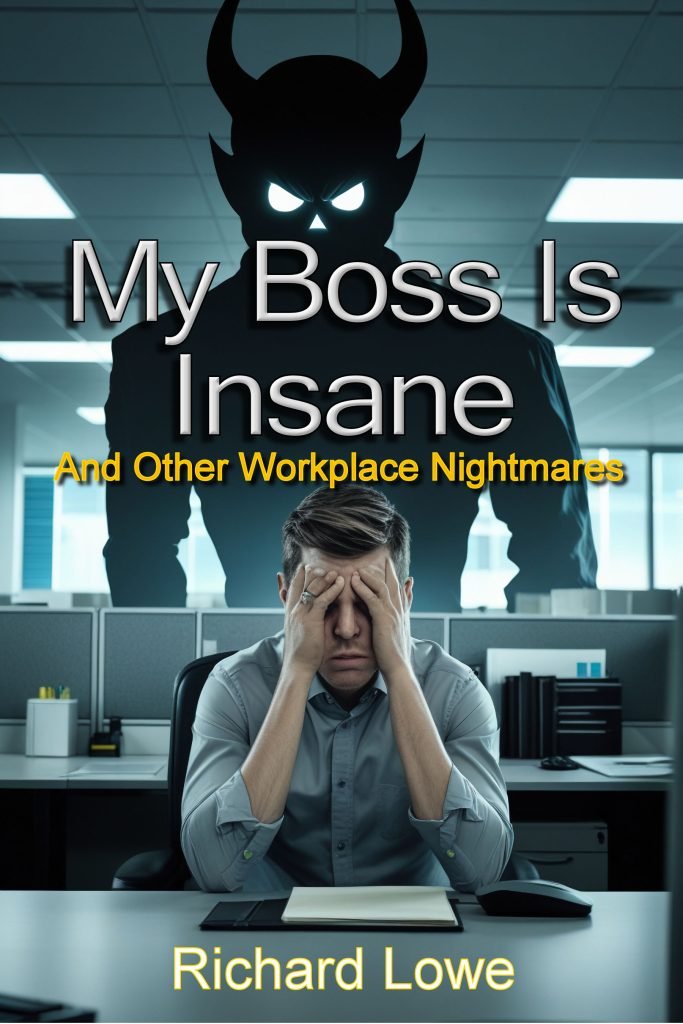
My Boss is Insane
You’ve had the boss. The one who screamed at you in front of the whole office. The one who promised you a commission and then explained why it didn’t apply. The one who made your life miserable every day while HR told you to focus on improving your attitude.
You are not alone, you are not crazy, and you are not powerless.
Richard Lowe spent thirty-three years in corporate America working for, around, and occasionally surviving some of the most dysfunctional managers in the business. The micromanager who required written justification for a $75 software manual. The racist executive who nearly used a slur in front of witnesses. The boss who showed his entire team a framed certificate from a psychiatrist confirming he was legally insane, and explained that it made him very difficult to fire. The HR VP who made unwanted advances on a subordinate who was alone in the building at 9 pm, then called him an idiot for saying no. The startup owner who pocketed an employee’s $85,000 commission by ruling it was earned on company time.
Every story in this book actually happened. The names have been changed. The dysfunction has not been exaggerated.
This is not a book written by a consultant or a business school professor. Lowe is not going to tell you about management theory or the importance of growth mindset. He is going to tell you what it is actually like when your boss is broken, what you can actually do about it, and why the systems supposedly designed to protect you mostly won’t.
The book covers the full range of workplace nightmares: the racist boss, the religious harasser, the pathological liar, the manager who mentally retired twelve months before his actual retirement date, the unethical boss who needs you to bury expenses in the wrong budget, the micromanager who wants to review every email you send, the genuinely unstable executive, the screamer, the sexual predator. Each chapter is built around a real story, followed by hard-won advice on how to handle it.
But the book does not stop at survival. The second half covers the strategic infrastructure that determines whether you are trapped or free: how to document everything in a way that will actually hold up, why HR is not your friend and never was, how to manage up when your boss is incompetent but untouchable, how to build an escape fund that gives you the power to walk away from any toxic situation, and how to develop skills that are portable across industries so no single employer can hold you hostage.
Your career belongs to you. Your mental health belongs to you. No paycheck is worth sacrificing either one for a manager who has made it clear they cannot be trusted with either. You have more power than you think.
| Amazon Kindle | Paperback (IngramSpark) | epub (Kobo) |
| 📖 Look Inside | Need a Ghostwriter? Let’s Talk | |
| ISBN: | 978-1-972810-28-6 (Paperback) |
| ISBN: | 978-1-946458-65-0 (eBook) |
| Publisher: | The Writing King |
| Publication Date: | April 9, 2026 |
| Print Length: | 120 pages |
| Language: | English |
Questions
Read a Chapter
After dealing with toxic bosses for over three decades, I’ve learned one fundamental truth: your memory means nothing, your word means nothing, and witness testimony means nothing. The only thing that matters in workplace disputes is what you can prove with documentation.
I learned this lesson the hard way when I tried to challenge a manager’s behavior without proper evidence. My boss, Frank, had a pattern of making promises in verbal conversations and then denying he’d ever made them. He would agree to budget increases in meetings, then claim he never approved the spending. He would promise promotions and raises to team members, then act surprised when they brought up his commitments.
The breaking point came when Frank promised our entire team bonuses for completing a critical project ahead of schedule and under budget. We busted our asses for three months, working nights and weekends to meet his aggressive timeline. When we delivered the project two weeks early and 15% under budget, we were proud of what we’d accomplished.
“Great work, everyone,” Frank announced at our team meeting. “I’ll make sure those bonuses we discussed are in your next paychecks.”
Two weeks later, no bonuses appeared. When I approached Frank about it, he looked at me like I was crazy. “Bonuses? I never promised any bonuses. You must have misunderstood.”
I was furious but powerless. It was my word against his, and he was two levels above me in the organization. When I brought it up with other team members, they all remembered the promise but were afraid to speak up against a manager who controlled their careers.
That’s when I realized that verbal agreements and promises are worthless when dealing with dishonest managers. From that day forward, I documented everything. After every meeting or phone call where decisions are made or commitments given, I send a summary email: “Hi Frank, just wanted to confirm what we discussed. You agreed to approve the $50,000 equipment purchase and said the bonuses for early project completion would be processed by month-end. Please let me know if I misunderstood anything.”
Most of the time, managers don’t respond to these emails — which creates a paper trail showing they didn’t dispute your version of events. This approach saved me twice. In one case, a boss tried to claim I had never completed a project he’d cancelled midway through. My email trail showed his original approval, my progress updates, and his cancellation order. In another situation, a manager tried to give me a negative performance review based on missed deadlines caused by his constantly changing priorities. My documentation showed the timeline of his changing instructions. The review was withdrawn.
The only managers who object to documentation are those who plan to lie about what happened later. Start documenting today.