
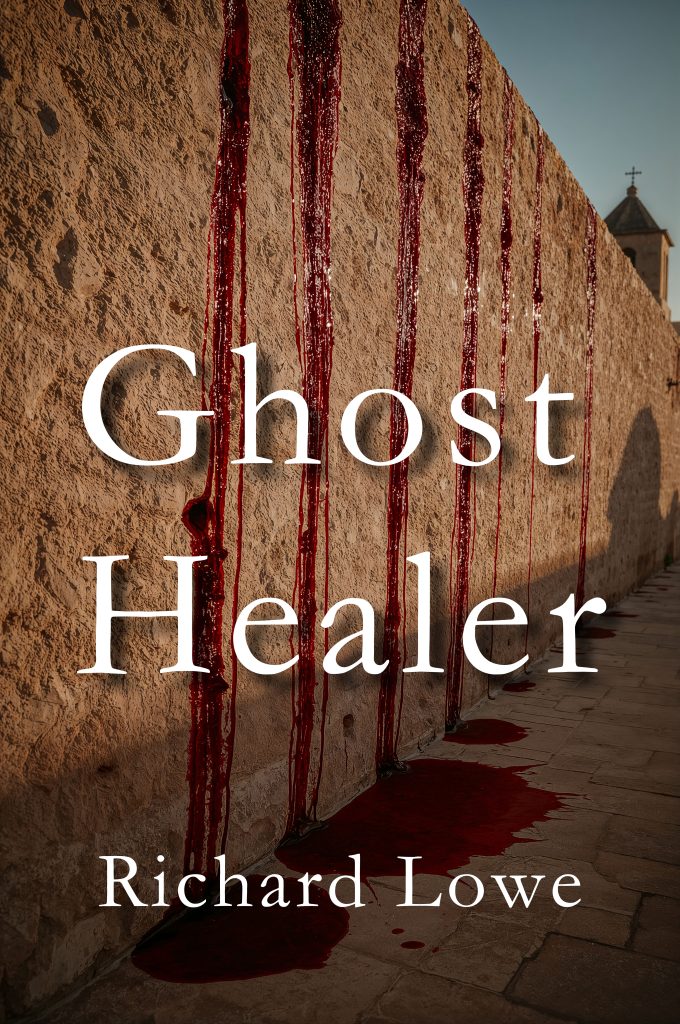
Ghost Healer
Cal Rourke does not think of himself as a ghost hunter. He thinks of himself as someone who corrects errors.
The ghosts he encounters are not the kind that rattle chains or haunt the living out of malice. They are people who stayed because they believed something that was not true — a woman who spent sixty years keeping a room ready for a man who died before he could return, a retired schoolteacher who constructed an elaborate theory to explain why time had stopped rather than accept that she was dead, a print shop owner who could not leave the business he had built because something in it had been moved six feet from where it belonged. In every case, the presence is organized around a wrong external fact. Find the fact. Correct it. Watch them go.
For three years Cal has driven the back roads of the American South, working cases that reach him through word of mouth and a sparse website with no name on it. He is methodical, patient, and genuinely skilled at what he does. He can read a room the way other people read faces. He knows what grief smells like, what long-established waiting feels like in the air of a house, what it means when the temperature drops in a doorway. He has closed dozens of cases across Georgia, South Carolina, Alabama, Mississippi, and Louisiana, and he has gotten good enough at the work that its cost — the physical toll, the isolation, the particular loneliness of a life spent in other people’s unfinished business — has become background noise he no longer examines.
Then he finds himself sitting across from Destiny MacGee, a therapist in Savannah who does not believe him and cannot stop being curious about him. In their sessions, she begins asking the questions he has been successfully avoiding for years: What does he actually believe about his own life? What is he looking for in all those empty houses? What happened to the golden childhood he describes — the Sunday mornings before his parents’ divorce that he has held intact in his memory as evidence that things were once right?
Cal is very good at finding the wrong external fact in other people’s lives. He is considerably less practiced at recognizing one in his own.
Ghost Healer is a literary novel about grief, memory, and the stories people tell themselves to stay in place. It is set in the specific light and heat of the American South, in old houses and print shops and motel rooms and the long silences between cases. It asks what it would mean to heal yourself the same way you heal everyone else — and whether you would be willing to find out what you have been organizing everything around not knowing.
| Amazon Kindle | Paperback (IngramSpark) | epub (Kobo) |
| 📖 Look Inside | Need a Ghostwriter? Let’s Talk | |
| ISBN (Paperback): | 978-1-972810-45-3 |
| ISBN (eBook): | 978-1-972810-46-0 |
| Publisher: | The Writing King |
| Publication Date: | April 20, 2026 |
| Print Length: | 258 pages |
| Language: | English |
Questions
Read the Opening
Prologue
The concrete floor of the warehouse was cold against my cheek.
I had been lying on it for what felt like a long time. My right side had two broken ribs. Something in my lower back was reporting a problem I did not yet have the clarity to classify. The ceiling above me was high and industrial, the structural members exposed, a skylight at the center that had been painted over long ago. No light came through it. The building smelled of printer’s ink so strongly I could taste it on the back of my tongue.
I tried to get up.
Something hit me back down. Not a hand. Not anything I could point to or describe to the paramedics who would eventually find me. Something that operated through me rather than on me, that knew specifically where to press to produce the most damage and pressed there with the deliberation of something that had been thinking about this for a long time.
The second rib went. I went back to the floor.
I pressed my palm flat against the concrete and breathed in the short careful way broken ribs require and looked at the ceiling.
I was in an empty warehouse in Charleston, South Carolina. I was thirty years old. I had driven here on a Tuesday morning and I had come through the loading dock door and now I was on the floor and I was not going to get up the way I usually got up.
The pain in my lower back worsened. My left ear was ringing in the way it had been ringing for a year, the sound I had given up expecting to leave. My vision went gray at the edges. Through the gray I was aware that the gap between a functional Cal Rourke and whatever was on the other side of losing consciousness was narrowing in a direction that was going to resolve against me.
I had one thought before the gray took it.
The cylinder. Augusta. Six feet to the left of where it should be.
That was the ninth month of the third year.
This is how it started.