
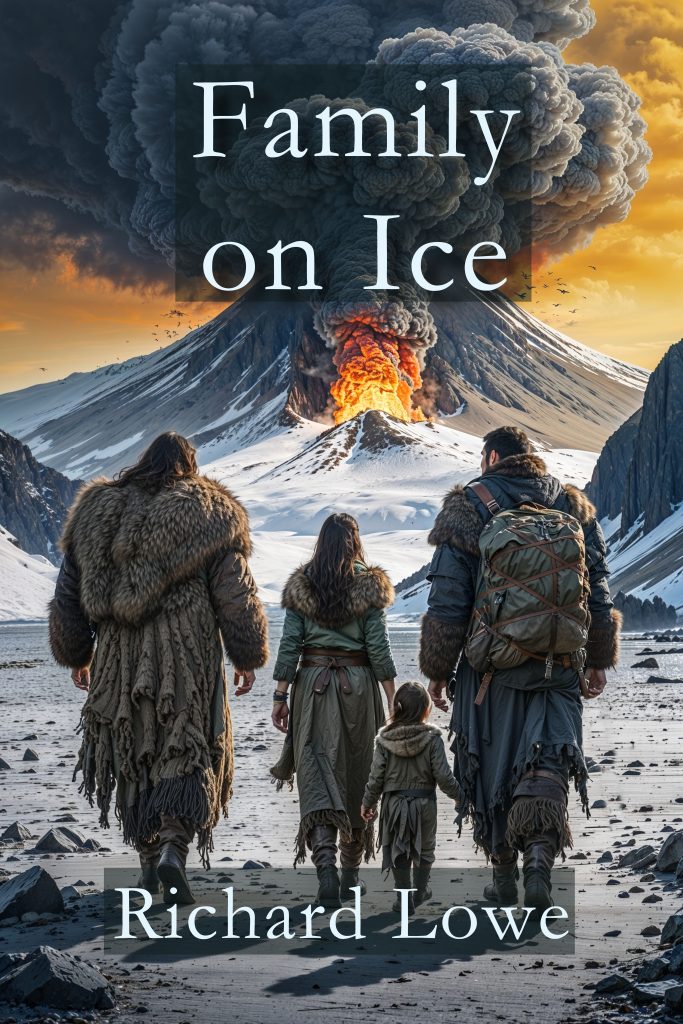
Family on Ice
74,000 years ago, the Toba supervolcano erupted in what is now Sumatra, releasing more material than any eruption in the last two million years. The ash fell across continents. The sulfur aerosols it injected into the stratosphere reduced sunlight across Eurasia by as much as ninety percent. The cold did not break. The game moved wrong. The human species came within a generation of disappearing entirely.
Family on Ice is set in that winter.
Dak is a hunter who reads terrain the way other men read faces. His wife Sela counts everything — food, water, fuel, the days until the child she is carrying will arrive. Their daughter Fen ranges ahead and reports back, reading landscape faster than she can explain it. Their son Tev, eight years old, keeps counts of things no one asked him to count and produces results no one expected.
When the ash starts falling and the game disappears and the water sources go bad, this family must leave the bowl camp they have sheltered in for three winters and walk toward a glacier wall at the edge of the known world, where a river runs clean inside the ice and the wind stops at the base of something a thousand feet high.
The journey takes them through tribal politics, an alliance they didn’t choose, the death of people they love, a river crossing that nearly ends everything, and a volcanic winter that forces every calculation to be made again from the beginning.
Along the way they encounter the last Neanderthals — people built differently, who have been in this landscape longer, who know things about the ice and the cold that no one else alive knows. The contact between these two kinds of human is rendered without explanation or fantasy, entirely through behavior and gesture and the slow accumulation of shared work.
Family on Ice is a literary survival novel in the tradition of spare, character-driven fiction. McCarthy-influenced in its prose style — no quotation marks, rotating point of view, declarative sentences that carry enormous weight — it never condescends to its people or explains their world to the reader. These are fully intelligent human beings operating without our tools, in a landscape that is ending, walking toward something none of them have seen.
The novel asks what a family is when everything else is gone. It answers in the only way the evidence supports: they keep going.
| Amazon Kindle | Paperback (IngramSpark) | epub (Kobo) |
| 📖 Look Inside | Need a Ghostwriter? Let’s Talk | |
| ISBN (Paperback): | 978-1-972810-41-5 |
| ISBN (eBook): | 978-1-972810-42-2 |
| Publisher: | The Writing King |
| Publication Date: | April 20, 2026 |
| Print Length: | 254 pages |
| Language: | English |
Questions
Read the Opening
Chapter One
Wrong Light
The light came wrong.
Dak had been outside since before the sky changed, since the dark was still total and the stars sharp, because the cold had woken him, not suddenly but by accumulation, the warmth of the sleeping skins finally giving way to the cold. Once awake, he stayed awake. He’d built the fire up and stood with his back to it and waited. He did this most mornings.
The night had things in it.
This dawn he stood and read nothing he recognized.
He had used his father’s strike-stone to start the fire. He used it first, every fire. It was not the best flint in his kit. There was a better piece he’d traded for three winters ago, sharper edge, cleaner grain. But he used the old one first, every fire, as his father had used it and his father before that.
The stone fit the heel of his hand like a thing used so many times it had shaped itself to the using. The middle finger of his right hand didn’t close all the way. Broken young, healed off-angle. The stone fit that hand, that imperfect grip, like nothing else in his kit quite fit it.
The wrong light came from the sunrise side as dawn came, the dark thinning to gray at the horizon, but the gray was off. Not cloud. Not overcast. The wrongness was in the light itself, not in what was blocking it, and he watched it spread across the sky and could not name it.
He knew most things the sky did. Many winters reading this sky, since before his voice broke and his father started taking him out in the dark. He knew this sky.
He didn’t know what this was.
The shelter flap moved behind him. He heard her feet on the frozen ground, her particular step, the slight hesitation on the left from an ankle she’d turned badly the winter before last. He didn’t turn. He knew she was looking at him before she looked at the sky. She read his face first, then looked past him at whatever he was looking at.
Many winters of this.
He heard her stop. A long pause. She didn’t say anything. Neither did he. What she read this morning she kept to herself, the same as he did.
Well into the morning Fen came out of the shelter without being called. She stood at his shoulder and looked at the sky and didn’t speak and then looked at him and then at Sela and then back at the sky.
Is it fire, she said.
No, he said.
She considered this. What then, she said.
He didn’t answer. Neither did Sela. The three of them stood in the wrong light and looked at the sky and none of them had anything useful to say about it.
Tev came out when the sky was lighter. He stood at Dak’s other shoulder and looked at the sky for a long time without speaking. Then he looked down at the ash on the ground near the fire and crouched and examined it without touching it. Stood and looked at the sky again.
It’s coming from somewhere, he said.
Dak looked at him.
The ash. Same direction as the light. From the trouble direction, he said.
Dak looked toward the ash. The ridge blocked the direct view but he knew the terrain beyond it: a slope down to a river valley, more ridge beyond that, mountains, more of the same farther than he had ever been.
Yes, he said.
Tev nodded and went back inside. He reached into his own pack, took out the counting stones, and could be heard sorting them before he settled.
Fen watched him go and then looked at Dak with the question she didn’t ask because she already knew he didn’t have the answer.
He didn’t have the answer.