
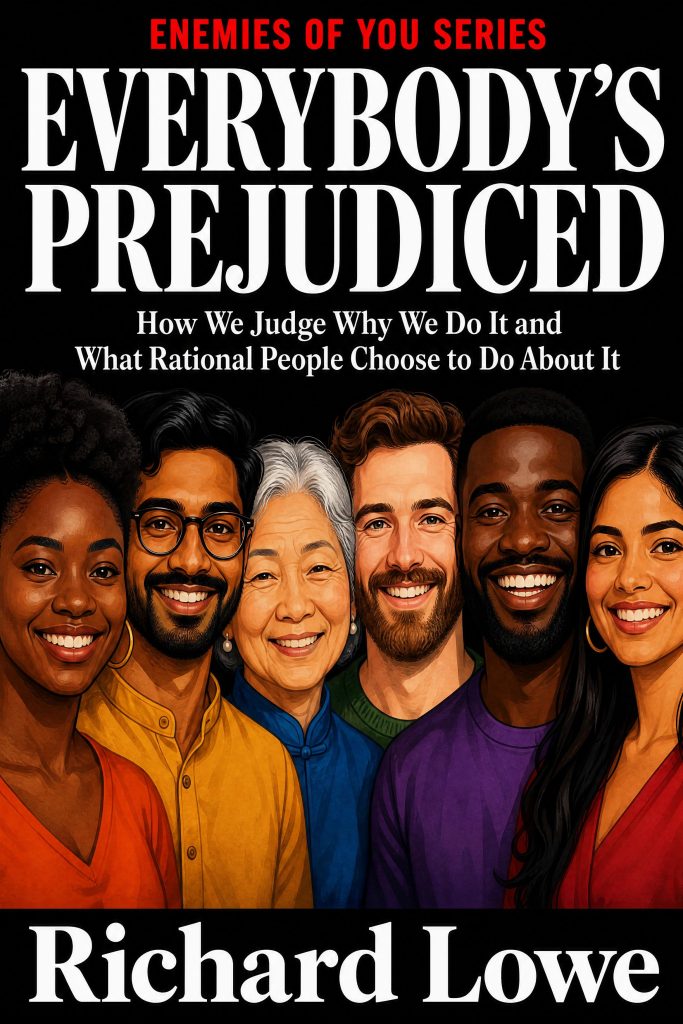
Everybody’s Prejudiced
Most people think prejudice is something other people have. This book takes that apart.
Everybody’s Prejudiced is not a book that studies bias from a safe distance. It is a book that starts with the author’s own. Richard Lowe puts his prejudices on the table before asking anyone else to examine theirs, because that is the only way a book like this earns the right to say what it is going to say. The argument is simple and uncomfortable: the same mechanism that produces prejudice runs in every human brain, points in every direction, and never shuts off. Pretending you are above it is the most dangerous move you can make.
The book starts with the machinery. Prejudice gets installed before you are old enough to question it. It runs on the tribal wiring every brain carries. It is shaped by culture, religion, and the stories you were handed before you had any say in the matter. Lowe walks through how it gets in, then through where it shows up — race, gender, religion, class, age, disability, sexual orientation, the body, and the prejudices nobody bothers to name.
From there it turns to how prejudice survives, what DEI got right and what it got wrong, what trauma builds, and what happens when the mechanism runs free. The final section is the part most books skip: what rational people actually do about it. Contact. Holding the line. The slow, unglamorous work of changing a mind — starting with your own.
Lowe writes from sixty-plus years of observation rather than from a credential, at a reading level built for normal people living normal lives, not academics or activists. The claims are his, grounded in experience and supported by real research, and he tells you plainly which is which.
Part of the Enemies of You series.
| Amazon Kindle | Paperback (IngramSpark) | epub (Kobo) |
| 📖 Look Inside | Need a Ghostwriter? Let’s Talk | |
| ISBN (Paperback): | 978-1-972810-71-2 |
| ISBN (eBook): | 978-1-972810-72-9 |
| Publisher: | The Writing King |
| Publication Date: | June 20, 2026 |
| Print Length: | 411 pages |
| Language: | English |
Questions
Read the Introduction
Introduction
I’ll Go First
Let me save you the trouble of wondering where I’m coming from. I’m going to put my own prejudices on the table before I ask you to examine yours. That’s the deal. The only way this book earns the right to say what it’s going to say is if the person writing it goes first.
This book was written by a Christian white man. I want to address that directly, because prejudice is often portrayed as something white people observe in others, study from a distance, or experience only as the people who hold it rather than the people it is aimed at. That framing is wrong, and it is part of what this book is arguing against.
White people experience prejudice. Men experience prejudice. Christians experience prejudice. Working-class people experience prejudice. Old people experience prejudice. People with disabilities experience prejudice. Veterans experience prejudice. The same process operates in every direction. Pretending otherwise does not make it untrue. It just makes it invisible to the people who most need to see it.
I am writing this book because I have experienced prejudice from multiple directions, held prejudice in multiple directions, and spent decades watching the same mechanism produce harm regardless of which way it was pointed. I wanted to write an honest book about that, agenda-free, applying the same standard no matter who held the bias or who it was aimed at. That required someone willing to go first with their own prejudices before asking anyone else to examine theirs. I qualified on every count.
That is why a white man wrote this book.
One more thing. I am not a sociologist, a psychologist, a researcher, or an academic of any kind. I am a person. I have the same brain producing the same automatic judgments that every other person has. I have lived inside the same mess everyone else is living inside. The research in this book is real, and I have tried to represent it accurately. But the engine of the book is not research. It is observation — sixty-plus years of watching how this works in actual rooms with actual people.
That is the only qualification I am claiming. It turns out to be enough.