
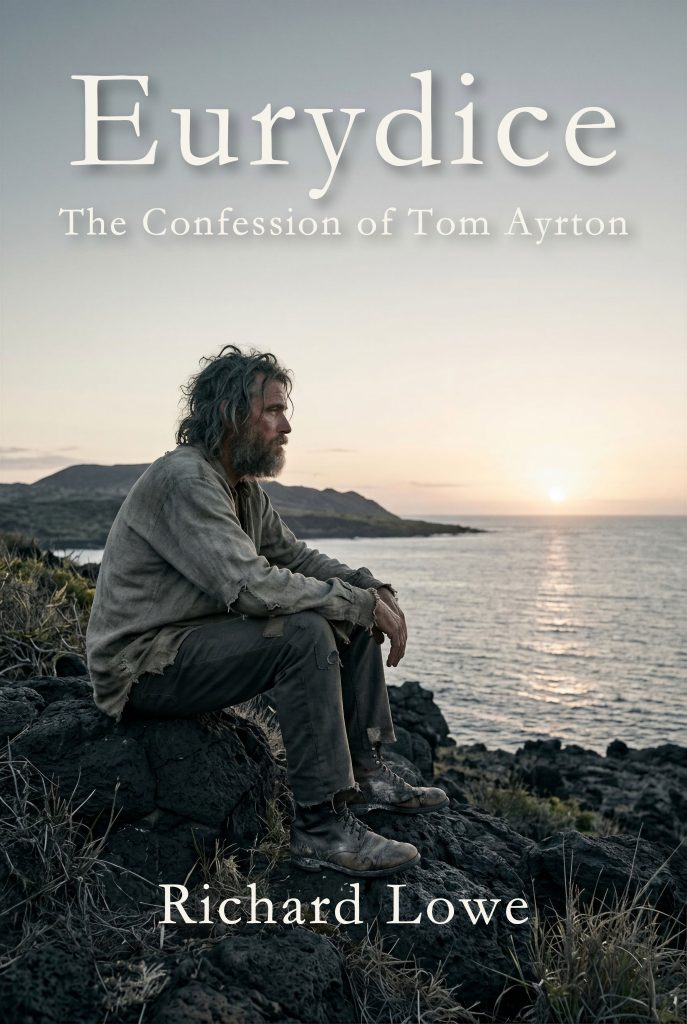
Eurydice: The Confession of Tom Ayrton
In The Mysterious Island, Jules Verne marooned Tom Ayrton on a barren rock for twelve years, rescued him, reformed him, and killed him defending the colony he’d come to love — all in roughly thirty pages. Verne never once went inside him. Eurydice is the account Verne never wrote: the full confession of the man on the rock, in his own voice, on his own terms.
Twelve years alone on Tabor Island does something to a man, and Verne was not interested in what. Richard Lowe is. Told as a series of recorded sessions between Ayrton and the journalist Gideon Spilett — begun three days after the colony charted its course toward Tabor and what waited there — Eurydice is the testimony of a man who has had over a decade of silence to assemble, and who agrees to speak only on conditions neither party will write down. What Spilett records is not the tidy redemption arc of the published account. It is the slower, stranger truth of who Ayrton was before the rock, what he actually did to the ship called the Britannia, and what the isolation built in him that no rescue could undo.
Verne is deliberately vague about Ayrton’s crimes. That vagueness is where this novel begins. Ayrton speaks plainly about the things the published record left blank, and Spilett — a correspondent with his own reasons for managing a story — shapes the confession even as he claims only to be taking it down. Between the man who is finally telling the truth and the man deciding what to do with it, the account becomes something neither of them fully controls.
The third novel in the Victorian Era Series, following 20,000 Leagues Under the Sea and The Mysterious Island. It takes a character the original abandoned and gives him the interior life Verne never thought to look for, arriving somewhere the source novel never went.
| Amazon Kindle | Paperback (IngramSpark) | epub (Kobo) |
| 📖 Look Inside | Need a Ghostwriter? Let’s Talk | |
| ISBN (Paperback): | 978-1-972810-67-5 |
| ISBN (eBook): | 978-1-972810-68-2 |
| Series: | The Victorian Era Series |
| Publisher: | The Writing King |
| Publication Date: | June 20, 2026 |
| Print Length: | 388 pages |
| Language: | English |
Questions
Read the Opening
The Maroon
The Beach
The boat came through the reef at half tide, four men at the oars, two more in the bow keeping watch on the rocks to either side. I sat in the stern with my hands loose in my lap. They had not bound them.
There was nowhere to go.
The channel was narrow. On both sides the reef worked constantly, that low continuous sound like breathing, the surge pressing through the rock formations and pushing back out. Salt on the air, strong where the channel kept the water moving through exposed basalt.
The bow ground up onto gray sand and stopped.
They worked without looking at me. A crate of provisions wrapped in sailcloth. Two oilskin bundles. A canvas sack of line. A hatchet with a worn handle. A knife in leather, recently oiled.
A rifle, lock wrapped in oilcloth, set apart from the other supplies on the thwart.
One cartridge on the floorboards beside it.
Not with the other goods. On the boards. Apart.
Glenarvan at the stern rail that morning. His face. The look of a man who had decided this was right while acknowledging, in the tightness around his eyes, that the doing is not comfortable. The cartridge was outside the proceedings. The addition that a man of conscience makes when the official and the private are not the same.
The man in the shallows held the gunwale and waited. I stepped out over the bow. Cold hit my feet immediately through the leather. The sand shifted under my feet with each small surge. I stood there while the man stacked the supplies above the tideline.
The rifle last, carried separately, set on the dry sand with the cartridge placed beside it.
The man walked back to the bow and pushed off. The oarsmen pulled. The boat came alongside the Duncan and the falls came down and the boat rose. The anchor chain came up and the engine turned over and the ship moved. The bow swinging north, then faster as she came onto her heading.
I watched her go. She grew smaller in stages and then the hull dropped below the horizon and only the smoke of her stack remained, and then the wind took the smoke and there was nothing.
I sat on a flat rock above the storm wrack. The rock still held the warmth of the day.
She would have told me to get up. She would have said: the light is going and you haven’t looked at the island. Get up. Do the thing that needs doing. She would have been right. I sat on the rock anyway.
Before dawn I picked up the rifle and loaded it and sat on the flat rock with it across my knees.