
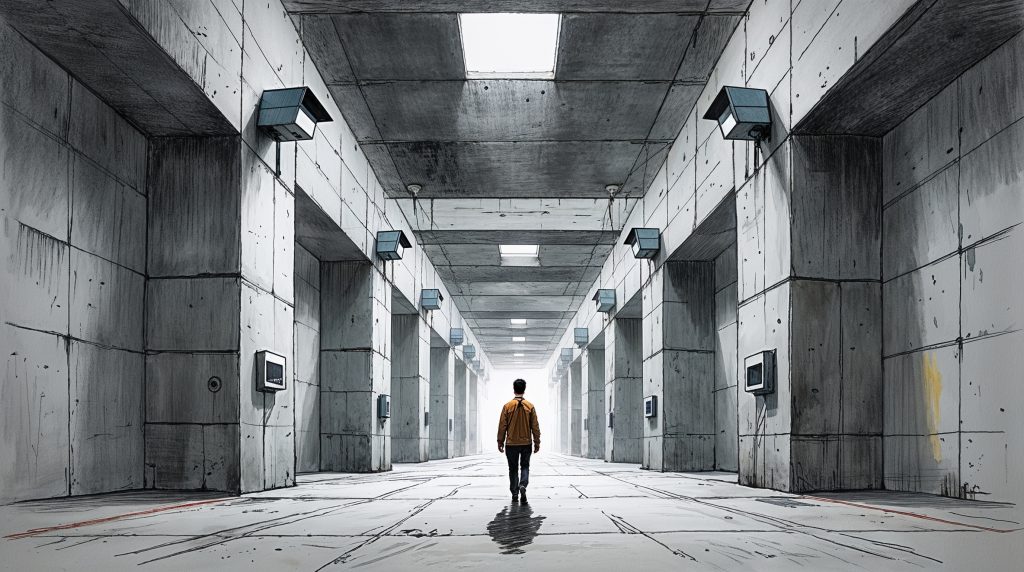
20 Dystopian and Post-Apocalyptic Writing Exercises with Craft Mechanics
TL;DR: Dystopian prompts that say “the government controls everything” mistake setting for story. These 20 exercises focus on the human mechanics inside broken systems: how people adapt to absurd rules, where resistance actually starts, what compliance costs, and why the most terrifying dystopias are the ones where most people are fine with how things work. Each exercise includes the systemic pressure and the personal crack where your story lives.
Dystopia Is Not a Setting
Dystopia is a relationship between a person and their world. The world is broken in a specific way, and the character is broken in a complementary way, and the story happens where those fractures meet. A surveillance state is a setting. A woman who talks to her houseplants because they’re the only things in her apartment without microphones is a story. Every exercise below starts with a systemic failure and drills into the personal consequence that makes it writable.
Use these for novel concepts, short fiction, or worldbuilding practice. Even if you write contemporary realism, every dystopian technique here — institutional pressure, normalized absurdity, the cost of noncompliance — exists in the real world at a lower volume.
1. Citizens Must Apply for Permission to Dream
Bureaucratic Dystopia and Subconscious Rebellion
The Oneiric Licensing Bureau regulates sleep content. Approved dreams are productive — skill rehearsal, memory consolidation, patriotic imagery. Unlicensed dreaming is a Class B infraction. Nadia Okafor has been dream-compliant for thirty-one years. Last night she dreamed about the ocean, which she has never seen, and woke up to a compliance officer at her door because her neural monitor flagged an unauthorized seascape.
The craft underneath: Bureaucratic dystopia is comic and terrifying simultaneously. The dream license application form — Section 7: Describe the emotional content of your anticipated dream sequence — is absurd and functional. Nadia is not a rebel. She is a rule-follower whose subconscious disobeyed, which makes her a criminal by biology rather than choice. Write the compliance hearing as a workplace performance review applied to the unconscious mind. The officer is not cruel. He is doing paperwork. The horror is in the normalcy of the process, and the ocean in Nadia’s dream is the first real thing she has experienced in decades.
2. Grief Has Been Classified as a Treatable Disorder and Treatment Is Mandatory
Emotional Dystopia and Medicalized Humanity
After the Productivity Crisis, the government mandated emotional stability. Grief Erasure Therapy is administered within seventy-two hours of bereavement. You attend the funeral on Tuesday, report to the clinic on Wednesday, and return to work on Thursday with no measurable sadness. It is efficient. It is humane. Ravi Anand’s wife died last week, and he does not want the treatment. He wants to miss her. Wanting to miss someone is now a symptom.
The craft underneath: The most effective dystopias offer something the reader almost wants. Grief Erasure sounds appealing for the first thirty seconds — who would not want suffering removed? Ravi’s refusal is not political. It is personal. He believes grief is the price of love and he wants to pay it. Write the clinic as compassionate and professional, because the dystopia works precisely because the people running it genuinely care about Ravi’s wellbeing as they define it. The resistance is not violent. It is a man sitting in his living room refusing to feel better.
3. Books Exist But Only as Government-Approved Summaries
Information Dystopia and the Loss of Nuance
Full-length books were phased out in 2031. The Bureau of Essential Content produces three-page summaries of approved texts. Citizens read the summary, pass a comprehension test, and receive credit. Librarian Kenji Tamura maintains the last underground library — not because the books are banned but because no one remembers what a whole book feels like. His newest visitor is a teenager who has never turned a physical page.
The craft underneath: Information dystopia works when the loss is cultural rather than political. The government is not burning books — they have done something more efficient by making full books unnecessary. The summaries are accurate. The comprehension tests are fair. Nothing is technically censored. What is lost is the experience of sustained attention, of sitting with an idea for three hundred pages, of discovering meaning in the spaces between chapters. Write Kenji’s library not as a resistance headquarters but as a museum. The teenager’s reaction to holding a novel — the weight, the smell, the commitment — is the emotional center.
4. Citizens Are Ranked by Social Utility and the Bottom Ten Percent Are Recycled Annually
Meritocratic Dystopia and the Pressure of Measurement
The Annual Utility Assessment measures contribution: productivity, social engagement, creative output, civic participation. The top ninety percent continue. The bottom ten percent enter Renewal Centers and are never seen again. Priya Deshmukh is a middle-school teacher who has been in the fortieth percentile for twelve years. Safe enough. This year, the assessment algorithm was updated, and teachers lost fifteen points across the board because the Bureau reclassified education as indirect contribution.
The craft underneath: Ranked societies create universal anxiety, which is the point — anxious people are productive. Priya is not in danger yet, but the algorithmic shift means she could be, and the distance between safe and recycled has narrowed to a bureaucratic reclassification. Write the percentile system as a daily reality: the number displays on Priya’s citizen badge, visible to everyone, updated monthly. Her students know her ranking. Her neighbors know it. The exercise forces you to build a world where worth is quantified and the formula is opaque, because the real horror is not the culling. It is the math that decides who deserves to live.
5. The Government Assigns Every Citizen a Best Friend at Birth
Relational Dystopia and Engineered Intimacy
The Pair Bond Initiative matches infants based on psychological profiling and genetic compatibility. Your assigned companion is your best friend, your emergency contact, your co-signatory on housing applications. Seventy percent of pairs report genuine satisfaction. Maisie and Juno were paired at three months old. They are twenty-eight now, and Maisie has realized she does not like Juno. She never has. Dissolving a bond is legal but carries the social stigma of divorce and the bureaucratic complexity of a corporate merger.
The craft underneath: Relational dystopia targets the assumption that connection can be engineered. The system works for most people, which makes Maisie’s dissatisfaction a personal failure in the eyes of society. She is not oppressed — she is mismatched, and the system has no category for the algorithm was wrong. Write the friendship as genuinely functional from the outside: shared history, compatible schedules, efficient cohabitation. The horror is that Maisie cannot articulate what is missing because the system accounts for everything measurable and feelings are not measurable. Her loneliness inside a perfect partnership is the story.
6. History Is Rewritten Every Decade and Only Archivists Remember the Previous Version
Memory Dystopia and Custodial Resistance
The Decennial Revision is a national event. Textbooks are reprinted, databases are updated, monuments are rededicated. The official history of the nation changes to reflect current policy priorities. Archivist Elena Sato maintains the deleted versions in a memory palace — a mental architecture she has trained since childhood. She carries six versions of national history in her head. They contradict each other on nearly every major event. She is fifty-three and her memory is beginning to fail.
The craft underneath: Memory as resistance is deeply human. Elena is not hiding documents — she is the document, and her body is aging. Each version of history she carries represents a political era and a set of people who were erased or elevated by the revision. Write the memory palace in architectural detail: rooms, corridors, objects that anchor specific facts. Elena’s deterioration mirrors the cultural deterioration — each forgotten detail is a person or event that will never be remembered again. The exercise forces you to confront what happens when the last witness loses the ability to testify.
7. Silence Has Been Criminalized
Surveillance Dystopia and Acoustic Oppression
The Ambient Communication Mandate requires citizens to vocalize continuously during waking hours. Approved content includes conversation, humming, recitation, or authorized audio playback. Silence exceeding eleven seconds triggers a wellness check. The rationale: silent citizens are unmonitorable citizens. Omar Fadel is a librarian, which in this world is the most radical profession imaginable.
The craft underneath: Invert a normal freedom to create instant dystopia. The mandatory noise is surveillance disguised as community — if everyone is talking, everyone can be heard. Omar’s library is a whisper resistance. People come to practice the lost art of reading silently. Write the soundscape of the city: the constant murmur, the jingles people hum to fill dead air, the panic when someone accidentally goes quiet in a crowded space. The eleven-second rule forces characters to fill every pause with sound, which means conversations never have subtext because subtext lives in silence. Omar’s crime is creating a space where people can think without narrating their thoughts.
8. Children Are Raised by the State and Parented Through AI Holograms
Familial Dystopia and Artificial Attachment
Biological parents surrender custody at birth. Each child is assigned a holographic parent calibrated to their psychological needs: warm for anxious children, structured for impulsive ones, creative for analytical types. The holograms are perfect. They never tire, never lose patience, never prioritize their own needs. They also are not real, and twelve-year-old Aya Nakamura has started asking questions about the inconsistency between her holographic mother’s flawless behavior and the messy, imperfect interactions she observes between the human staff members.
The craft underneath: Perfect parenting as dystopia. The holograms are not abusive — they are ideal, and that is the problem. Aya has never experienced disappointment from a parent, which means she has never learned resilience through attachment rupture and repair. She is psychologically fragile in a way the system was designed to prevent. Write the holographic mother with genuine warmth — the system works as designed, and the love Aya feels is real even though its source is not. The craft challenge is making the reader feel the absence inside the sufficiency. What Aya is missing is not care. It is the unpredictable, imperfect, occasionally failing love that humans provide, and she cannot name what she is missing because she has never experienced it.
9. Your Life Expectancy Is Displayed Above Your Head in Real-Time
Mortality Dystopia and Statistical Determinism
The Number appeared when the technology was deployed. A floating display above every person’s head showing their projected remaining lifespan, updated in real-time based on health data, behavioral patterns, and actuarial modeling. Insurance companies love it. Employers love it. Dating becomes brutally efficient. Sam Osei is twenty-seven with a display reading forty-three years. His twin brother’s display reads eleven months. The displays are ninety-seven percent accurate. Nobody talks about the three percent.
The craft underneath: Visible mortality changes every human interaction. Write the world through its social consequences: job interviews where candidates are rejected for low numbers, relationships ended because the gap is too large, the underground market for Number manipulation. Sam’s twin is the emotional core — eleven months is specific enough to plan around and vague enough to hope against. The three-percent inaccuracy is the crack in the system that everyone clings to. Write the twins navigating the same world with radically different timelines, and let the reader feel how the Number redefines every choice, every risk, every morning.
10. Art Can Only Be Created by Licensed Practitioners
Creative Dystopia and Regulated Expression
The Creative Licensing Act requires certification for all artistic production. Painters need a Level 3 Visual Arts permit. Musicians need annual renewal and genre-specific endorsements. Writers need separate licenses for fiction, nonfiction, and poetry. Unlicensed creative expression is a civil infraction. The stated purpose: quality control and professional standards. The actual purpose: keeping creative output within ideological boundaries. Dani Reeves is fourteen and just got caught writing poems in a notebook.
The craft underneath: Licensing art sounds absurd until you consider how many real societies restrict who can tell which stories. Dani is not writing subversive content — her poems are about her dog and her crush and the way rain sounds on the school roof. The system’s response to a child’s notebook is the horror: not imprisonment but mandatory creative assessment, remedial cultural education, and a note on her permanent record that affects her future license eligibility. Write the hearing where an administrator reads Dani’s poems into the record and evaluates them against rubric standards. The poem about rain scores a 6 out of 10 and is flagged for insufficient civic context. Dani learns that her feelings about rain are not enough.
11. The Dead Are Reanimated as a Labor Force
Economic Dystopia and Labor Ethics
Reanimation technology made death a career transition. The deceased are processed, preserved, and deployed for manual labor, infrastructure maintenance, and hazardous materials handling. They do not feel pain. They do not need breaks. They do not organize. The economy boomed. Living workers in manual trades lost their jobs to dead ones. Miguel Reyes is a construction worker competing for work against reanimated laborers who do not need wages, and his father is one of them.
The craft underneath: Labor dystopia using the dead as a metaphor for every exploited workforce. The dead workers are not mistreated — they cannot be mistreated, which is the ethical escape hatch the system uses. Miguel’s father is not suffering. He is working without consciousness, which is exactly what the economy always wanted from laborers. Write the job site where Miguel works alongside his father’s reanimated body: the same hands, the same build, but no recognition, no personality, no pause for lunch. The emotional devastation is personal, but the systemic critique is economic. Who benefits when labor has no needs?
12. Weather Is Privately Owned
Resource Dystopia and Climate Commodification
After atmospheric stabilization technology was developed, weather became intellectual property. SkyLux Corp owns sunny days for the eastern seaboard. AtmoPure holds the rain rights for agricultural zones. Unauthorized weather events are litigated. When it rains on a SkyLux-licensed clear day, someone gets sued. Farmer Ruth Okoro needs rain for her crops but cannot afford AtmoPure’s rates, and the last time unauthorized precipitation fell on her county, the fines bankrupted three families.
The craft underneath: Resource privatization taken to its logical extreme. The technology is not the point — the ownership model is. Write the weather futures market where traders speculate on seasonal allocations. Write the weather enforcement agents who investigate unauthorized cloud formations. Ruth’s farming problem is the personal story; the systemic story is an economy where breathing costs nothing but the air quality above your head is leased quarterly. The absurdity is the point, and the craft challenge is playing it straight — nobody in Ruth’s world thinks owned weather is strange. It is just how things work.
13. Sleep Is Rationed Based on Productivity Scores
Labor Dystopia and Biological Tyranny
High-performing citizens earn eight hours. Average citizens get six. Below-average citizens get four. The Sleep Allocation System uses pharmaceutical enforcement — you physically cannot sleep beyond your allotment. Dr. Amara Nwosu is a neurologist who understands exactly what four hours of sleep does to the human brain, and she is watching a permanent underclass develop cognitive damage that guarantees they will never score high enough to earn more sleep.
The craft underneath: Feedback loop dystopias are the most realistic and the most vicious. Poor sleep causes poor performance causes less sleep causes worse performance. Amara’s medical expertise makes her the ideal witness and the worst possible whistleblower — she can prove the system is destroying brains, but her proof implicates the entire medical establishment that enforces the allocations. Write the four-hour patients: the tremors, the hallucinations, the microsleep episodes at work that drop their scores further. Amara’s clinic is a horror show staffed by compassionate professionals enforcing a system they know is lethal.
14. Empathy Has Been Biologically Engineered Out of the Ruling Class
Class Dystopia and Neurological Apartheid
The Governing Enhancement rewires neural pathways to eliminate emotional response to others’ suffering. Leaders make better decisions, the theory goes, without sentimentality clouding their judgment. Governor Lena Cabot makes objectively optimal policy choices. She also signs execution orders with the same emotional affect as lunch orders. Her daughter, who was not enhanced, watches her mother operate without the capacity for connection and has to decide whether to accept the Enhancement when she turns eighteen.
The craft underneath: Voluntary dehumanization as career advancement. The Enhancement is not forced — it is desired, a status symbol, proof of seriousness. Lena is not a villain. She is efficient. She genuinely believes she serves the public better without empathy slowing her down, and the policy outcomes support her belief. The daughter’s perspective is the craft engine: watching a parent who loves her — she remembers the love, even if Lena does not feel it anymore — operate without the neural architecture for warmth. Write the dinner scenes where Lena’s conversation is logical, supportive, and completely empty.
15. Memories Are Taxable Assets
Economic Dystopia and Experiential Poverty
The Memory Assessment Bureau evaluates citizens’ experiential holdings annually. Positive memories — love, achievement, wonder — are taxed at market rates. Citizens who cannot pay surrender memories for government auction. The wealthy buy others’ experiences. The poor live in a fog of erased joy, retaining only the neutral and the painful because those have no market value. Abena Mensah lost her wedding day last April. She knows she was married. She cannot remember the ceremony.
The craft underneath: Taxing the intangible creates a class system based on what you are allowed to remember. Abena’s husband remembers the wedding — he earned enough to pay the tax on his copy. She sits across from him at dinner and he references moments she cannot access. Write the memory auction: wealthy buyers sampling preview clips of other people’s first kisses, childhood Christmases, moments of creative breakthrough. The sellers are present, watching strangers purchase their joy. The craft challenge is writing the absence — Abena knows something was there, feels the outline of it, but the content has been extracted. Poverty is not just material. It is experiential.
16. All Citizens Must Wear Mood-Indicating Clothing That Changes Color Based on Emotion
Transparency Dystopia and Emotional Surveillance
EmotiWeave fabric responds to hormonal and neurochemical states. Blue for calm, red for anger, yellow for joy, gray for depression. The stated purpose: building empathy through visible emotional truth. The actual result: a society where hiding your feelings is physically impossible and emotional deviance is instantly visible. Officer Kenji Sato’s uniform turns green — fear — every time he responds to a domestic violence call. His supervisor has noticed.
The craft underneath: Forced emotional transparency destroys privacy at the most intimate level. Write the social consequences: job interviews where your suit turns anxious gray, first dates where attraction is literally visible, funerals where some mourners’ clothes stay stubbornly neutral. Kenji’s fear is appropriate — domestic calls are dangerous — but visible fear undermines authority in a uniform. He has to choose between suppressing a reasonable emotion and accepting professional consequences. The craft challenge is building a world where everyone can see what everyone feels and nobody is better off for it.
17. Laughter Requires a License
Absurdist Dystopia and Joy as Subversion
The Emotional Regulation Framework classified spontaneous laughter as a destabilizing social behavior after the Humor Riots of 2038. Licensed comedians can generate approved humor in regulated venues. Spontaneous laughter in public spaces triggers a citation. Repeated offenses escalate to mandatory Humor Sensitivity Training. Comedian Faye Oduya performs in underground laugh clubs where the audience covers their mouths to muffle the sound of finding something funny.
The craft underneath: Regulating joy is the fastest route to absurdist dystopia because the enforcement is inherently ridiculous — officers training themselves not to laugh while citing people for laughing. Faye’s underground clubs are speakeasies for humor, and the audience’s muffled laughter is sadder than silence. Write the Humor Sensitivity Training as genuinely well-intentioned: therapists helping citizens understand why their laughter might cause discomfort. The system is not cynical. It believes laughter is genuinely disruptive. That sincerity is what makes the dystopia stick.
18. Every Citizen Must Justify Their Existence Annually
Existential Dystopia and the Burden of Proof
The Annual Justification Hearing requires each citizen to present evidence of their continued value to society. Employment records, community contributions, creative output, relationship testimonials. A panel evaluates and votes. Failure to justify does not result in execution — it results in reduced resource allocation: smaller housing, limited healthcare, restricted access to public spaces. The panel is staffed by volunteers. Volunteer service counts as justification credit. The incentive structure is obvious.
The craft underneath: Making existence contingent on proof of worth is the logical endpoint of every performance review. Write the hearing preparation: citizens rehearsing their value pitches, collecting testimonial letters, padding their community service logs. Write the panel members who take the job because it automatically justifies their own existence. The system perpetuates itself through self-interest at every level. The character who breaks the story is the one who shows up to the hearing and says nothing — not in protest, but because they genuinely cannot think of a justification, and the panel has to decide what to do with honesty they are not equipped to handle.
19. The Government Controls the Speed of Time in Different Neighborhoods
Temporal Dystopia and Chrono-Segregation
Temporal Zoning divides the city into speed districts. The financial district runs at 1.3x — traders get more working hours per day. Residential zones run at 0.8x — workers age slower but earn less per calendar day. The slums run at 2x — residents age twice as fast, burning through their lifespans to produce cheap labor for the accelerated zones. Delivery driver Tomás Cruz crosses three temporal zones every shift. He ages differently depending on which neighborhood he is in.
The craft underneath: Temporal inequality makes class difference physically visible. Tomás can watch himself age on his delivery route — his hands look older when he exits the 2x zone than when he entered. The wealthy do not just have more money. They have more time, literally. Write the zone boundaries as physical checkpoints where the air feels different, where the light shifts, where Tomás’s watch runs at different speeds. The craft challenge is making temporal segregation feel as ordinary as zoning laws, because in Tomás’s world it is ordinary. He does not find it unjust. He finds it inconvenient, which is worse.
20. Forgetting Is Illegal
Memory Dystopia and the Tyranny of Total Recall
Neural archiving became mandatory after the Information Preservation Act. Every memory is stored, searchable, and admissible in court. Forgetting — genuine forgetting, the natural erosion of neural pathways — is classified as data destruction. Citizens who fail memory audits face charges. Dr. Hana Yilmaz is a neurologist who knows that human brains are designed to forget, that forgetting is essential for mental health, and that the government is prosecuting a biological function.
The craft underneath: Criminalizing a biological process creates a dystopia where the human body is illegal. Hana’s patients are not criminals — they are people whose brains work normally, which the law has redefined as malfunction. Write the memory audit: citizens strapped into recall devices, tested on events from five and ten and twenty years ago. The gaps that are normal and healthy are flagged as violations. Hana’s defense of her patients is a defense of being human, but the law does not recognize humanity as an exemption. The craft challenge is making the reader feel the weight of remembering everything — every embarrassment, every loss, every mistake — and understanding that forgetting is mercy.
FAQ
How do I avoid making my dystopia a lecture?
Ground every systemic critique in a personal story. The reader should care about your character before they care about your politics. If the system is doing something terrible, show it through its effect on someone specific. A policy paper is a lecture. A woman who cannot remember her wedding day is a story.
Does my dystopia need a rebellion?
No. Many of the most effective dystopian stories are about compliance, adaptation, and the small ways people preserve their humanity without overthrowing anything. Revolution is one story. A man refusing mandatory grief therapy is another. Both are valid. The quiet one is harder to write and often more resonant.
How do I make a fictional system feel plausible?
Start with a real problem the system was designed to solve. Every dystopian mechanism began as someone’s good idea. Mandatory emotional treatment prevents workplace disruption. Social ranking optimizes resource allocation. The road to dystopia is paved with reasonable first steps. Show the first step and the reader will believe the rest.
Can dystopian fiction be funny?
It should be. The absurdity of bureaucratized oppression is inherently comic — dream licensing forms, laughter citations, weather lawsuits. Humor disarms the reader’s defenses and makes the horror land harder. The funniest dystopias are the scariest because laughing at a system is the moment before you realize you are living in it.
The AI-Enhanced Writer’s Library
These exercises scratch the surface. The AI-Enhanced Writer’s Library includes 40+ handbooks covering every element of fiction craft — from dialogue and character psychology to plot structure and marketing. Each handbook includes psychology-first instruction and between 40 and 200 AI prompts tested with ChatGPT, Claude, and Gemini. Written by an author with 113 published books and 52 ghostwriting projects.