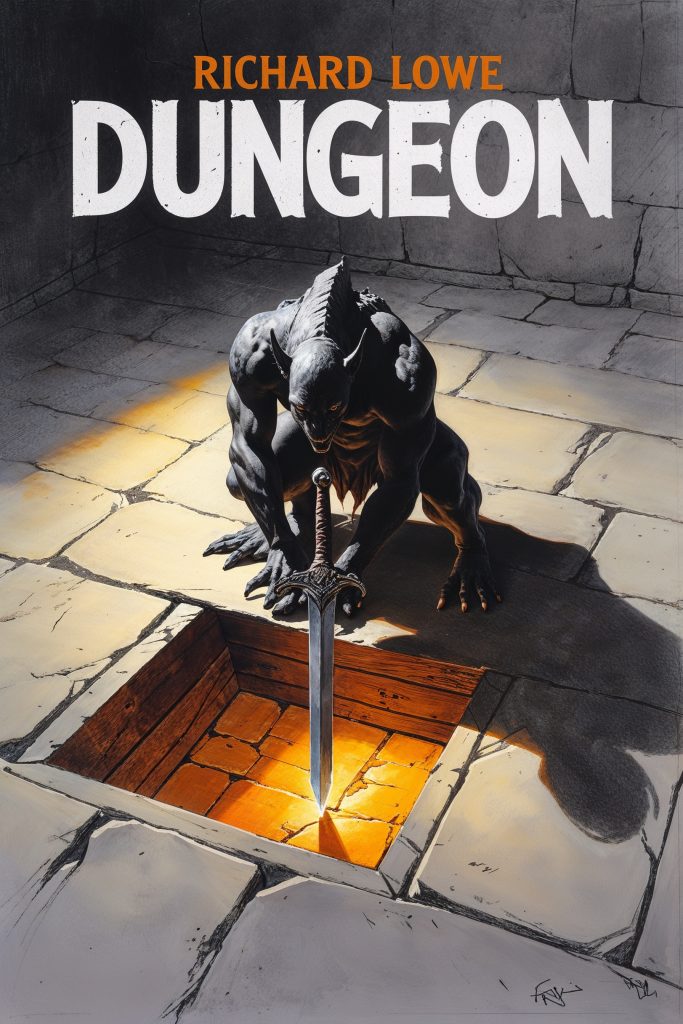
Corvin Cray is a deserter. Ten years in the Imperial Legion, one order he wouldn’t follow, and now his name is on a warrant and his options have narrowed to approximately one.
East of Miren, north off the main road, there is a house at the edge of a forest with a maintained mailbox and a leaflet inside explaining everything. Beneath the house is a dungeon. The dungeon contains treasure enough to make a man invisible to the men looking for him. The dungeon has also never been designed with the adventurer’s survival as a primary objective.
Dungeon is a novel adaptation of the 1977 MIT mainframe text adventure — the FORTRAN predecessor to Zork — told through the eyes of a sardonic, methodical ex-soldier working his way through two hundred rooms, twenty categories of treasure, and the slow realization that the dungeon may be more reliable than anything he left behind.
For readers who remember typing GO NORTH and meaning it, every room is familiar. The troll at the bridge. The thief who takes things from fastened pockets without being heard. The grue in the dark. The Flood Control Dam. The volcano gnome. The cyclops. The trophy case with its twenty empty slots and its lock. They are all here, rendered in prose that takes the world of the game seriously as a place a person might actually survive in, if the person is careful and paying attention and not too proud to use a boat.
For readers who have never touched the game, Corvin is enough. A man who needed somewhere warrants don’t reach, who found it, and who has to decide what that means.
Dungeon is the story of how the case was filled.
| ISBN (Paperback): |
978-1-946458-90-2 |
| ISBN (eBook): |
978-1-946458-91-9 |
| Publisher: |
The Writing King |
| Publication Date: |
April 8, 2026 |
| Print Length: |
210 pages |
| Language: |
English |
Questions
What is this book based on?
The 1977 MIT mainframe text adventure known as Dungeon — the FORTRAN predecessor to Zork. Every major element of the original game is here: the trophy case, the troll, the thief, the grue, the Flood Control Dam, the volcano gnome, the cyclops, all twenty categories of treasure. The novel renders the game’s world as a place a person might actually survive in.
Do I need to know the game to enjoy the book?
No. Corvin works as a character on his own terms — a sardonic, methodical ex-soldier who needed somewhere warrants don’t reach and found it. The dungeon is strange and dangerous and often absurd regardless of whether you’ve seen it before. Readers who know the game will recognize everything. Readers who don’t will just encounter it fresh.
What kind of book is this?
Literary fantasy with dry humor. It’s not an action novel — Corvin survives by being careful and methodical, not heroic. It takes the logic of the original game seriously: the dungeon is consistent, the rules hold, and understanding them matters. The tone is closer to sardonic first-person memoir than epic quest.
What is the trophy case?
In the original game, the trophy case in the house above the dungeon is where you deposit treasure to score points. In the novel it’s the same — twenty empty slots, a lock, the whole point of the exercise. Dungeon is the story of how the case was filled.
Read the Opening
Prologue
Six Months Before
The order came down at dusk on the fourteenth day of the siege, which was the fourteenth day Corvin had been standing in the same field outside Halvenmark watching the same fires on the same ridge while the Legion’s engineers worked on the same problem they’d been working on since the second day. The problem was the town. The town was full of people who had come there because the Legion had told them to come there, which was a detail that had become inconvenient to the officers managing the siege.
The order was passed by a sergeant whose name Corvin did not know. Read it. Sign here. Move on.
He read it. He did not sign. He stood in the field with the paper in his hand for a moment that lasted longer than a moment, and then he folded it and put it in his coat and walked north.
It took the Legion six hours to notice he was gone.
He knew this because he’d covered roughly eighteen miles by the time the first rider came through, which was fast enough that they’d sent the rider before they’d properly decided what to pursue him for. Desertion was the correct charge but it required documentation he doubted they’d had time to file. By morning it would be filed. By afternoon copies would be moving to every garrison and posting station within two days’ ride.
He had twelve silver pennies, the clothes he was standing in, the Legion sword he’d drawn ten years ago and carried since, and the specific problem of a man who has done an irreversible thing and has not yet worked out the implications.
He worked them out over the following weeks. The first implication was money. The second implication was the warrant. He saw the first copy in a town called Oriel, tacked to a post outside the garrison, and stood in front of it long enough to read it carefully. Height, build, the scar on his left forearm, the way he carried his shoulders from ten years of pack weight. No likeness. The reward was modest. He took the notice off the post and walked away and spent the rest of that day rearranging how he held his shoulders.
The third implication, which took longer to arrive, was where he was going. He needed somewhere warrants didn’t reach.
The man in the tavern was drunk enough to be telling the story badly and sober enough to know he was telling it badly, which made him the best kind of source. The shape was this: a house at the edge of the eastern forest, abandoned, with a dungeon beneath it, and in the dungeon treasure enough to make a man comfortable for the rest of his life. The man had not been into the dungeon himself. He knew someone who had. The someone had come back with a coin — gold, worn, the face on it belonging to no dynasty Corvin recognized.
“Where,” he said.
The man told him. He put two pennies on the table and went east.
Amazon Kindle
Paperback (IngramSpark)
epub (Kobo)
×
Prologue
Six Months Before
The order came down at dusk on the fourteenth day of the siege, which was the fourteenth day Corvin had been standing in the same field outside Halvenmark watching the same fires on the same ridge while the Legion’s engineers worked on the same problem they’d been working on since the second day. The problem was the town. The town was full of people who had come there because the Legion had told them to come there, which was a detail that had become inconvenient to the officers managing the siege.
The order was passed by a sergeant whose name Corvin did not know. Read it. Sign here. Move on.
He read it. He did not sign. He stood in the field with the paper in his hand for a moment that lasted longer than a moment, and then he folded it and put it in his coat and walked north.
It took the Legion six hours to notice he was gone.
He knew this because he’d covered roughly eighteen miles by the time the first rider came through, which was fast enough that they’d sent the rider before they’d properly decided what to pursue him for. Desertion was the correct charge but it required documentation he doubted they’d had time to file. By morning it would be filed. By afternoon copies would be moving to every garrison and posting station within two days’ ride.
He had twelve silver pennies, the clothes he was standing in, the Legion sword he’d drawn ten years ago and carried since, and the specific problem of a man who has done an irreversible thing and has not yet worked out the implications.
He worked them out over the following weeks. The first implication was money. Twelve pennies lasted eight days if he was careful. He found work: two days clearing a field, three days helping a carter whose horse had gone lame between towns. The carter had questions about where Corvin was coming from and where he was going. Corvin said east and kept working and the carter let it go.
The second implication was the warrant. He saw the first copy in a town called Oriel, tacked to a post outside the garrison. Height, build, the scar on his left forearm, the way he carried his shoulders from ten years of pack weight. No likeness. The reward was modest. He took the notice off the post and walked away and spent the rest of that day rearranging how he held his shoulders.
The third implication, which took longer to arrive, was where he was going. He’d been going east because east was away from Halvenmark. After two weeks it was just movement without destination, which he recognized as a different problem. He needed somewhere warrants didn’t reach.
The man in the tavern was drunk enough to be telling the story badly and sober enough to know he was telling it badly, which made him the best kind of source. A man who was drunk enough to believe his own story told it smoothly. This man kept losing his thread and backing up and changing details, which meant he was working from something real and trying to fit it into the shape of a story worth telling.
The shape was this: a house at the edge of the eastern forest, abandoned, with a dungeon beneath it, and in the dungeon treasure enough to make a man comfortable for the rest of his life. The man had not been into the dungeon himself. He knew someone who had. The someone had come back with a coin. Here the man produced it: gold, worn, the face on it belonging to no dynasty Corvin recognized.
Corvin looked at the coin. He looked at the man. He thought about the qualities of a place that had been written up in a leaflet and apparently maintained a mailbox and a trophy case and a set of structured categories for its contents.
“Where,” he said.
The man told him. The directions were imprecise but precise enough. Three days east of Miren, north off the main road, look for the house at the clearing’s edge.
He put two pennies on the table.
“That’s all you’re giving me?” the man said.
“You didn’t go in,” Corvin said. He picked up his pack and went east.
— End of Prologue —
Amazon Kindle
Paperback (IngramSpark)
epub (Kobo)