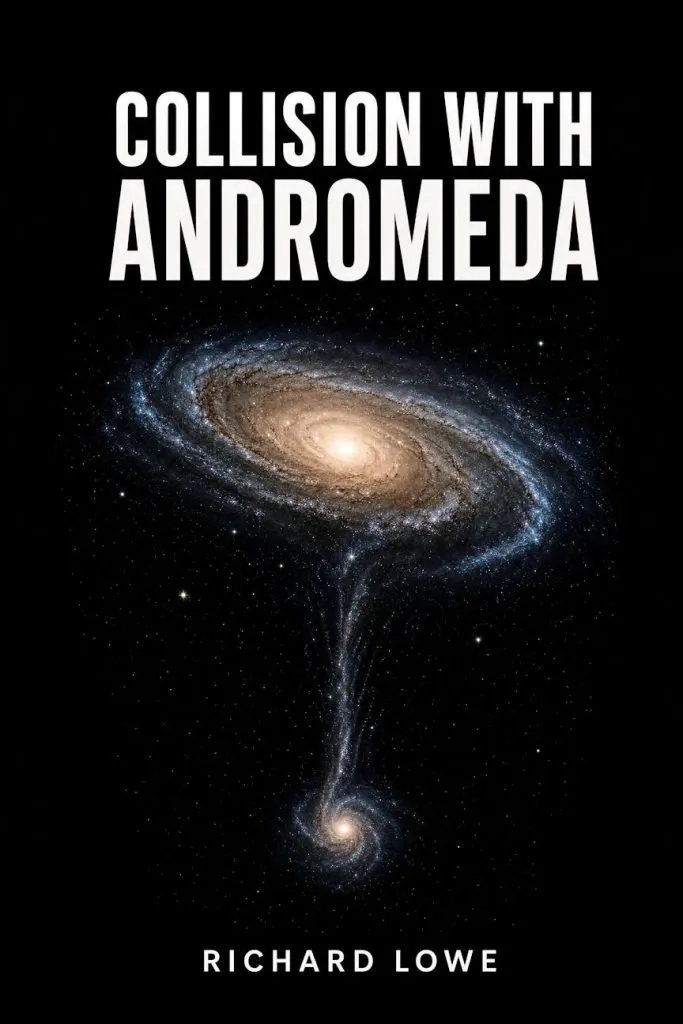
The Milky Way is conscious. Thirteen billion years old, spanning four hundred billion stars, thinking in timescales that make civilizations look like sparks. It has a plan. Humanity is part of it.
They just don’t know that yet.
Collision with Andromeda spans seventeen million years and follows the Okonkwo family across the full arc of that plan and everything that follows from it. Scientists who build weapons they don’t fully understand. A woman who becomes the galaxy’s living interface. A man who spends four centuries answering a wrong that was done to his family. Generations who scatter across the stars carrying names that mean more than they know.
Above them all, the galaxy watches. Patient. Hungry. Telling itself that what it is doing is necessary.
It is wrong about that. The consequences are larger than it imagined.
The novel works at two scales simultaneously. Its galaxy POV chapters render non-human consciousness with genuine alienness — no pronouns, no human grammar, a mind that measures time in stellar rotations and cannot quite perceive anything as small as a person. Its human chapters are grounded in grief, stubbornness, and the persistence of identity across millennia.
Readers of Iain M. Banks and Arthur C. Clarke will find the scale familiar. The moral territory is harder to place. Collision with Andromeda does not resolve into lessons. It resolves into consequences, and it makes you feel the full weight of them.
A seventeen-million-year story about what it costs to mean well, and what it costs when meaning well is not enough.
| ISBN (Paperback): |
978-1-972810-14-9 |
| ISBN (eBook): |
978-1-972810-15-6 |
| Publisher: |
The Writing King |
| Publication Date: |
April 6, 2026 |
| Print Length: |
506 pages |
| Language: |
English |
Questions
What is the galaxy POV like to read?
Genuinely alien. No pronouns, no human grammar, no past tense. Thought rendered as texture and attention rather than language. A mind measuring time in stellar rotations that cannot quite perceive anything as small as a person. The challenge was making it feel genuinely non-human without making it unreadable. The book alternates between these chapters and the fully grounded human chapters, which creates a specific kind of disorientation that’s the point.
Who is the Okonkwo family?
The through-line across seventeen million years. Scientists who build a weapon they don’t fully understand. A woman who becomes the galaxy’s living interface. A man who spends four centuries answering a wrong done to his family. Generations who scatter across the stars carrying names that mean more than they know. The galaxy is using them. They don’t know that until it’s too late to matter.
Does the book have a resolution?
It resolves into consequences, not lessons. The galaxy means well in the way that something vast and very old means well — with genuine care for outcomes it cannot quite perceive at the level where people live and die. It is wrong about what it’s doing. The book makes you feel the full weight of that wrongness without telling you what to conclude from it.
Who would enjoy this book?
Readers of Iain M. Banks and Arthur C. Clarke who want civilizational-scale science fiction with serious moral weight and genuinely alien consciousness — not humans-in-space but something stranger. Also readers who are willing to sit with ambiguity. This book does not hand you a verdict.
Read the Opening
Chapter One
The Cygnus Test
The argument had run for three hours. The observation deck smelled of recycled air and burnt coffee from the machine no one had cleaned in a week.
Tanaka stood at the window of the observation deck, back to the room, watching cargo drones drift between the station’s loading bays. The viewport was cold under her fingers. Her thumb traced the pale line on her ring finger where the wedding band used to be. Behind her, voices rose and fell. Okonkwo’s deep baritone. Reyes defending the timeline. Dr. Yusuf from the ethics board, flown in from Geneva to object.
“The extinction data.” Yusuf again. She pushed her glasses up. “It’s not conclusive. Dating methods across these distances — there’s always margin of error. You’re building a doomsday weapon based on what might be coincidence. That’s what I’m saying. That’s the problem.”
“Seventeen planets.” Tanaka did not turn around. “Seventeen planets with complex life. All dead. Sterilized to microbial level. When we dated extinction events…” She paused. “Simultaneous. Fifty-year margin. Four hundred light-years of space.”
“The dating methods…”
“Accurate to within a decade. We checked. Checked again. Sent three separate probes to Gliese 667C alone.” Tanaka turned. Yusuf was younger than she expected. Thirty, maybe. “Seventeen worlds. Four hundred light-years apart. All died at the same moment. Not approximately. Not roughly. The exact same moment.”
Okonkwo spoke instead. He had been standing motionless by the wall, arms folded, a cigarette unlit between his fingers. He rolled it slowly back and forth as he talked. “And what if we become the very thing that kills, eh? What if someone uses this weapon not against whatever is out there, but against us? The machete that clears the bush can also clear the village, isn’t it?”
“Then we are the same monsters we always were. At least we will be alive to regret it.”
“That is not a moral argument, this thing you are saying.”
“No. Survival argument.” Tanaka pulled out a chair and sat. Her thumb found the bare ring finger again. “Morality is not why I am here. I am here to make sure humanity exists long enough to argue about morality.”
A month later, Tanaka stood in a control room full of silence. Forty-three people. No one was speaking. The device sat three light hours away, a sphere of exotic matter smaller than a grape, suspended in a magnetic cradle.
“Begin countdown.”
Reyes nodded. “Thirty seconds.” He was tapping his pen against the console, a nervous rhythm. Tap tap tap. “Que Dios nos ayude,” he muttered, so quiet only Tanaka heard.
Nothing happened for three hours while light crawled back across the void. Then the data arrived.
The screens went black.
Not dark. Not dim. Not the black of space, which was never truly black, always peppered with stars and radiation. This was nothing. Where the device had been. Where the test platform had been. A sphere of absolutely nothing. No light. No radiation. No temperature. No gravity. No dark matter. No dark energy. No time.
Nothing.
Reyes spoke first. “The diameter.” He stared at the display. “Three miles. You know what the models said. Maybe four, with variance.”
“And?”
Reyes looked at her. “One million miles.” He stared at the display. “The void is one million miles across.”
Silence. One million miles. Larger than the sun. Three hundred thousand times bigger than predicted.
Yusuf stepped forward from the door, barely whispering. Her glasses had slipped but she did not push them up. “We told you. We told you we did not understand the mathematics. But you would not listen.”
They checked. Recalibrated. Ran measurements through three separate systems. One million miles. Every time.
Okonkwo walked to the main display. The cigarette had snapped in half in his fingers. He did not seem to notice. He stared at the black circle for a long moment. Turned to Tanaka. Whatever he was going to say died before it reached his mouth.
No champagne. No cheering. Forty-three people staring at screens.
Tanaka watched the void. Seventeen worlds. Complete extinction. Something out there that could bring death across four hundred light-years. Humanity had just punched a hole in the universe a million miles wide.
“I do not know,” she said.
Amazon Kindle
Paperback (IngramSpark)
epub (Kobo)
×
Chapter One
The Cygnus Test
The argument had run for three hours. The observation deck smelled of recycled air and burnt coffee from the machine no one had cleaned in a week.
Tanaka stood at the window of the observation deck, back to the room, watching cargo drones drift between the station’s loading bays. The viewport was cold under her fingers. Her thumb traced the pale line on her ring finger where the wedding band used to be. Behind her, voices rose and fell. Okonkwo’s deep baritone. Reyes defending the timeline. Dr. Yusuf from the ethics board, flown in from Geneva to object.
“The extinction data.” Yusuf again. She pushed her glasses up. “It’s not conclusive. Dating methods across these distances — there’s always margin of error. You’re building a doomsday weapon based on what might be coincidence. That’s what I’m saying. That’s the problem.”
“Seventeen planets.” Tanaka did not turn around. “Seventeen planets with complex life. All dead. Sterilized to microbial level. When we dated extinction events…” She paused. “Simultaneous. Fifty-year margin. Four hundred light-years of space.”
“The dating methods…”
“Accurate to within a decade. We checked. Checked again. Sent three separate probes to Gliese 667C alone.” Tanaka turned. Yusuf was younger than she expected. Thirty, maybe. “Seventeen worlds. Four hundred light-years apart. All died at the same moment. Not approximately. Not roughly. The exact same moment.”
Yusuf opened her mouth. Closed it.
Okonkwo spoke instead. He had been standing motionless by the wall, arms folded, a cigarette unlit between his fingers. He rolled it slowly back and forth as he talked. “And what if we become the very thing that kills, eh? What if someone uses this weapon not against whatever is out there, but against us? The machete that clears the bush can also clear the village, isn’t it?”
“Then we are the same monsters we always were. At least we will be alive to regret it.”
“That is not a moral argument, this thing you are saying.”
“No. Survival argument.” Tanaka pulled out a chair and sat. Her thumb found the bare ring finger again. “Morality is not why I am here. I am here to make sure humanity exists long enough to argue about morality.”
“Dr. Tanaka.” Yusuf tried again. “A weapon that tears holes in spacetime itself. Places with no space, no time, no existence. What if it spreads instead of stabilizes…”
“It will not spread.”
“You know theoretical mathematics only. Conditions no human has observed. You are gambling with existence itself, and for what?”
“For survival.” Tanaka stood. “Something out there sterilized seventeen planets. It coordinates over impossible distances. Watches. Waits. Decides which species live or die.” She walked to the door. “I am finished waiting for it to notice us.”
A month later, Tanaka stood in a control room full of silence. Forty-three people. No one was speaking. The device sat three light hours away, a sphere of exotic matter smaller than a grape, suspended in a magnetic cradle.
“Begin countdown.”
Reyes nodded. “Thirty seconds.” He was tapping his pen against the console, a nervous rhythm. Tap tap tap. “Que Dios nos ayude,” he muttered, so quiet only Tanaka heard.
“Five.” “Four.” “Three.” “Two.” “One.”
Nothing happened for three hours while light crawled back across the void. Okonkwo sat alone in the corner, rolling an unlit cigarette between his fingers. Tanaka stared at her console. Then the data arrived.
The screens went black.
Not dark. Not dim. Not the black of space, which was never truly black, always peppered with stars and radiation and the faint warmth of the cosmic microwave background. This was nothing. Where the device had been. Where the test platform had been. A sphere of absolutely nothing. No light. No radiation. No temperature. No gravity. No dark matter. No dark energy. No time.
Nothing.
Reyes spoke first. The pen clattered from his fingers. “The diameter.” He stared at the display. “Three miles. You know what the models said. Maybe four, with variance.”
“And?”
Reyes looked at her. “One million miles. The void is one million miles across.”
Silence. One million miles. Larger than the sun. Three hundred thousand times bigger than predicted.
Yusuf stepped forward, barely whispering. Her glasses had slipped but she did not push them up. “We told you. We told you we did not understand the mathematics. But you would not listen.”
“Check the instruments,” Tanaka said. But her hands were shaking. “Recalibrate. Check again.”
They checked. Recalibrated. Ran measurements through three separate systems. One million miles. Every time.
Okonkwo walked to the main display. The cigarette had snapped in half in his fingers. He did not seem to notice. He stared at the black circle for a long moment. Turned to Tanaka. Whatever he was going to say died before it reached his mouth.
No champagne. No cheering. Forty-three people staring at screens.
Tanaka watched the void. Seventeen worlds. Complete extinction. Something out there that could bring death across four hundred light-years. Humanity had just punched a hole in the universe a million miles wide.
“I do not know,” she said.
— End of Chapter One —
Amazon Kindle
Paperback (IngramSpark)
epub (Kobo)