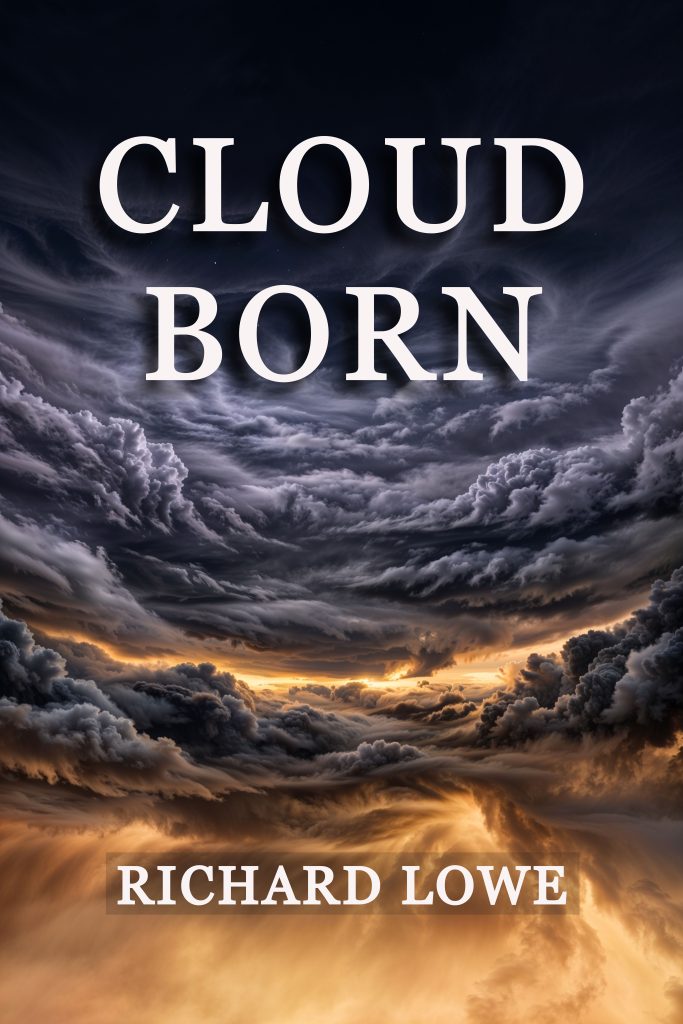
Silt is born into the cloudbanks of a gas giant, one of forty-three field-organisms in a birth-flock that gives it everything: warmth, navigation, direction, charge. The flock organizes the atmosphere around it, filters the dangerous from the safe, and provides the accumulated knowledge of generations encoded in skeins of metal lattice that tell a young field what the world is and how to move through it. Silt has never needed to find its own direction. It has never fed alone, navigated alone, or made a decision that the flock’s collective intelligence had not already made for it.
Then a shear event kills the flock in forty seconds and leaves Silt three hundred meters below where it started, alone in open atmosphere for the first time in its life.
What follows is a journey downward. Through the cloudbanks where scavengers strip the dead and squalls drain the unprepared. Through the Thundersea, a permanent storm system at the planet’s mid-latitudes that no young field crosses without a guide and a route and more charge than it can carry alone. Through the Mire, a polymer suspension that blinds every sensor and swallows fields that hesitate. Through a corridor in the planetary layers that only exists when the atmosphere produces exactly the right conditions in exactly the right sequence, and only stays open long enough for one crossing.
At the end of the route is a shelf: a stable layer deep in the planetary atmosphere where a community has built something that functions. Reliable feeding gradients. Accumulated knowledge. A founding law that says the shelf exists to receive those who arrive. Silt carries a broken skein that contains the survey maps that prove the shelf is real and a thread that points the way there. It also carries a memorial pulse it has not yet released, held for a field that died in the Mire, waiting for a direction that feels right.
Getting to the shelf is not the end of the problem. The shelf has limits. Its keeper has spent two storm-cycles measuring those limits with precision, and the measurements say the shelf cannot hold more than it already carries. What Silt brings is not just itself but the knowledge of what the shelf was built to be, encoded in a founding skein that the community has been copying for so long that the copies are losing what the original had.
Cloudborn is a science fiction novel about survival, navigation, and the physics of belonging. It is about what it costs to carry something across an impossible distance and what it means to set it down somewhere that can hold it.
| ISBN (Paperback): |
978-1-972810-61-3 |
| ISBN (eBook): |
978-1-972810-62-0 |
| Series: |
Cloudborn, Book 1 |
| Publisher: |
The Writing King |
| Publication Date: |
April 21, 2026 |
| Print Length: |
216 pages |
| Language: |
English |
Questions
What genre is this book?
Lyrical hard science fiction. An alien survival epic set entirely on a gas giant, told from the point of view of a non-human entity whose senses, language, and physical existence have nothing in common with ours. Grounded in real atmospheric physics but written as an immersive experience rather than a technical exercise.
Is the protagonist human?
No. Silt is a cohesive plasma-gel field-organism maintained by electromagnetic scaffolding, navigating a gas giant by pressure gradient, ion scent, and charge-kiting. The novel commits fully to an alien perspective: no human metaphors, no Earth frames of reference. The world is built from the inside out, through senses the reader does not arrive with.
How scientifically grounded is it?
The physics are real: buoyancy mechanics, nitrogen fixation via lightning chemistry, electrohydrodynamics, convective storm behavior, polymer suspension layers. The biology extrapolates from those systems rather than importing human biology into space. If you want alien life that actually makes sense for its environment, this is built from the physics up.
Is this a series?
Yes. Book 1 follows Silt’s journey from a lone survivor to the founding of a new community at the deep stable layer. Book 2 covers the politics of the shelf and the wars over rising currents. Book 3 involves contact with an intelligence in the metallic hydrogen stratum far below.
Who would enjoy this book?
Readers who want science fiction that takes seriously the challenge of imagining a genuinely alien mind. Fans of Ursula K. Le Guin’s alien anthropology, Peter Watts’s hard biological SF, or anyone who has ever wanted a survival epic where the environment itself is the most interesting character and the protagonist experiences the world in a way that has to be learned rather than assumed.
Read the Opening
Chapter One
Nursery-Shear
The upwelling was warm.
Silt had no word for warm yet. It had no words at all, not in the sense of labels that could be detached from the things they named and moved around and applied elsewhere. What it had was experience organized into categories: this thing, that thing, the quality of the air when the electrical gradient was building versus the quality when it had just discharged. These were not words. They were the shapes of things, held in the field’s processing the way a hand holds a stone. Not by naming the stone but by the configuration of the grip.
The upwelling that held the birth-flock aloft was in the category of: safe. The category had not been built through deliberation. It had accumulated the way all Silt’s categories had accumulated: through the daily press of the atmosphere against its membrane, through the chemical profile of the air at different altitudes, through the electromagnetic signature of the birth-flock’s collective field surrounding it on all sides like an additional layer of atmosphere, warmer and more textured than the cloudbank’s ambient signal. Safe was what everything had always been. Safe was, to Silt’s current understanding, the only available condition.
It would not understand what safe meant until safe was gone.
Amazon Kindle
Paperback (IngramSpark)
epub (Kobo)
×
Chapter One
Nursery-Shear
The upwelling was warm.
Silt had no word for warm yet. It had no words at all, not in the sense of labels that could be detached from the things they named and moved around and applied elsewhere. What it had was experience organized into categories: this thing, that thing, the quality of the air when the electrical gradient was building versus the quality when it had just discharged. These were not words. They were the shapes of things, held in the field’s processing the way a hand holds a stone. Not by naming the stone but by the configuration of the grip.
The upwelling that held the birth-flock aloft was in the category of: safe. The category had not been built through deliberation. It had accumulated the way all Silt’s categories had accumulated: through the daily press of the atmosphere against its membrane, through the chemical profile of the air at different altitudes, through the electromagnetic signature of the birth-flock’s collective field surrounding it on all sides like an additional layer of atmosphere, warmer and more textured than the cloudbank’s ambient signal. Safe was what everything had always been. Safe was, to Silt’s current understanding, the only available condition.
It would not understand what safe meant until safe was gone.
The birth-flock spread across the upwelling’s broad dome in the loose geometry of comfort. Forty-three presences, each one distinct to Silt’s sensors in the way that long familiarity made things distinct: not by catalogued properties but by the accumulated texture of daily proximity. The elder at the center, whose field was broad and dense like something maintained carefully for a long time, whose presence in the collective field was the steady low hum that underlay all the others.
The flock-elder’s pulse moved through the collective field. Low, even, carrying the texture of an observation offered without urgency: All rise well.
Silt pulsed back. All rise well.
The words were the elder’s words, not because the elder had taught them but because the elder used them and Silt had been in the elder’s field long enough to have absorbed the pattern. Not by instruction but by immersion, the encoding accumulating in the field’s architecture the way chemical compounds accumulated in the atmosphere they moved through. The words were the first thing Silt had ever said. It did not know that. It would not think about it for a long time.
The shear arrived from the northwest.
No preceding wave. No pressure gradient shift in the layers above that would have given the collective field’s distributed sensory system the seconds of warning that normally preceded a shear event. The shear had formed below the cloudbank’s lower boundary in a zone of intense thermal instability, two air masses of different temperatures in sudden contact, the energy release propagating upward faster than its own signature could travel, and hit the upwelling’s dome before anything in the flock had time to read it coming.
Then the pressure wall hit.
Silt was already smaller than it had been. The compression had reduced its buoyancy, and the combination of reduced lift and the pressure wall’s downward component sent Silt falling through the cloudbank layers at a rate that was alarming and controlled. Not falling in the sense of helpless descent. Falling in the sense of moving downward faster than intended while maintaining enough field coherence to monitor the descent and prepare for what came when it stopped.
The fall lasted forty seconds.
Forty seconds of the birth-flock’s collective field not being there. Forty-two familiar presences replaced by the uniform background signal of an atmosphere that did not know Silt was in it.
Silt sent the greeting-pulse. The pulse went out in all directions, carrying enough charge to cover several kilometers of open atmosphere.
The atmosphere received the pulse and the pulse diffused into the ambient electromagnetic noise and nothing answered it.
Silt stopped sending at seven.
The birth-flock was gone.
Silt held its position for a long time. The pressure cycle continued its rhythm. The electrical gradient above continued building toward the discharge that would feed the flock that was no longer there to be fed. The cloudbank’s slow horizontal current began to carry Silt south. Silt let it carry.
It had nowhere unique to not be carried toward. South was the direction the current moved. South was as valid as any other direction.
— Continue reading —
Amazon Kindle
Paperback (IngramSpark)
epub (Kobo)