
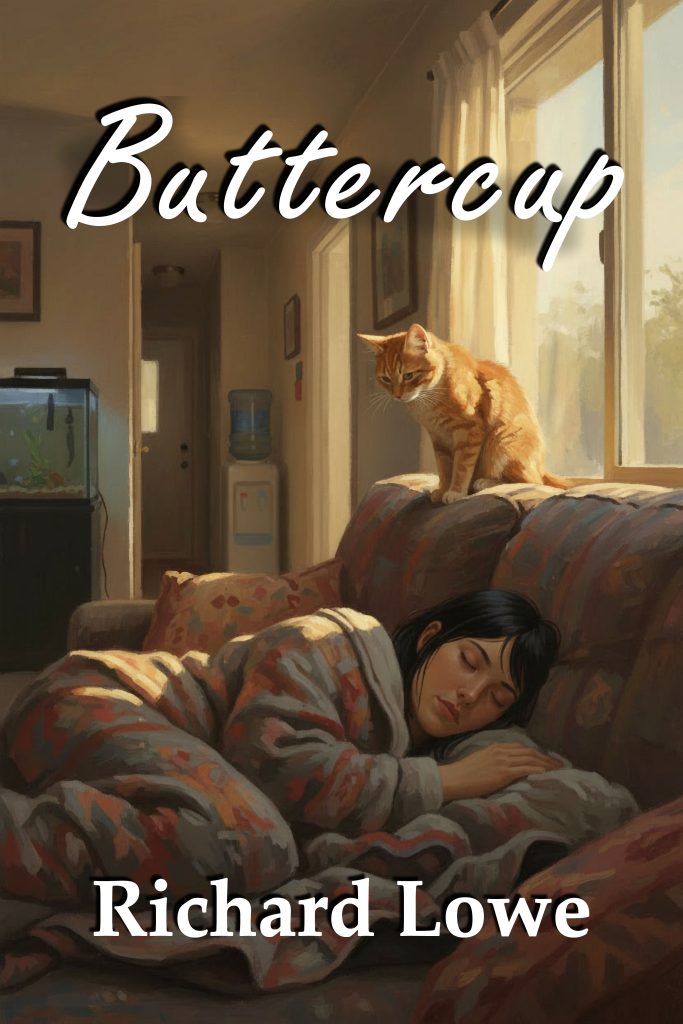
Buttercup
Claudia died on January 31, 2005. Two weeks later, her cat Buttercup died too. The vet said it was kidney failure. He also said cats can die of grief.
This is their story, told by Buttercup.
For ten years, a small orange cat watched everything that happened in a Los Angeles apartment — the emergencies and the ordinary evenings, the long bad months and the good days when Claudia cooked something complicated and talked to her while she did it. Buttercup tracked the things nobody else noticed: the way a room’s smell changes when someone is frightened, the specific sound of breathing that costs too much, the difference between the man who stays calm and the man who is afraid and staying calm anyway.
Buttercup is an unreliable narrator. She misreads things, admits what she doesn’t understand, and sees the world entirely through smell and sound and the weight of the people she loves. She is also, it turns out, the most honest witness this story has.
This is a memoir about Claudia — funny, sharp, sick for most of the years Richard knew her, and more fully herself than almost anyone he’d met. It’s about what it costs to love someone whose body is working against them, and what it looks like from the floor, from the back of the couch, from the doorway at three in the morning when the air changes and a cat starts to run.
It’s about grief that goes all the way down. The human kind and the animal kind, which turn out to be the same thing.
| Amazon Kindle | Paperback (IngramSpark) | epub (Kobo) |
| 📖 Look Inside | Need a Ghostwriter? Let’s Talk | |
| ISBN (Paperback): | 978-1-972810-20-0 |
| ISBN (eBook): | 978-1-972810-21-7 |
| Publisher: | The Writing King |
| Publication Date: | April 7, 2026 |
| Print Length: | 160 pages |
| Language: | English |
Questions
Read the Preface
Preface
By Richard Lowe
Claudia died on January 31, 2005.
Buttercup died two weeks later. The vet told me she died of grief. I didn’t know cats could do that. I do now.
This book is their memoir. Not mine, though I’m in it. Not exactly a novel, though it reads like one. It’s what happened in that apartment over ten years, told by the one who was paying the most attention.
I chose Buttercup as the narrator because she saw everything. She was there for the emergencies and the ordinary evenings and the long bad months and the good days when Claudia cooked something complicated and talked to her while she did it. She tracked things I didn’t notice I was doing. She felt things before I understood them. If you want to know what those years were really like — not what I thought about them, but what they actually were in the rooms where we lived — Buttercup is the honest witness.
Let me tell you about Claudia.
She was funny. Sharply, specifically funny, with opinions about everything and no interest in keeping them to herself. She had a laugh that arrived before she was ready for it and changed her face completely. She cooked food that took all afternoon and filled the apartment with smells I still think about. She named a snail Dexter, after a cartoon character, and cried for days when he died, and she didn’t think that was excessive and neither did I.
She was also sick, for most of the years I knew her. Severe asthma. Kenalog shots every day to open her lungs. The medication caused her to retain water — she was 320 pounds by the end, and she left wet footprints when she walked, and her skin was always damp and warm. She moved carefully because her body required it. She managed this quietly and without complaint, which was her way of managing everything.
The apartment was built around her. I understood this while it was happening, which I’m grateful for. I didn’t take those years for granted. I was paying attention.
So was Buttercup.
Someone pulled her out of a river when she was two weeks old. She had been thrown in a sack with her littermates and he was the one who happened to be walking along the bank when she washed up. He gave her CPR. She bit him. Then she let him carry her home and then to the shelter.
She chose me at the shelter the way she describes it in this book — climbing the wire, demanding I stop walking past her cage. She was right. I was the one.
For fourteen years she ran down the hallway when Claudia’s breathing went wrong. She sat outside Claudia’s door in the long afternoons and thought at the wood. She followed me from room to room the morning Claudia died, when I couldn’t stop moving, and she didn’t try to make me stop. She understood that keeping busy was all I had.
When Claudia was gone, Buttercup didn’t know what to do with herself. I was keeping her alive with daily IVs. She let me because I needed her to still be there. Two weeks later she wasn’t.
The vet said her kidneys failed. He also said that cats feel loss in their bodies, that the absence of someone central can do to a cat what it cannot easily do to most other animals. She had spent ten years calibrated to Claudia. When Claudia was gone, she didn’t know how to recalibrate.
They grieved each other. That is the truest sentence I know about both of them.
This book is for anyone who has loved an animal and lost one. It’s for anyone who has watched someone they love get further away and tried to hold the room at the right temperature anyway. It’s for anyone who has sat on a bench in a botanical garden six weeks after the worst thing happened and felt, alongside the grief, something that was almost like gratitude — for having been there, for having paid attention while it was happening.
It’s for Claudia, who deserved more time.
It’s for Buttercup, who used every minute of hers.
— Richard Lowe