
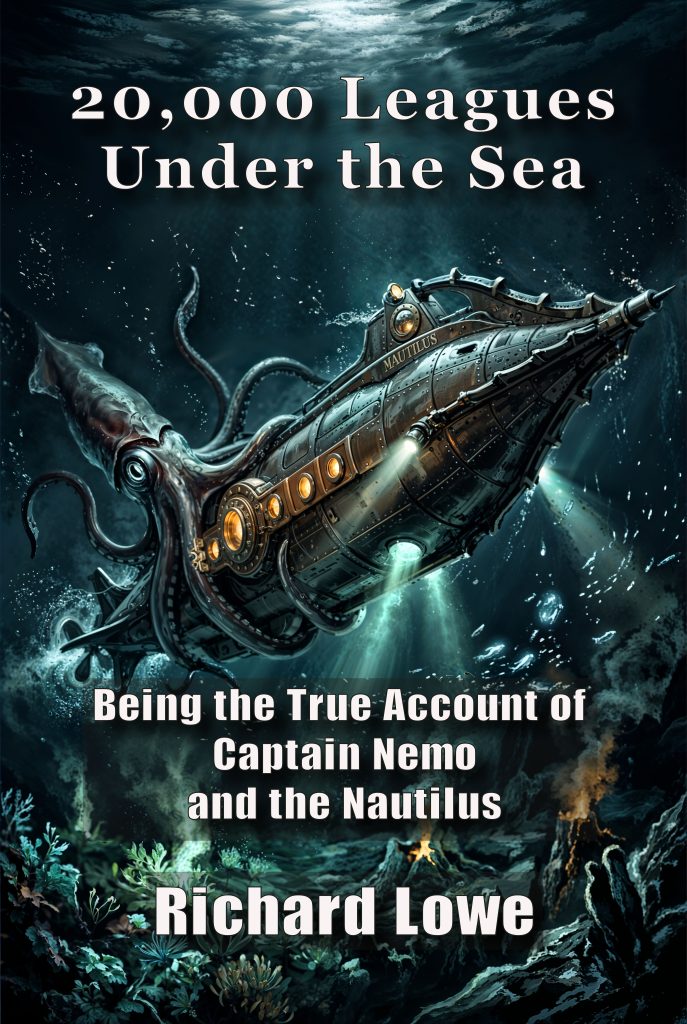
20,000 Leagues Under the Sea
The Nautilus has taken three prisoners. One of them, Ned Land, a Canadian harpooner pulled from the ocean after the ship he was sailing was rammed and disabled by something beneath the surface, wants out from the first day and never stops counting. He counts days the way a man counts because counting is the only form of control available to him. He watches hatches. He maps the interior. He waits.
The second prisoner, Professor Aronnax, is a French naturalist who arrived planning to escape and has quietly stopped planning. The wonder of what he has been shown is doing its work on him. He catalogs what he sees. He asks questions. He has begun to forget, in small ways, that he is not here by choice.
The third is not a prisoner. Lakara is Nemo’s executive officer, his second in command, the hardest person either man has encountered in a life full of difficult people. She has been aboard the Nautilus since 1853. She has not been back to America since the early 1850s, when she identified a winter camp in the Powder River country for a massacre that was covered up before the ink was dry. She does not volunteer this information. She deals with problems fast and does not mention them again.
Captain Nemo cages his prisoners with gravity rather than cruelty. He believes he is offering them something. He is a man who gave up the world after the world destroyed everything he had, built something extraordinary beneath the ocean’s surface, and has been using it to make unilateral decisions about who lives and who dies ever since. The novel is not sure he is wrong to believe what he believes. It is sure that the people in his submarine did not consent to the lesson.
A reimagining of Jules Verne’s 1870 classic told from the perspective of Ned Land — present tense, immediate, physical — with alternating chapters from inside Nemo’s past-tense interior. The coral cemetery. The giant squid. The warship whose nationality is deliberately withheld, because the point is not who it is. The point is that Nemo does it and Aronnax has to decide what that means about the man he has been accommodating. The Maelstrom. The escape. What Ned keeps afterward. What he cannot put down.
Book One of The Adventures of Captain Nemo. The Victorian Era Series.
| Amazon Kindle | Paperback (IngramSpark) | epub (Kobo) |
| 📖 Look Inside | Need a Ghostwriter? Let’s Talk | |
| ISBN (Paperback): | 978-1-972810-55-2 |
| ISBN (eBook): | 978-1-972810-56-9 |
| Series: | The Victorian Era Series / The Adventures of Captain Nemo, Book 1 |
| Publisher: | The Writing King |
| Publication Date: | April 20, 2026 |
| Print Length: | 364 pages |
| Language: | English |
Questions
Read the Opening
Chapter One
The Monster
I don’t believe in sea monsters.
I want to say that at the start, before any of this, because everything that follows is going to sound like a man who does. I am a harpooner. I have spent twenty-two years on the water. I have killed things in the ocean that most men have never seen and will never see. I know what is in the water.
There is no monster.
There is something else.
It started in the summer of 1855. Ships coming into port with their hulls staved in. Not from reef, not from ice, not from anything the captains could account for. The damage was consistent in a way that damage from a reef is not consistent. A reef makes an irregular wound shaped by the underwater geography that caused it. This made a wound that was regular, controlled, the same depth and the same shape repeated across three ships in four months, in three different parts of the Pacific Ocean.
A consistent wound from three different locations means the location is not the cause. The thing is the cause. And the thing moves.
The newspapers decided it was a creature. A narwhal, enlarged beyond reason. The papers in San Francisco ran illustrations. The papers in New York ran the illustrations from San Francisco. In Paris they drew their own. The newspapers are written by men who have not been on the water.
I had been on the water since I was sixteen. My father put me on a whaling ship out of St. John’s, Newfoundland, in 1833, when I was sixteen and large for my age and needed somewhere to go. I threw my first harpoon at a right whale six weeks out of St. John’s and missed it badly and the captain said nothing and I threw the second and hit it and that was the beginning of twenty-two years.
When the US Navy came looking for a harpooner to join the expedition aboard the USS Susquehanna, I said yes. I said yes because I wanted to see what had done that to those hulls. I said yes because I don’t believe in sea monsters.
I was right not to.
I saw the light below the surface because the surface was still enough to show it. Not bioluminescence. This was white. Directed. Moving with purpose. Two hundred feet down, running parallel to the ship, keeping pace.
I watched it for thirty seconds and understood four things. One: it was large. Two: it was fast. Three: it was moving at exactly our speed — matching us, not coincidentally traveling alongside. Four: it had been there before I noticed it. It had known where we were before I knew where it was.
This was not an animal making a decision.
Then the lights dropped away. Down and forward, accelerating as they went, and gone into the deep in perhaps ten seconds.
Creighton was at my shoulder. “Is that your sea monster, Mr. Land?”
“No,” I said. “That’s someone’s submarine.”