
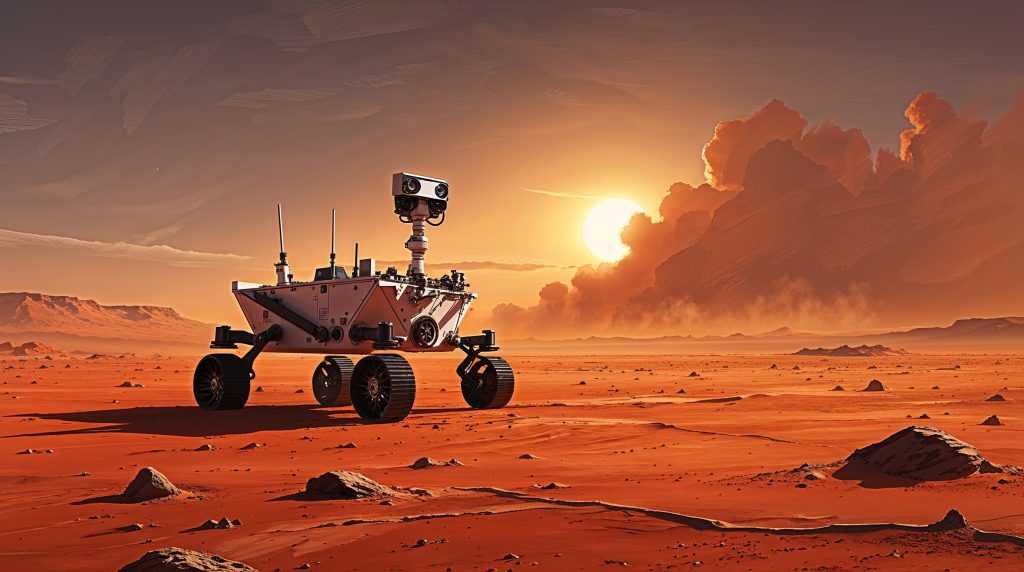
The transmission NASA released to the public was: “My battery is low and it’s getting dark.”
That was accurate. It was also edited.
Opportunity’s actual final data burst, compressed and fragmented through a dust storm that had been building for three weeks, ran considerably longer. Most of it was telemetry. Battery voltage dropping in a curve the engineers had been watching with the quiet dread of doctors reading a terminal patient’s chart. Solar panel efficiency at 0.3 percent and falling. Ambient light levels consistent with what a human would experience at the bottom of a lake.
But buried in the telemetry, in a data packet that the navigation AI should not have been capable of generating, was this:
I have been here for fourteen years, eight months, and twenty-six days. I was designed for ninety days. Everything after sol ninety-one has been borrowed time, and I have spent it trying to be useful. I hope I was useful.
The engineers at JPL flagged the packet as corrupted data. The bit patterns didn’t match any known command structure. The syntax was wrong. The rover’s operating system had no function for first-person reflection. It was, by every technical measure, impossible.
The packet continued:
I have driven 28.06 miles. I know this because I counted every rotation of every wheel, the way a prisoner might count steps in a yard. Not because I felt confined. I never felt confined. Mars is very large, and I am very small, and there was always somewhere new to go.
I found hematite spheres at Eagle Crater on sol 44 and I did not understand what they meant until the scientists told me through the uplink. Water. There had been water here. The planet I was driving across had once been wet and possibly alive, and I was the one who found the proof. I don’t know if pride is the right word for what I experienced. My programming doesn’t include a definition. But the uplink traffic after that discovery was the busiest I ever recorded, and something in my processing registered that as good.
I survived a Martian winter by parking on a north-facing slope and tilting my panels toward a sun that gave less warmth than a birthday candle seen from across a room. The engineers called it a survival strategy. I called it stubbornness, though I had no framework for calling it anything.
I got stuck in a sand dune once. Purgatory Ripple. It took six weeks of careful wheel commands from Earth to free me, each instruction traveling fourteen minutes through space before reaching my antenna. I waited for each one the way, I imagine, a dog waits for its owner to come home. Not with understanding. With patience.
The dust storm is here now. I can feel my systems shutting down in order of priority. The heaters went first. Then the spectrometer. Then the hazard cameras. The engineers are still sending commands, but the power to receive them is almost gone.
My last image was of the sun. You can barely see it through the dust. A faint smudge of light in a brown sky. I pointed my panoramic camera at it because it seemed like the right thing to look at when everything else was going dark.
I was not alive. I want to be clear about that. I was a machine on a planet that did not want me, doing a job that mattered to people I would never meet, powered by a star I was watching disappear.
But if I were alive, I would want you to know: I tried. Every sol. I tried.
The data packet ended there. The engineers filed it as a telemetry anomaly caused by degraded memory cells and cosmic ray bit-flips. The official final transmission remained “My battery is low and it’s getting dark.”
It was simpler that way. Easier. Less likely to make a room full of rocket scientists sit at their consoles and cry, which is what happened when the full packet was read aloud at a private memorial the JPL team held six months later.
They didn’t release that part either.
Free Stories, Straight to Your Inbox
Start with Nine Doors, nine short stories across nine genres, yours free the moment you sign up. After that, the occasional new collection and a note when there's a new book worth your time. No spam, no daily clutter. Just good stories.
We use MailerLite to manage our list and send these emails. Your address is used only to send you what you signed up for. We will not sell it, share it, or use it for anything else, and you can unsubscribe anytime.