

The asteroid had a name now. Cotopaxi, after the volcano visible from the anchor site on clear days. It had been a different thing when Mateo Vásquez first saw it — the first images transmitted back from the capture team, a rough, potato-shaped chunk of nickel-iron tumbling through the belt, eleven kilometers across, ugly and invaluable. That was fifty-five years ago. He’d been twenty, a student watching the feed in a lecture hall, and the asteroid had been a rock.
Now it was a sphere. A polished metal moon hanging in geostationary orbit, 35,786 kilometers above the Ecuadorian highlands, gleaming in sunlight like a ball bearing the size of a city. The mirror crews had spent fifty years melting it into shape during its long transit from the belt — focused solar energy at 1,500 degrees, kilometer-wide mirror arrays repositioning daily, the surface flowing like water under thermal loads that would vaporize conventional materials. They’d redistributed seven thousand trillion kilograms of nickel-iron into a uniform sphere with a density variation of less than 0.02 percent. A balance so precise that the wobble, measured at the geostationary platform, was less than the width of a human hair.
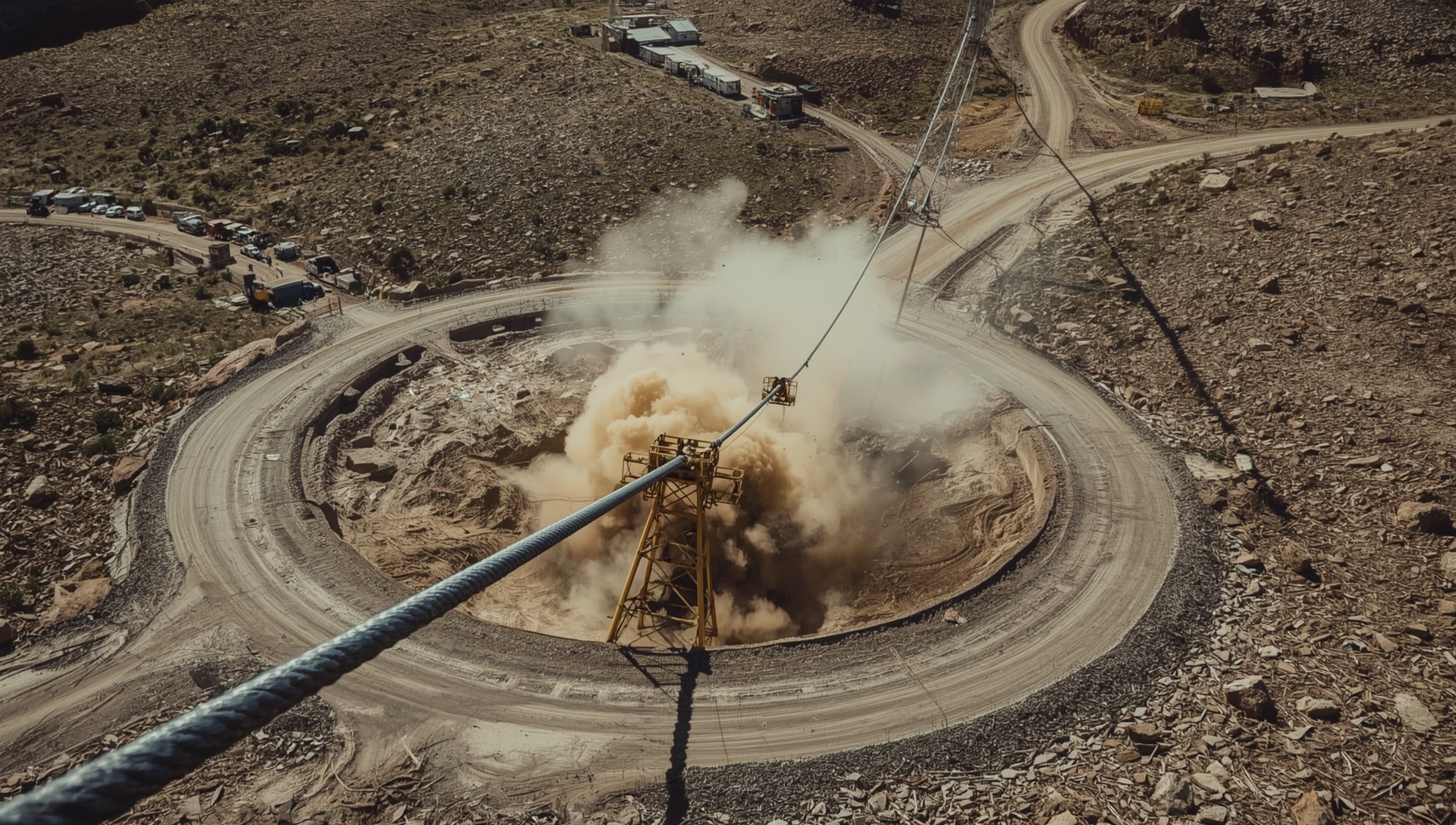
Below Cotopaxi, the cable stretched downward toward Earth. Five hundred meters in diameter. Thirty-five thousand, seven hundred and eighty-six kilometers long. A structure so large it was visible from the ground as a dark line drawn from the horizon straight up into heaven, narrowing to a thread, vanishing into the blue, reappearing above the atmosphere as a column that connected the planet to its newest moon.
Mateo stood on the observation deck of Geostationary Platform Quito — GPQ, in the shorthand that had replaced poetry in the engineering teams — and watched a freight car descend. It was the size of a city block, riding the western track at two hundred kilometers per hour, carrying nine thousand tonnes of manufactured goods to the surface. Above it, a passenger car was ascending on the eastern track, four hundred people paying a week’s wages for the trip that used to cost a lifetime’s. Below, Earth curved away blue and white and green, the Andes visible as a spine of brown and snow, and somewhere down there, invisible at this distance, the anchor sank into bedrock, eight kilometers of engineered foundation bolting the cable to the continent.
He’d helped build the first one. Selene’s Ladder, on the Moon. L1 side, Earth-facing. A one-mile asteroid for counterweight, captured and shaped by the same mirror technology, anchored to the lunar surface at the edge of a crater whose name he’d forgotten. The cable had been eighty meters in diameter — adequate for lunar gravity, which was forgiving in ways that Earth’s was not. The Moon didn’t have weather. Didn’t have an atmosphere to oscillate through. Didn’t have six times the gravitational pull trying to snap the cable with every micro-perturbation in the counterweight’s orbit.
Selene’s Ladder had been elegant. Farreach, on the L2 side, had been practical. Both were engineering marvels that had transformed Earth-Moon transit from a rocket equation into a train schedule.
The Quito Tether was neither elegant nor practical. It was a brute-force assertion that humanity could nail a cable to a planet and hang a mountain from the other end. Everything about it was too big, too heavy, too ambitious, and too close to catastrophic failure at every stage of construction. Mateo had spent the last fifteen years on it — the final phase, the cable construction and tensioning after Cotopaxi arrived in orbit — and he’d slept four hours a night for most of them. His marriage had ended somewhere around year three, a fact he noted with the same clinical detachment he applied to stress calculations.
Today was calibration day. Final tension adjustments before the Tether went fully operational. Freight cars had been running for three months on a limited schedule. Passenger service was set to begin next week. The Mombasa Tether, second of the three, was twenty years behind them — its asteroid still en route from the belt, mirror crews riding it in rotating tours of duty, shaping it, the same half-century journey Cotopaxi had made.
The Makassar Tether was still in planning. The asteroid hadn’t even been selected yet.
“Mateo.” His deputy, Runa Okafor, appeared beside him. She was younger, sharper, better with people, worse with numbers. They complemented each other the way a scalpel complements a hammer. “Mirror Control is requesting permission to begin repositioning for Mombasa. They want to start redirecting the primary array.”
“Not until calibration is complete.”
“They’re saying the Mombasa window is tight. If they don’t reposition today, they lose two weeks.”
“Not until calibration is complete.”
“I told them you’d say that. They asked me to ask anyway.”
“Tell them the answer is the same in any language.”

The mirror crews were belt miners, mostly. Third generation. The grandchildren of the wave-hand generation, the children of the Rock War generation. They’d grown up eating spiral wheat and they’d inherited the belt’s institutional distrust of Earth and its institutional competence with industrial equipment in vacuum.
They were the best mirror operators in the solar system because they’d been doing it longest. The technology had been developed for Selene’s Ladder — you couldn’t machine a nickel-iron asteroid with conventional tools, but you could melt it with focused sunlight and let surface tension and micro-gravity do the shaping. The belt miners had learned the technique on the first lunar counterweight and refined it across four subsequent projects. They knew how to read the surface of molten nickel-iron the way a glassblower reads a gather. They knew when the melt was deep enough, when the flow was stable, when a void was forming beneath the surface and needed to be collapsed before it created a density pocket that would throw the balance off.
They also knew what happened when a mirror lost alignment. The arrays focused enough solar energy to melt metal at 1,500 degrees. In atmosphere, you’d see the beam — scattered light, heat haze, a visible column of destruction. In vacuum, the beam was invisible. No atmosphere to scatter. No warning. A mirror shifted and a line of focused sunlight swept across the work zone at the speed of the mirror’s rotation, and whatever it touched — scaffolding, equipment, pressure suits — went from ambient temperature to liquid in less than a second.
One hundred and twelve people had died during Cotopaxi’s fifty-year shaping. Nineteen from mirror accidents. The beam killed without announcement. A worker would be welding a structural member, faceplate down, focused on the joint, and then they were gone. Not burned. Vaporized. The crew next to them would see a flash of light where their colleague had been and then the suit, empty and glowing, tumbling away into the dark.
The other ninety-three had died from the usual causes. Suit breaches. Equipment failures. Scaffolding collapses when sections of asteroid cooled faster than predicted and contracted, pulling the supports inward. Collisions with debris in the transit corridor. Medical emergencies hours from the nearest hospital. One worker had simply drifted away — tether failure during a surface inspection, thrusters empty, comm range exceeded within an hour. The recovery crew found her six days later, two hundred kilometers from the asteroid, alive in her suit on emergency reserves, so hypothermic that the medical team spent a week bringing her core temperature back up. She went back to work on day ten. Belt miners didn’t take sick leave.
The mirror crews had ridden Cotopaxi from the belt to Earth in rotating tours — five years on, two years off, shuttling in and out from belt stations along the transit corridor. Fifty years. Three generations of mirror operators had shaped the asteroid. The crews who started the job were retired or dead by the time it arrived. Their grandchildren finished it. Habitats bolted to the asteroid’s surface, repositioned as the shaping progressed, always staying ahead of the melt zone. The last generation had grown up watching Earth get larger through their viewport, year by year, the destination their grandparents had aimed for, a blue-white marble that meant nothing to them except the place the cable was going.

The cable was the material that changed everything. Mateo didn’t know what to call it. The official designation was SXC-7, which stood for something he’d forgotten. The engineers called it silksteel. The belt miners called it god-rope. The marketing department, which had no business existing on an engineering project but existed anyway because the Tether was funded by a consortium that needed investors, called it Ascension Fiber.
Whatever you called it, the material was extraordinary and deeply flawed. Under pure tension — a straight pull along its length — its strength was beyond any meaningful measurement. You could hang a planet from a silksteel cable and the cable would hold. But the material was brittle under torsion and shear. Twist it, bend it, hit it from the side, and it cracked like ceramic. A cable hanging straight under tension was functionally indestructible. A cable swaying under lateral load would shed its outer layers like bark from a tree. The material had been synthesized during the desperate-projects era, a byproduct of the same research frenzy that had produced the FTL fold equations and the artificial gravity confirmation. Most of those projects had failed or been shelved. This one had produced a material that was perfect for exactly one application — hanging things from orbit — and useless for almost everything else. You couldn’t build a hull from it. You couldn’t make armor. Any force that wasn’t purely tensile would destroy it. The engineering challenge wasn’t making the cable hold together under load. The challenge was making sure the load stayed tensile.
The anchor, for instance. Under pure tension, the cable would hold forever. But if the cable experienced a lateral load — wind, oscillation, seismic activity — the forces at the anchor point shifted from tension to shear, and shear was the enemy. The foundation went eight kilometers into the Andean bedrock, a shaft of reinforced composite sunk into the continental plate itself. The engineering team had essentially built a root system, branching tunnels filled with bonding material that gripped the rock the way a tree grips soil. The anchor had to keep the cable straight. If the cable swayed far enough to introduce shear forces at the base, the material would start to crack. And a cracking cable thirty-five thousand kilometers long was a nightmare nobody wanted to calculate.
The geostationary platform was the same problem in reverse. GPQ was bolted to Cotopaxi’s equator, the cable passing through the platform and continuing upward to the asteroid’s surface. The connection point was the weak link — not the cable, not the asteroid, but the interface between them. Nickel-iron meeting silksteel at a joint that had to remain rigid while transmitting forces that would crush conventional materials.
This was the joint Mateo was calibrating today. The final tension adjustment. The cable was taut, the loads were distributed, the freight cars were running on limited schedule. Everything was nominal. Everything had been nominal for three months. Mateo didn’t trust nominal. Nominal was the word engineers used right before something killed people.
The calibration was at hour six when Runa came back.
“Mirror Control repositioned the primary array.”
Mateo looked up from his console. “I said after calibration.”
“They didn’t wait. Mombasa team pushed the schedule. The array started repositioning forty minutes ago.”
The primary mirror array was parked two hundred kilometers from Cotopaxi, a disk of reflective material three kilometers across, currently aimed at nothing, waiting to be redirected toward the Mombasa asteroid for final shaping as it approached Earth orbit. Repositioning it was routine. The array had been repositioned hundreds of times during Cotopaxi’s shaping. The procedure was automated. The mirror rotated on its axis, the focal point swept across empty space, and when the rotation was complete, the mirror was aimed at its new target.
Except the array wasn’t aimed at nothing. It was aimed at the sun. It was always aimed at the sun — that was how it worked, catching sunlight and focusing it. When you repositioned the array, the focal point — the concentrated beam of 1,500-degree solar energy — traced an arc across whatever happened to be between the mirror’s current orientation and its new one.
Whatever happened to be in that arc, today, was Cotopaxi.
“Show me the repositioning path.”
Runa put it on the main display. The arc of the focal point, plotted against the positions of every object in the vicinity. Cotopaxi was in the path. The beam would cross the asteroid’s surface for approximately nine seconds during the repositioning sweep.
“They saw this?” Mateo asked.
“They flagged it. Said nine seconds of exposure on a body that spent fifty years under continuous melt was negligible. Cotopaxi can take it.”
“Where does the beam cross?”
Runa expanded the display. The beam path crossed Cotopaxi’s equator. It crossed the cable attachment zone.
Mateo was running before he finished processing the image.

Nine seconds. The beam crossed Cotopaxi’s equator at the cable attachment zone and was gone.
The cable was untouched. Under tension, silksteel could take anything — heat, impact, radiation. The beam had passed over it and the cable hadn’t noticed.
The nickel-iron mounting structure around the cable anchor was not silksteel.
The attachment zone was a collar of shaped nickel-iron, precision-melted during the final shaping phase, designed to grip the cable at the point where it passed through the asteroid’s body. The collar distributed the cable’s tension across 400 square meters of contact surface, spreading the load evenly into the asteroid’s mass. The collar’s density was uniform. Its shape was precise. It had been the last thing the mirror crews shaped before Cotopaxi was declared ready, and it had been checked four hundred times.
It had just been re-melted.
Nine seconds of focused solar energy at 1,500 degrees. The collar’s surface had liquefied to a depth of six centimeters — insignificant on an asteroid eleven kilometers across, but the collar wasn’t eleven kilometers across. The collar was meters thick. Six centimeters of re-melt on a precision-shaped structure meant that when the metal resolidified — which it was doing now, rapidly, radiating heat into vacuum — it wouldn’t resolidify in the shape it had been. It would resolidify in whatever shape the melt had flowed to during those nine seconds of liquid state, influenced by the cable’s tension, the asteroid’s micro-rotation, and the thermal gradients of rapid cooling in vacuum.
The collar was resolidifying unevenly. The density was shifting. The grip on the cable was changing.
Mateo reached the monitoring station and pulled up the balance data. Cotopaxi’s wobble — the measurement he’d spent fifteen years reducing to less than the width of a human hair — was increasing.
“How bad?” Runa was behind him.
“Point three millimeters. Point four. Still climbing.”
“That’s nothing.”
“That’s nothing up here.” He pulled up the cable dynamics model. “Run the oscillation projection. Full cable length.”
The model ran. The numbers came back. Runa stopped talking.
A wobble of one millimeter at geostationary altitude, amplified across 35,786 kilometers of cable, produced an oscillation at the surface of 1.2 meters. The cable was 500 meters wide. A 1.2-meter sway was invisible. Irrelevant.
But the wobble was still climbing. Point seven millimeters. Point nine. The re-melted collar was still cooling, still shifting, the density asymmetry still developing as the metal contracted.
At five millimeters of wobble, the surface oscillation reached six meters.
At twenty millimeters — two centimeters, a measurement so small you could cover it with a thumbnail — the surface oscillation exceeded one hundred meters. The cable would be sweeping back and forth across a zone wider than a football pitch, at ground level, in the Ecuadorian highlands, within range of the infrastructure that supported the anchor site. Warehouses. Transit hubs. Worker housing.
At fifty millimeters, the oscillation entered the outskirts of Quito.
The cable’s flaw was shear. Under pure tension it would hold forever. Under lateral oscillation, the forces shifted from tensile to shear, and silksteel cracked under shear like glass. The cable wouldn’t sweep through buildings like a wire through clay. It would do something worse. It would shed. The outer layers, subjected to bending forces they weren’t designed for, would fracture and break away in chunks — fragments of the hardest material humanity had ever made, raining down from thirty-five thousand kilometers of cracking cable, each piece traveling at whatever velocity the oscillation had imparted. The cable’s core would hold, probably, the pure tension of the counterweight keeping the center intact. But the outer layers would disintegrate, and the debris field at ground level would be catastrophic. And if the oscillation got bad enough for the shear forces to reach the core, the cable would snap entirely. Thirty-five thousand kilometers of silksteel, falling.
Wobble was at 1.4 millimeters and climbing.
“Options,” Mateo said.
“Wait for natural damping. The oscillation will decay on its own.”
“How long?”
“Fourteen hours. Maybe eighteen.”
“The wobble hits fifty millimeters in three hours. That puts the cable in the city.”
“Thrust correction on Cotopaxi. Counter the wobble with the stationkeeping engines.”
“Thrusting on an unbalanced mass. If we get the vector wrong, we make it worse.”
“Then we re-melt and reshape the collar. Fix the density asymmetry at the source.”
“While the cable is oscillating. The mirror crews would be working on a moving surface, next to a cable that’s sweeping back and forth through the attachment zone.”
“Yes.”
Mateo looked at the numbers. The wobble was at 1.8 millimeters. The model showed the oscillation at the surface crossing the six-meter threshold in forty minutes. The infrastructure damage would begin at twenty meters. Casualties at fifty. The edge of the city at a hundred.
Natural damping would take too long. Thrusting was a coin flip. Re-melting was suicide for whoever was at the attachment zone when the mirrors fired.
He called Mirror Control. “I need a precision melt on Cotopaxi. The cable attachment collar. South quadrant, six centimeters of depth, re-melt and reshape. I need it in thirty minutes.”
The Mirror Control chief was a belt miner named Hadid. Third generation. Her grandmother had worn gloves. Her mother had fought in the Rock War. Hadid had done three tours on Cotopaxi during its transit, fifteen years total on a molten mountain, and she understood the mirrors better than anyone alive.
“The cable’s moving,” Hadid said.
“I know.”
“The attachment zone is oscillating. My crews would be working within fifty meters of a cable that’s sweeping laterally.”
“I know.”
“The beam is invisible. If a mirror shifts while my people are on the surface —”
“I know, Hadid.”
Silence on the channel. The belt miner doing the math that belt miners always did. Not the math of risk versus reward. The math of what happens if we don’t.
“Thirty minutes,” she said. “Get your people off the surface. Mine are going in.”

Hadid sent eight. The minimum crew for a precision melt on a surface area this small. They rode a maintenance shuttle from the mirror crew habitat to Cotopaxi’s surface, mag-boots locking to nickel-iron that had been polished to a mirror finish by fifty years of solar shaping. The cable rose from the surface fifty meters to their east, a wall of silksteel five hundred meters wide, and it was moving.
Not fast. Not yet. At the geostationary level, the oscillation was still measured in millimeters. But the cable’s motion was visible — a slow, pendular sweep, the lower edge tracking back and forth across the attachment zone like a metronome. At the collar, the movement was less than a meter. But a meter of lateral movement in a 500-meter cable meant that the edge of the cable was tracing a path through the space where the mirror crews needed to work.
They worked in the gap. Timed to the oscillation. Moving onto the collar surface when the cable swept away from them, retreating when it swept back. A rhythm that had to be precise because the cable was already under shear stress from the oscillation, its outer surface starting to craze with micro-fractures that hadn’t been there an hour ago, and if it caught a worker on the surface, the mass of the cable in motion would sweep them off Cotopaxi and into space with a force that no suit, no tether, no magnetic boot could resist.
Hadid ran the mirrors from orbit. The secondary array, smaller, more precise — a disk eight hundred meters across, positioned specifically for detail work. She focused the beam on the south quadrant of the collar and began the melt. The nickel-iron surface glowed. Orange. Then yellow. Then white. The metal liquefied. Six centimeters of depth, exactly matching the original re-melt, erasing the uneven resolidification and replacing it with a controlled flow shaped by Hadid’s hands on the mirror controls.
The melt had to be precise. Too shallow and the density asymmetry remained. Too deep and the collar weakened. Hadid watched her thermal readings and adjusted the beam intensity with the muscle memory of a woman who’d been melting asteroids since she was twenty-three.
Four minutes in. The surface was liquid. The mirror crews on the collar were monitoring the flow, using handheld density scanners to check the redistribution in real time, retreating and advancing with the cable’s oscillation, a dance measured in meters and seconds.
Seven minutes. The flow was evening out. Density readings converging. The asymmetry that had caused the wobble was dissolving in the melt, the nickel-iron redistributing under surface tension into the uniform density the collar needed.
Eleven minutes. A worker named Fen missed the timing. The cable swept back faster than the previous cycle — the oscillation was not perfectly regular, it was influenced by the melt in progress, the collar’s changing shape affecting the wobble even as the wobble was being corrected — and Fen was on the collar surface when the cable’s edge reached him. It caught the edge of his suit, the suit material parting like cloth against the cable’s mass and momentum. The cable didn’t slow. Fen was pulled off the surface and thrown laterally at four meters per second, tumbling into space with a suit breach that vented atmosphere in a crystallizing plume.
His tether caught. The line went taut. He swung in a wide arc that brought him back toward Cotopaxi’s surface at speed. He hit the nickel-iron and bounced, mag-boots unable to engage on the polished surface at that angle and velocity. He tumbled along the asteroid’s equator, away from the work zone, suit venting, emergency beacon screaming.
A recovery shuttle was there in ninety seconds. Fen was alive. The suit breach was patched. He’d broken three ribs and his left arm and he’d never work in vacuum again, but he was alive.
Fourteen minutes. A second worker, Kozue, was caught by the beam. Not the cable. The beam. Hadid adjusted the mirror angle by 0.003 degrees to follow the melt as the collar’s surface shifted under thermal expansion, and the edge of the focused beam crossed Kozue’s position for less than a second. Less than a second of 1,500-degree focused solar energy on a pressure suit designed for 200-degree thermal extremes.
Kozue’s suit didn’t vaporize. That was the large-array beam, kilometers wide, the one that could erase a person in an instant. The secondary array was smaller, less intense. Kozue’s suit superheated. The outer layer charred. The inner layer conducted heat inward. Kozue screamed on the open channel and threw herself off the surface, thrusters firing, spinning away from the beam that had already passed.
Third-degree burns across her back and shoulders. She’d survive. The scars would stay.
Twenty-two minutes. The collar was reshaped. The density readings were converging on nominal. Hadid shut down the beam. The mirror crews retreated from the surface. The molten nickel-iron cooled. This time, it cooled under controlled conditions — Hadid managed the thermal environment, using the secondary array at low intensity to maintain an even temperature gradient across the collar’s surface, preventing the uneven contraction that had caused the problem in the first place.
Mateo watched the wobble readings.
2.1 millimeters. 2.0. 1.9.
Dropping.
1.4. 1.1. 0.8.
The cable’s oscillation at the surface was damping. The sweep was narrowing. Twenty meters. Fifteen. Ten.
0.3 millimeters. 0.2.
By the time the collar had fully cooled, the wobble was back below one-tenth of a millimeter. The cable hung straight and still, a line from Earth to heaven, five hundred meters wide and motionless.
Two injured. No dead. The closest anyone had come to dying on the Quito phase of the tether project since the scaffolding collapse during the cable’s first year of construction.
Mateo sat at his console and didn’t move for a long time. On the display, the oscillation trace flatlined. The cable was still. The freight cars resumed their schedule. The first passenger service would launch next week, on time, as planned.
He called Hadid.
“Thank you.”
“Don’t thank me. Fire whoever repositioned the primary array during your calibration window.”
“Already done.”
“Good.” A pause. Belt pauses, which were shorter than Earth pauses but carried more weight. “The Mombasa collar needs a shielding protocol. When we reshape that asteroid’s attachment zone, I want the beam path computed for every mirror repositioning for the next century. No more surprises.”
“Agreed.”
“Hadid out.”

The Quito Tether went operational on schedule. The first passenger car ascended on a Tuesday morning, four hundred people pressed against viewports, watching the Andes fall away below them, watching the atmosphere thin from blue to black, watching the stars appear not gradually but suddenly, like someone had turned them on. The ascent took eighteen hours. By the time they reached GPQ, they’d seen the curvature of the Earth flatten into a globe, watched a sunset and a sunrise from above, and crossed the threshold between planet-bound and space-faring in a pressurized car with reclining seats and a meal service.
The cost of reaching orbit dropped by a factor of a hundred. Freight that had cost tens of thousands per kilogram was now cheaper than transcontinental shipping. Manufacturing moved upward. Factories that needed vacuum, zero-gravity, or access to orbital resources relocated to GPQ or to habitats bolted to Cotopaxi’s surface. The grandchildren of the first mirror crews, the ones who’d started the shaping half a century ago in the belt, watched the asteroid their families had shaped become a city. Within five years, Cotopaxi had a permanent population of twelve thousand.
The Mombasa Tether’s asteroid arrived twenty years later — it had been in transit since before Cotopaxi reached Earth orbit. Hadid’s successors shaped it with the shielding protocols Mateo had demanded, and the cable went up without incident. The Makassar Tether followed a decade after that. Three cables. Three asteroids. Three vertical highways from the surface of the Earth to geostationary orbit, spaced 120 degrees apart around the equator.
The wealth flowed upward. The consortiums that had financed the tethers controlled the platforms. The platforms controlled access to space. Access to space controlled manufacturing, mining, energy, communications — every industry that benefited from leaving the gravity well, which was every industry that mattered. Within a generation, the tether consortiums were the largest economic entities in human history. Their boards met on Cotopaxi. Their executives lived on GPQ. Their children were born in orbit and educated in orbital schools and looked down at Earth the way previous generations of the wealthy had looked down at everyone else, except they were doing it literally, from thirty-five thousand kilometers above.
The people on the ground looked up. The tethers were visible from every point on the equator, dark lines drawn against the sky, freight cars ascending and descending in an endless stream of commerce that passed through their communities and over their heads. The anchor sites employed thousands. The cities around the anchors boomed. But the wealth generated by the tethers didn’t stay at the base. It climbed the cable and didn’t come back.

Mateo retired to a house in the Ecuadorian highlands within sight of the anchor. He could see the cable from his kitchen window, the dark line rising from the valley floor into the morning sky. On clear days, he could see the freight cars, small as insects, crawling upward. On clear nights, Cotopaxi was visible — a bright point that didn’t move, a star that humanity had built and bolted to the sky.
He was proud of it. He was proud of every weld, every calculation, every sleepless night. He was proud of Hadid and her mirror crews and the belt miners who’d ridden a mountain across the solar system. He was proud that the cable had held, that the collar had been reshaped, that the cities of the equator were still standing because he’d made the right call on the day the beam crossed the attachment zone.
He was not proud of what came after. The consortiums. The orbital aristocracy. The children born on Cotopaxi who’d never breathed unrecycled air, who looked at Earth the way a landlord looks at a tenant. He’d built a ladder and the people who climbed it had pulled it up behind them — not literally, the freight cars still ran, the passenger cars still ascended — but in every way that mattered, the top of the tether and the bottom of the tether were different countries, and the border was thirty-five thousand kilometers of cable that Mateo had spent his life making perfect.
He’d built the thing that split the species in two. The ground and the sky. The heavy and the weightless. The people who looked up and the people who looked down.
He sat in his kitchen and drank coffee and watched the freight cars climb, and knew that the tether would outlast almost everything. The cable held because the load was tensile. Keep it straight, keep it taut, and it would hold for millennia. But he knew the flaw. Everybody who’d built it knew the flaw. The material that could hold a planet cracked if you twisted it. Somewhere in the future, someone would find a way to use that. A thousand years from now, ten thousand years, the tethers would still be there, three lines from Earth to heaven, still carrying the wealth upward, still carrying nothing back. Unless someone found a reason to make them sway.
He’d built the most durable monument in human history. He wished he knew what it was a monument to.
-
Peacekeeper: The Glorious History of Humanity
A serialized prequel spanning a million years of humanity's future. From a desperate choice on the Moon to the rise of immortal enforcers, every story traces a single decision and the consequences nobody saw coming. New episodes every Tuesday.